
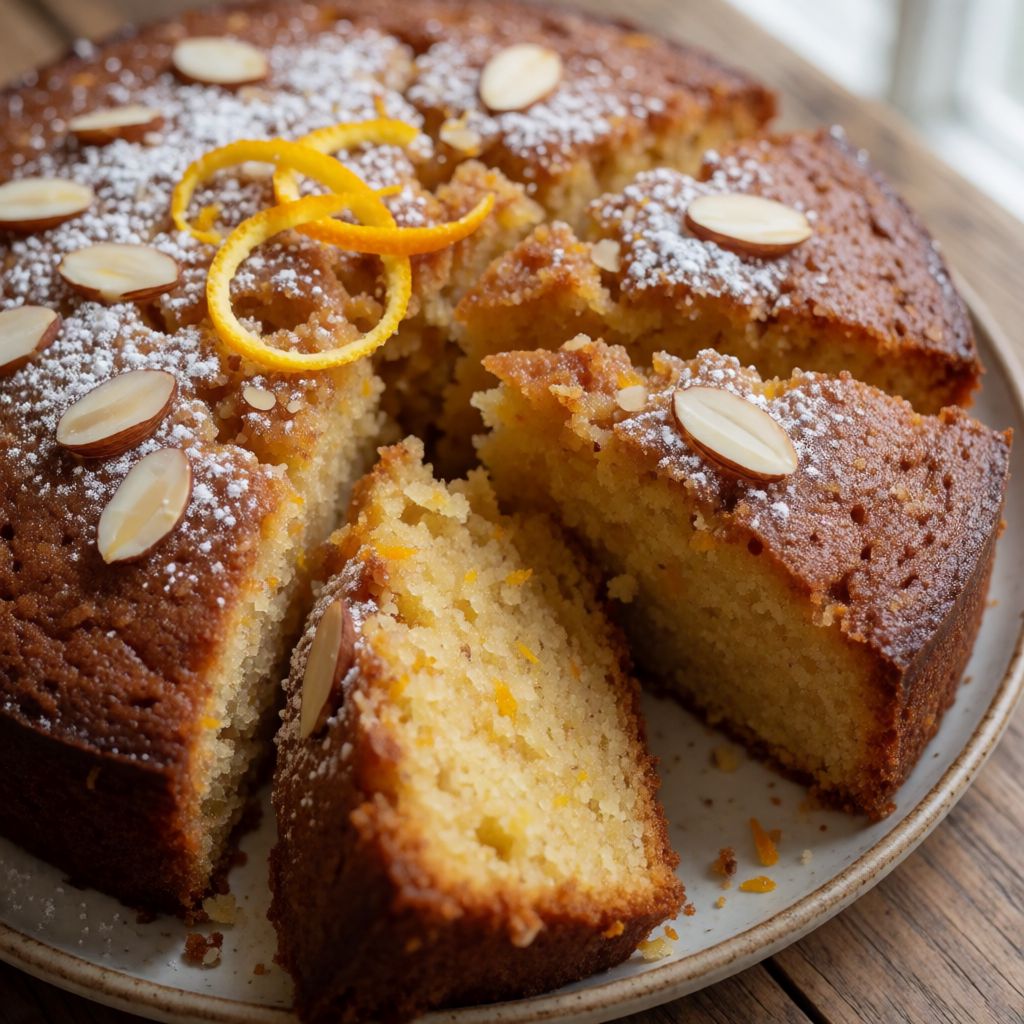
 AI photo
Almond and Orange Cake
A fragrant almond and orange cake, light and moist, finished with a dusting of icing sugar.
Labels are worked out automatically from the ingredients and can be wrong. Check the packaging if it matters to you.
Ingredients
- 4 pcs Eggs
- 130 g Caster sugar
- 2 pcs Orange zest
- 90 ml Orange juice
- 50 ml Vegetable oil
- 100 g Ground almonds
- 100 g Plain flour
- 50 g Potato starch
- 16 g Baking powder
- pinch Icing sugar for dusting








Steps
Crack the eggs into a bowl and add the sugar. Whisk with an electric mixer until pale, thick and creamy.
Add the orange zest, orange juice and vegetable oil, and keep whisking until smooth.
Blitz the ground almonds and flour together, then fold into the batter and mix well.
Sift in the potato starch, fold through, then add the baking powder.
Pour the batter into a 22 cm tin, greased with butter and dusted with flour.
Bake in a preheated oven at 180°C for 35–40 minutes, until golden on top.
38 minLet the cake cool completely in the tin, then turn it out.
Transfer to a serving plate and dust with icing sugar, if you like.
This is a sponge that leans on almonds instead of all its structure coming from gluten — which is why it stays damp and doesn't dry out the way a plain Victoria sponge can by Tuesday. The almonds bring fat and weight; the flour and potato starch are there mostly to hold air, not to build chew. Orange zest and juice do the flavour work, and the oil (not butter) is what keeps the crumb soft once it's cold, because oil stays liquid at room temperature and butter doesn't — a cake made with butter alone tightens up as it cools, this one doesn't.
What decides whether it works is the first step: whisking eggs and sugar until "pale, thick and creamy" is not decoration, it's the only leavening you're doing any real work for. Baking powder lifts a little, but the volume mostly comes from air beaten into the eggs and trapped by the almond-flour-starch mix. Under-whisk here and no amount of baking powder rescues you — you get a flat, dense disc instead of a cake with any lift.
Some say you can skip blitzing the almonds with the flour and just fold them in loose. No — the point of blitzing them together is to break up any clumps of ground almond so they distribute evenly through the batter instead of sitting in damp pockets that sink and leave a gummy streak once baked.
Eggs are the engine here, so use them at room temperature if you can — cold eggs from the fridge won't whip to the same volume, because the proteins are stiffer and trap less air. If you forgot to take them out, a few minutes in a bowl of warm (not hot) water does the job.
Ground almonds give this cake its character: moist, slightly nutty, denser than a sponge made with flour alone. If you're out of them, you can use ground hazelnuts — the texture holds, though you lose the mild sweetness almonds bring and gain something more savoury. Don't swap in almond flour that's been stripped of its oils for a "lighter" version — you'll lose the fat that keeps the crumb from drying out.
The flour and potato starch are doing different jobs even though they look similar in the bag. Flour gives just enough structure to hold the batter together; potato starch is there to soften that structure, because starch doesn't form gluten strands the way flour does — it keeps the crumb tender rather than bready. If you don't have potato starch, cornflour does the same job; don't leave it out and just add more flour, or the cake turns denser and chewier than it should be.
Vegetable oil wants no personality of its own — any oil that doesn't smell of anything works: sunflower, rapeseed, a neutral light olive oil if that's what's in the cupboard. Don't reach for a strong extra-virgin olive oil here; its flavour will fight the orange rather than sit quietly behind it.
The orange zest and juice are the actual seasoning of this cake, not a garnish. Zest only the orange, not the white pith underneath — the pith is bitter and will sour the flavour instead of brightening it. If you're using two oranges, taste the juice before adding it; very sweet oranges may want a squeeze of lemon alongside, very sharp ones don't need help.
Letting the cake cool completely in the tin before turning it out isn't fussiness — a cake made mostly on trapped air and nut flour, with no strong gluten scaffold, is fragile while warm. Turn it out too soon and it will crack or collapse at the edges where it's still setting. Patience here costs you nothing but twenty minutes with the kettle on for tea, and it's the difference between a cake that turns out whole and one that turns out in two pieces.