
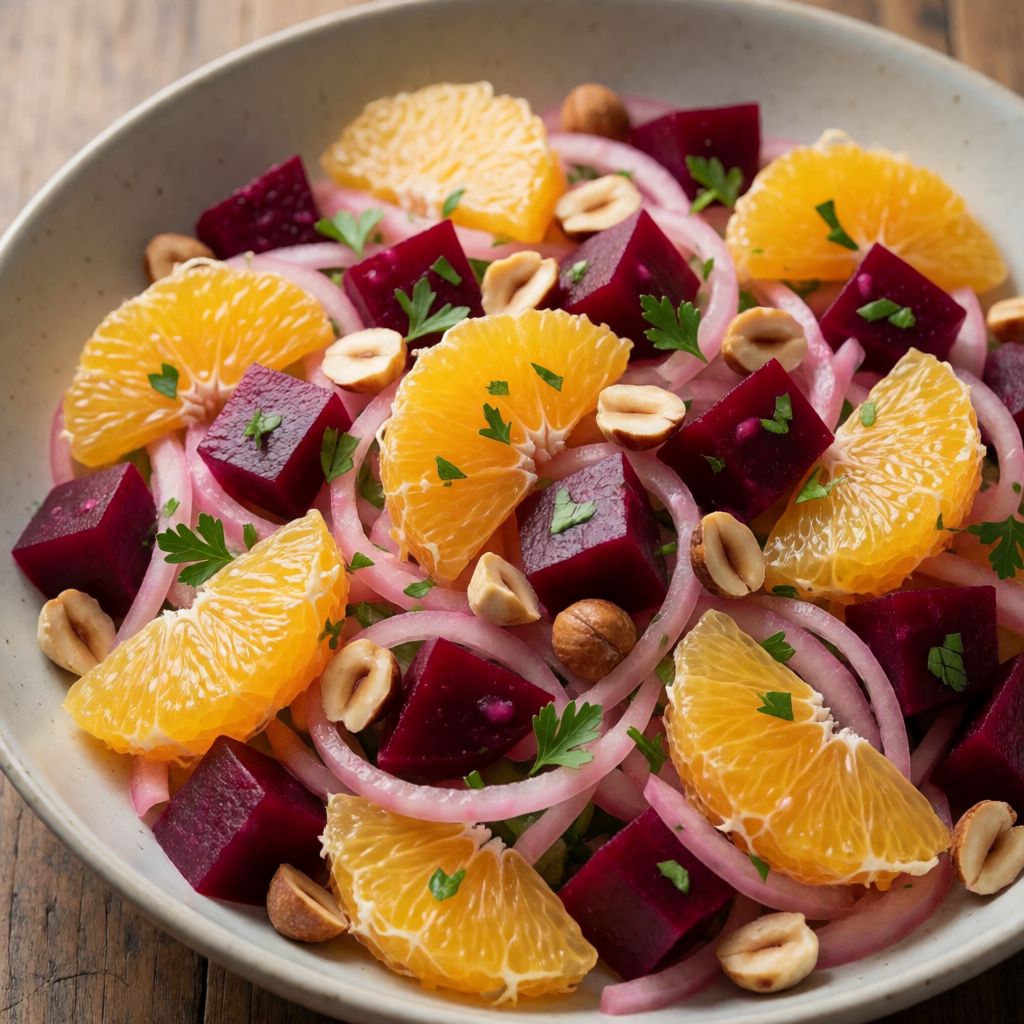
 AI photo
Orange and Hazelnut Salad
A refreshing winter salad of orange and hazelnut, finished with olive oil and rocket.
Labels are worked out automatically from the ingredients and can be wrong. Check the packaging if it matters to you.
Ingredients








Steps
Finely chop the onion and mix in a bowl with the parsley, salt and olive oil.
Chop part of the hazelnuts, leave a few whole, and flake the rest.
If adding beetroot, slice it thinly.
Peel the oranges, removing the white pith, cut the flesh into cubes and place in a deep dish.
Drizzle with the flavoured oil and leave in the fridge for 1 hour.
60 minDrain off any excess liquid from the oranges, arrange them on a serving plate and garnish with the hazelnut flakes, rocket and beetroot.
This is not a cooked dish — it is a dish that works by osmosis. Nothing goes on heat. The whole mechanism sits in two things: what salt does to a raw onion, and what an hour in a cold fridge does to an orange sitting in oil. Call it chemistry if you like, but it is really just patience with a timer you can't see.
The step that decides whether this salad is a salad or a bowl of orange soup is the drain at the end. Salt pulls water out of the onion — that's why you salt it first, not last — and that water joins the oil to make a loose dressing. Sit the orange cubes in that dressing for the hour and they give up juice too, because sugar and acid always move toward salt given the chance. By the time you take the dish out, there is a shallow pool at the bottom that was not there at the start. Pour it off. If you don't, the rocket goes limp in minutes and the hazelnut flakes turn soft before anyone's fork gets there — crunch is the one thing in this dish you can't get back once it's gone.
Some say raw onion has no business in a cold salad — too sharp, too much bite for something meant to be delicate. No, because the salt handles that before the onion ever meets the orange. What you taste at the table is not raw onion, it's onion that has already sweated out the compound that makes you cry over a chopping board. Fifteen minutes of sitting with salt and oil does more to tame an onion than any amount of soaking in water, which just dilutes the flavour along with the sting.
The orange is the one ingredient you can't substitute your way out of, so buy by weight in the hand, not by looks — a heavy orange for its size has more juice packed into it, and juice is half the point here. Take off every scrap of white pith when you peel it. That pith carries naringin, the compound that makes grapefruit pith bitter too, and it will sit on your tongue after the sweetness has gone. It's fiddly work with a knife, not a peeler — a peeler leaves pith behind, a knife lets you see it and cut past it.
For the onion, any onion will do the job of the mechanism, but a milder one — a red onion, a sweet white onion — needs less time under salt before it calms down, which matters if you're short on patience that day. A shallot works too, and gives you a gentler bite if you're serving this to someone who still remembers a bad onion salad from thirty years ago.
Hazelnuts give crunch and a fat that isn't greasy — that's the criterion, really: any nut with body but not oiliness, so walnut or almond stands in fine if hazelnuts aren't in the cupboard. The recipe doesn't ask you to toast them, so don't invent a step that isn't there — but if you want more of their smell to come through, a dry pan with no oil, moved about until the skins start to crack, wakes them up without turning them into a different ingredient.
Olive oil is the carrier here, and the rule for any oil used this way is simple: no smell of its own strong enough to fight the orange. A mild olive oil does that; a heavily flavoured rapeseed or walnut oil would not — it would just add its own argument to a dish that already has two ingredients talking to each other. Salt is doing chemical work, not seasoning work, so don't skip it thinking you'll add flavour later with something else — there is no later point where it can do what it does at the start.
Beetroot and rocket are both optional, and both are there for contrast rather than tradition — beetroot for earth and a little sweetness that sits under the citrus instead of competing with it, rocket for a bitter edge that stops the whole plate tasting like dessert. In a British kitchen, ready-cooked vacuum-packed beetroot is perfectly honest here — nobody is going to mark you down for not boiling your own — and watercress will do the rocket's job if that's what's in the fridge.
Parsley is there to smell green against all that orange and onion — don't chop it so fine it disappears, you want to still see it on the plate. And the hour in the fridge is the one ingredient with no substitute at all: rush it and the onion is still sharp, the orange hasn't given anything up, and you've made a fruit bowl with onion in it, which is a different and much sadder dish.