
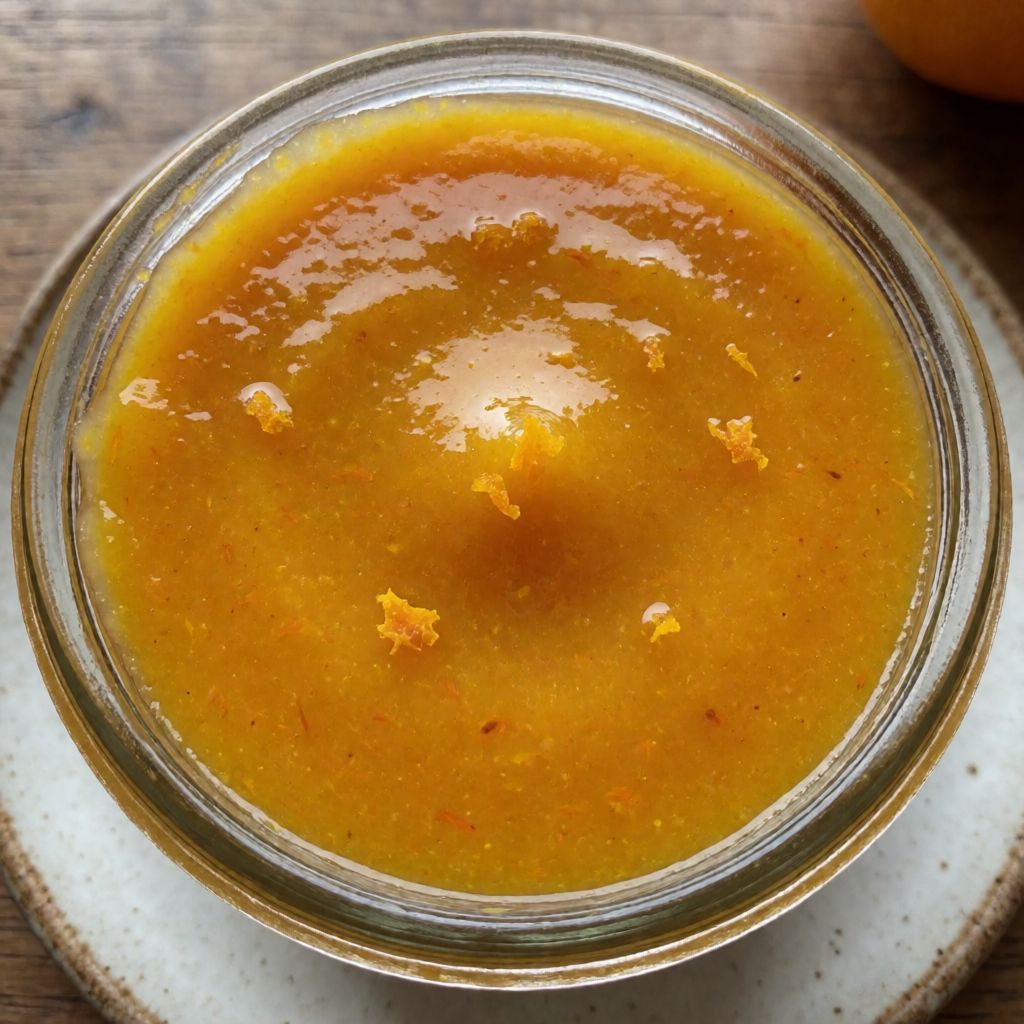
 AI photo
Orange Curd
A smooth, tangy orange curd made with fresh orange juice and zest, egg yolks and butter.
Labels are worked out automatically from the ingredients and can be wrong. Check the packaging if it matters to you.
Ingredients
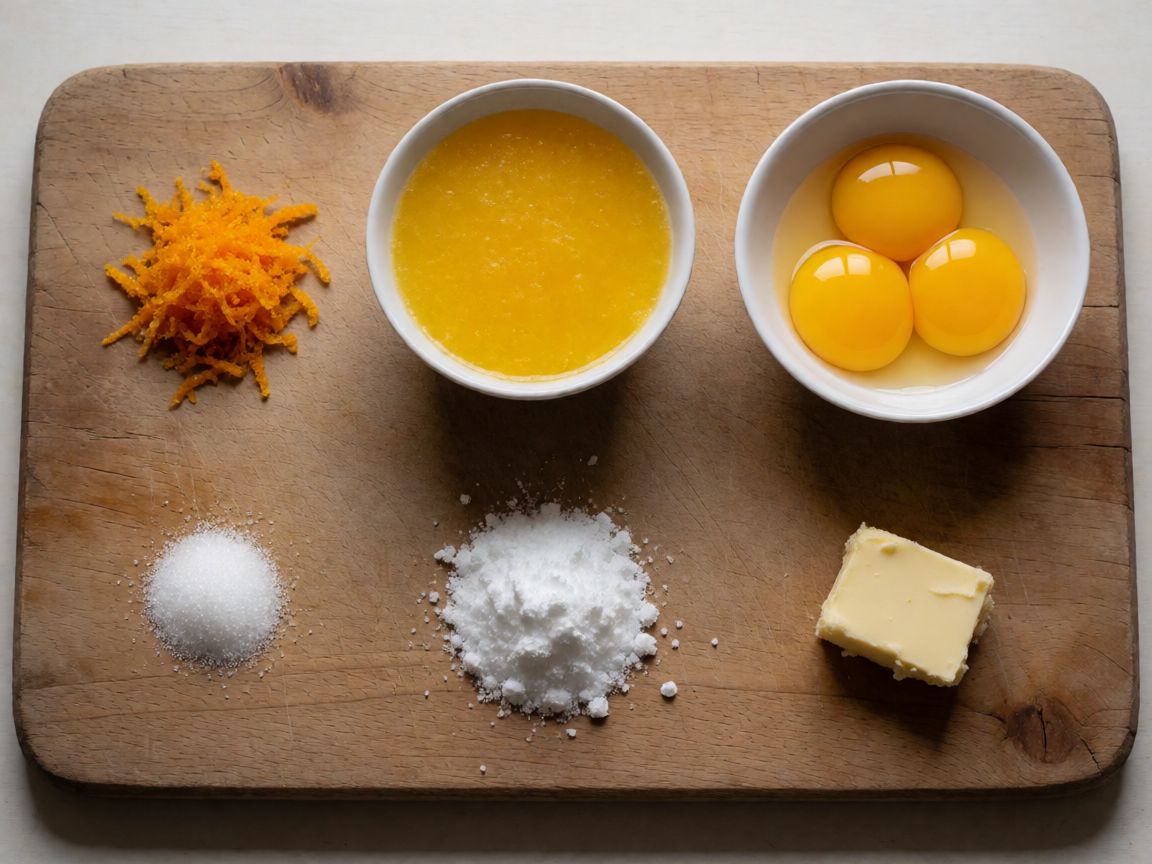
- 1 tbsp Orange zest
- 250 ml Orange juice
- 3 pcs Egg yolks
- 120 g Sugar
- 40 g Cornflour
- 2 tbsp Water
- 50 g Butter






Steps
In a bowl, mix the cornflour with the sugar and water.
2 minWash the oranges thoroughly, zest and juice them, measuring out 250 ml of juice.
5 minPut the zest in a saucepan and add the strained juice.
1 minPlace over low heat and add the cornflour-sugar mixture, stirring constantly with a whisk.
5 minIf you like, cook a little longer for a thicker consistency, continuing to stir.
Add the egg yolks all at once, continuing to stir.
1 minTurn off the heat and add the butter.
Mix well so that all the ingredients combine.
Let the orange curd cool completely before using.
This is orange curd — the sunnier cousin of the lemon curd every British kitchen already knows from the jam shelf. Same logic, same job: a spoonable, spreadable set custard that holds its shape on toast but melts the second it meets warm bread. The difference here is cornflour. Classic lemon curd is just yolks, sugar, butter and juice, cooked with real patience over a bain-marie because yolks alone turn gritty the moment they pass about 70°C. Add cornflour and you change the rules.
What decides whether this works is two things: the slurry, and the heat. The cornflour, sugar and water get mixed to a smooth paste before they ever touch the pan — that's not fussiness, that's the only way to stop cornflour clumping into little rubbery beads the second it hits something hot and wet. Once that paste is in with the zest and juice, the heat stays low: a few small bubbles at the rim, not a boil. The mixture visibly thickens and starts coating the back of the spoon — that's your signal, not a clock.
Some people insist citrus curd must always be cooked in a double boiler, slowly, babysat. Not this one, because the starch is doing a job the yolks alone can't — it wraps around the egg proteins and raises the temperature at which they curdle. That's why you can cook this directly in a saucepan on the hob instead of faffing about with a bowl over simmering water. It's also why the yolks go in all at once, off a moment's hard stirring, rather than being dribbled in slowly the way you would with a plain yolk custard — the starch has already bought you some room to move.
Start with the oranges, because the zest is doing real aromatic work, not decoration. Citrus oil lives in the skin, not the juice, and it only lets go properly with heat — which is why the zest goes into the cold pan with the juice rather than being stirred in at the end as a garnish. Pick oranges that feel heavy for their size — that's juice, not pith — and if you're using the zest, wash them properly or buy unwaxed. Supermarket oranges are often coated in wax to survive the shelf, and you don't want that in your pan. No orange on hand that's good enough? Any thin-skinned citrus works on the same logic — a blood orange shifts the colour, a mix with a little lemon sharpens it, because pure orange juice is low in acid and can taste flat without some.
The cornflour-sugar-water paste is the one step you cannot skip or rush, even though it looks like nothing. Cornflour dropped straight into a hot liquid seizes on contact — the outside of each granule swells and gelatinises before the inside gets any water, and you end up with little gritty lumps suspended in otherwise thin juice. Mixed first into cold water and sugar, every granule gets wetted evenly, so when it meets the heat it thickens as one smooth mass instead of in clots. This is the same principle behind a béchamel roux or a cornflour gravy — wet the starch before you cook it.
The egg yolks are there for richness and a silkier set than starch gives alone — starch thickens into something almost gluey on its own; yolk protein softens that into something closer to a proper curd. Only yolks, not whole eggs, because the whites would add water and a faint sulphurous edge you don't want here. If you've got whites left over, that's not waste — British baking has built a whole economy around exactly this problem: whites for meringue or royal icing, yolks for curd. Nothing here is designed to be thrown away.
Butter goes in once the heat is off, and that timing matters more than it looks. Butter is an emulsion of fat and a little water held in suspension — cook it hard and that emulsion breaks, the fat splits out, and you get a greasy slick instead of a glossy curd. Added off the heat, it melts into the hot custard, gives it shine and a fuller mouthfeel, and — usefully — its cool mass also acts as a brake, stopping the eggs and starch from carrying on cooking in the residual heat of the pan. If you're out of butter, any flavourless solid fat will do the same emulsifying job — a neutral refined coconut oil, for instance — though you lose the dairy roundness butter gives.
Letting it cool completely before use isn't caution, it's chemistry: the starch network keeps tightening as the temperature drops, and the curd that looks like a loose custard warm will be a proper spreadable set once it's cold. Rush this with the fridge on fast-chill and you risk condensation thinning the surface; just leave it at room temperature, covered, until the steam's gone, then chill it properly. It'll keep a week or so in the fridge — on toast with the tea, in a tart case, swirled through yoghurt. None of that needs a kazan or a double boiler. A saucepan and a willingness to keep the heat low and your hand moving is the whole kit.