
 AI photo
Orange Sauce and Caramelised Almonds for Rice Pudding
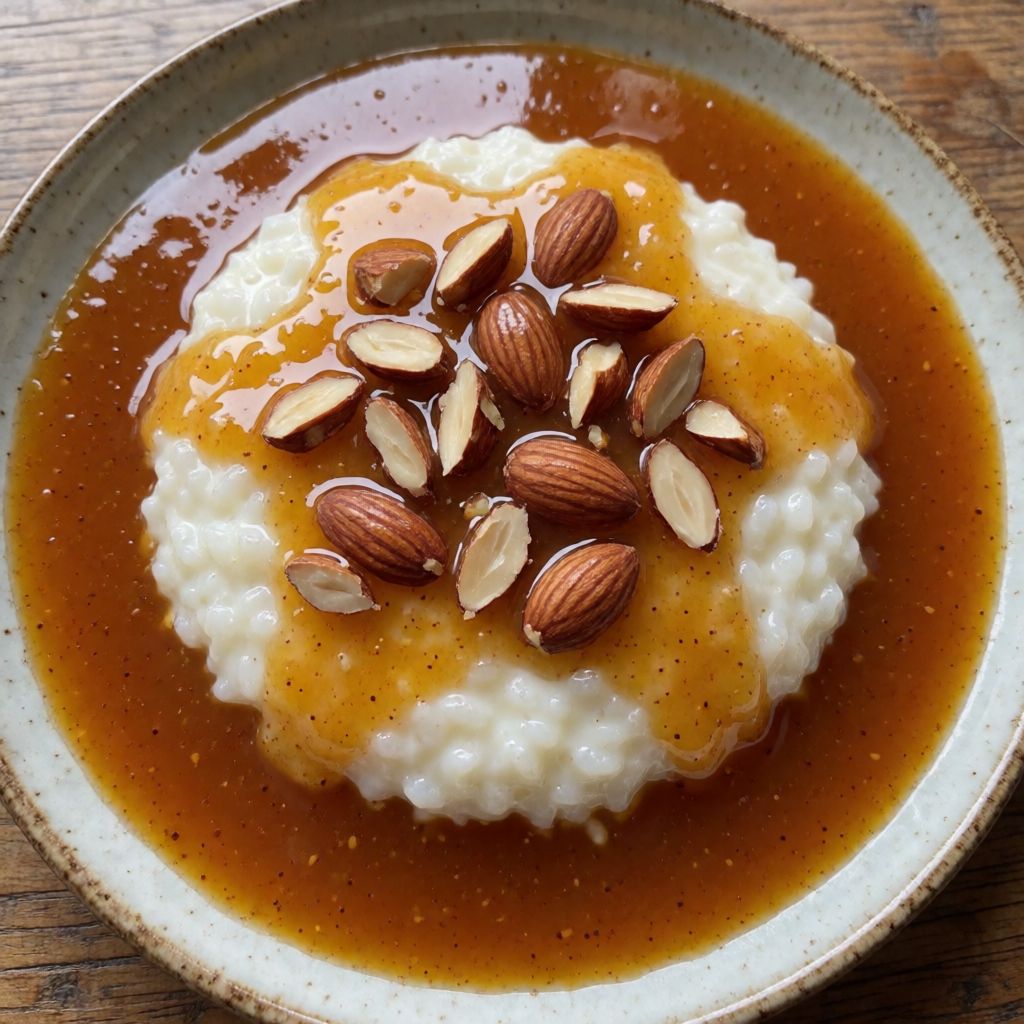
A zesty orange sauce with caramelised almonds, perfect for topping rice pudding.
Labels are worked out automatically from the ingredients and can be wrong. Check the packaging if it matters to you.
Ingredients
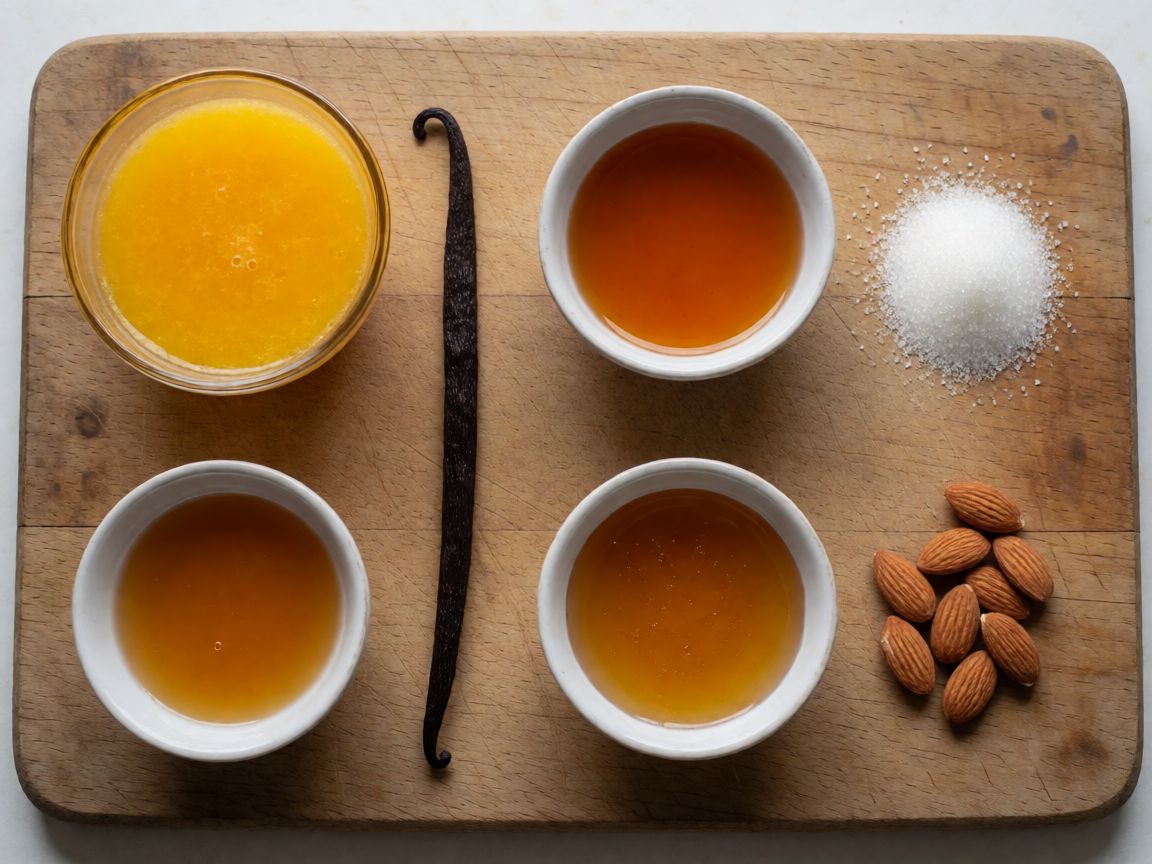
- 500 ml Orange Juice freshly squeezed
- 1 pcs Vanilla Pod
- 50 ml Grand Marnier
- 100 g Caster Sugar
- 2 tbsp Honey
- 100 g Almonds





Steps
Split the vanilla pod and scrape the seeds onto a board into the sugar, rubbing them in evenly so they're well distributed through the sugar.
Put the vanilla seeds, sugar and the whole empty vanilla pod into a saucepan together with the orange juice.
Bring the juice to the boil and cook for 15 minutes without a lid, so it reduces slightly in volume and becomes somewhat syrupy.
15 minAdd the Grand Marnier to the orange sauce and cook for a further 5 minutes.
5 minStrain the orange sauce through a fine sieve and pour it into, for example, a clean sterilised glass bottle.
Put the honey in a non-stick frying pan and heat until it melts and starts to bubble gently.
Add the almonds to the pan and stir occasionally until they turn a pleasant golden and crisp; take care they don't burn and that you don't burn yourself.
Spread the almonds on a sheet of baking paper and leave them to cool completely before roughly chopping.
This is a dressing-up job for a humble pudding. Rice pudding is milk and rice simmered down slow — the cheapest, kindest dessert the British kitchen has, the one that followed the Sunday roast when nobody had money or energy left for anything showier. What you're making here doesn't touch the pudding itself. It's two separate garnishes laid over it: a glossy orange syrup carrying vanilla and the warmth of an orange liqueur, and shards of almond locked in hard honey caramel for crunch against all that softness.
What decides whether this works is timing in two very different places. The orange juice has to reduce enough to coat a spoon and run slow off it — not stay watery, not go past syrup into marmalade. And the almonds have to come off the honey at exactly the moment they turn an appetising gold, because caramel doesn't warn you twice: it goes from perfect to bitter in the time it takes to answer the phone.
Some say bottled orange juice does the same job as fresh — no, because fresh juice carries its own natural sugars and acid in a balance that concentrates evenly under heat. Juice from a carton, reconstituted and stabilised, tends to either flatten out or turn sharp and slightly bitter once you drive off a third of its water. For a sauce this exposed, with nothing to hide behind, that difference shows.
Take the orange juice. Fresh-squeezed, as the recipe insists, because the point of step three is reduction — boiling off water until what's left is thicker and more concentrated than what you started with. Fresh juice behaves predictably under that kind of heat. Juice from concentrate carries additives meant to keep it stable on a shelf, not to behave well in a pan, and it can turn cloudy or faintly bitter as it cooks down. If you've only got the carton kind, use it, but don't expect quite the same clean orange hit.
The vanilla pod does two jobs, not one. The seeds, rubbed into the sugar, give you flavour distributed through every grain rather than clumped in one spot — that's why you work them in on a board before anything goes near heat. But the empty pod itself goes into the pan too, and that's not decoration: the husk still holds aromatic oils that slowly leach out into hot liquid over fifteen minutes of simmering, which a few drops of vanilla extract simply can't replicate. If you've no pod, use extract, but add it at the very end, off the heat — extract carries its aroma in alcohol, and boiling it drives that scent away just like it would the Grand Marnier.
Caster sugar, because it's fine enough to dissolve evenly alongside the vanilla seeds without leaving grit in the strained sauce. Any granulated white sugar that dissolves cleanly will do; what you want to avoid is anything coarse that sits stubborn at the bottom of the pan while the liquid above it boils.
Honey, for the almonds, rather than a sugar syrup, because honey already contains its own mix of simple sugars — it won't suddenly seize or crystallise on you mid-stir the way a plain sugar-and-water syrup sometimes will if you so much as touch it wrong. That's a real mechanical advantage, not a nicety: it means you can stir the nuts without fear of ruining the batch. Some say caramelising nuts needs a sugar thermometer and exact degrees — no, it doesn't, not here. You're watching colour and smelling for the change from raw sugar to toasted sugar; the moment it smells faintly of warm biscuit rather than plain sweet, and the nuts have gone an even gold, that's your cue, no thermometer needed.
Almonds, whole, because they hold their bite. Flaked almonds caramelise faster but also go from crisp to soft faster once they meet the moisture in a bowl of pudding — whole nuts, roughly chopped after they've cooled, keep their crunch longer against cream and rice. Any nut that can take a hot coating without turning to mush works in principle — hazelnuts, for one — but almonds are the honest, unfussy choice, and probably why this recipe reaches for them.
One point of patience, because it's easy to rush: let the almonds cool flat and untouched on the paper before you chop them. Hot caramel is liquid glass — it will stick to a knife, to a board, to a finger, and it will burn before it lets you know. Waiting costs you nothing but a few minutes, and it's the difference between clean shards and a sticky mess fused to your chopping board.