
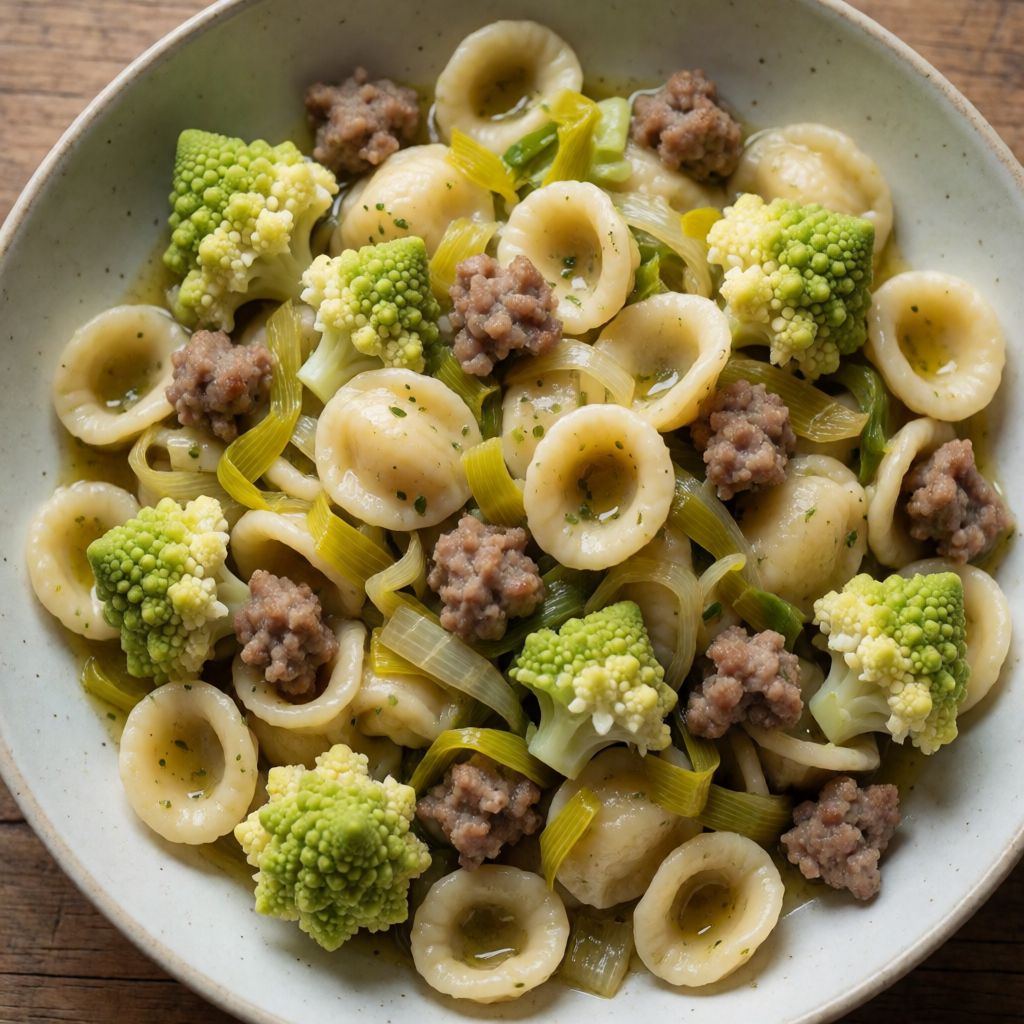
 AI photo
Orecchiette with Sausage, Leek and Romanesco
A hearty pasta dish combining orecchiette, spicy sausage, leek and romanesco cauliflower.
Labels are worked out automatically from the ingredients and can be wrong. Check the packaging if it matters to you.
Ingredients
- 1 pcs Romanesco
- 1 pcs Leek
- 150 g Sausage
- Olive Oil to taste
- Salt to taste
- 1 pcs Chilli Flakes
- 2 tbsp Parmesan
- 400 g Orecchiette
- 125 ml White Wine









Steps
Boil the romanesco, broken into florets, in plenty of salted boiling water.
15 minIn a frying pan, sauté the leek, then add the crumbled sausage and chilli flakes.
Pour in the wine and let it evaporate.
Cook for a few more minutes. It's ready when the centre reaches 70°C.
Drain the romanesco and add it to the pan.
In the same salted water, cook the orecchiette until al dente.
Drain the pasta and add it to the pan.
Toss everything together, add the parmesan, fry quickly and serve.
An orecchiette is a little ear, a small concave disc with a dimple in the middle, and that dimple is the whole point. It's not built to carry a smooth sauce — it's built to catch broken bits: a crumb of sausage, a fleck of romanesco. Swap it for a long pasta and the good stuff just slides off the fork. So before anything else, the shape decides whether this works.
Second thing that decides it: you cook the romanesco in the same pot of salted water you'll later boil the pasta in. Not for the washing-up — for the water. It picks up a bit of brassica flavour and a bit of starch from the floret surfaces, and that water goes back to work on the orecchiette. One pot, one fire, nothing wasted — this is peasant arithmetic, not a trick.
The pan work is a sequence with a reason behind every step, not a list to tick off. Leek goes in first and gently — it carries far less sugar than onion, so push it hard and it scorches before it ever turns sweet. The sausage goes in crumbled, never sliced, because sliced rounds don't crumb small enough to sit in the orecchiette's cup. The wine isn't there to flavour so much as to lift — it dissolves what's stuck to the pan and then has to boil off properly, alcohol smell gone, liquid gone glossy and thick rather than watery.
And the sausage is done at 70°C in the centre, not "a few more minutes" — that's the pork protein setting and the juices running clear, which is a food-safety number as much as a flavour one. If you don't own a probe, cut one piece open: no pink, no milky juice. That's patience doing its job, not the clock.
Romanesco is cauliflower's odd cousin — same family, different geometry, with that spiral fractal head that looks engineered because it basically is: it grows by repeating the same branching pattern smaller and smaller. Flavour-wise it sits between cauliflower and broccoli, slightly nuttier, slightly less sulphurous when cooked right. Buy one with a tight, firm head and no yellowing at the tips — yellow means it's been sitting about and will fall to mush before it's even tender. Break it into florets by hand rather than cutting, so it fractures along its own lines and doesn't shatter into crumbs. Done means a knife slides into the stem without resistance but the floret still holds its shape — bends, doesn't collapse. No romanesco in the shop? Cauliflower or broccoli both work; the criterion is a firm brassica that won't dissolve in boiling water, not the specific vegetable.
Leek: only the white and pale green part, the rest is for stock or the bin. Slice it and wash it properly — grit hides between the layers and no amount of cooking disguises sand. Its job here is to go soft and faintly sweet, not golden. That's a lower-sugar vegetable than onion, so the same heat that caramelises onion nicely will just catch and burn a leek. If you've only got onion, use it, but treat it the same gentle way rather than chasing colour.
Sausage: crumbled out of its skin, so it behaves like the romanesco florets — small enough to sit inside an orecchiette rather than slide past it. In a British kitchen that usually means a banger from the counter, which carries rusk and added water for bulk — cheaper filler, less meat per bite, more steam and less browning in the pan. Look for one with a high meat percentage if you can, it crumbles cleaner and renders fat instead of water. If you want the dish closer to its southern-Italian root, Italian salsiccia with fennel seed is the obvious swap, or make your own with minced pork and a spoon of fennel seed and chilli — the criterion is meat that tastes good enough to eat plain, since nothing here is hiding it.
The wine is there for acid, not sweetness — it cuts through the sausage fat the way lemon cuts through oil. Use something dry you'd actually drink; a sweet or flat "cooking wine" leaves a dull, slightly sour edge once the alcohol's gone, because what's left is mostly sugar and nothing to balance it. Chilli flakes work better bloomed early in the fat, before the wine goes in — their heat is partly oil-soluble, so a few seconds in warm oil gets you more than a late shake over the finished dish ever will. And parmesan goes in once the pan's off a hard boil — drop hard cheese into something properly bubbling and it seizes into strings and clumps instead of melting through; a gentle residual heat is what you want, stirred rather than boiled.
On the pasta itself: orecchiette is traditionally just durum wheat semolina and water, no egg, hand-shaped in Puglia by pushing a thumb through a disc of dough — which is exactly why the shape has that cup. It was a poor region's pasta: durum semolina was the cheap, available grain, and a shape with more surface per gram of dough meant the sauce — however little meat or oil you had — went further and clung harder, feeding more mouths from less. Some say only fresh, hand-rolled orecchiette is the real thing — no, because the dried, shop-bought version is exactly the practical, everyday version most Italian kitchens actually reach for; it just needs a minute or two longer and a bite-test near the end rather than trusting the packet time blindly.