
 AI photo
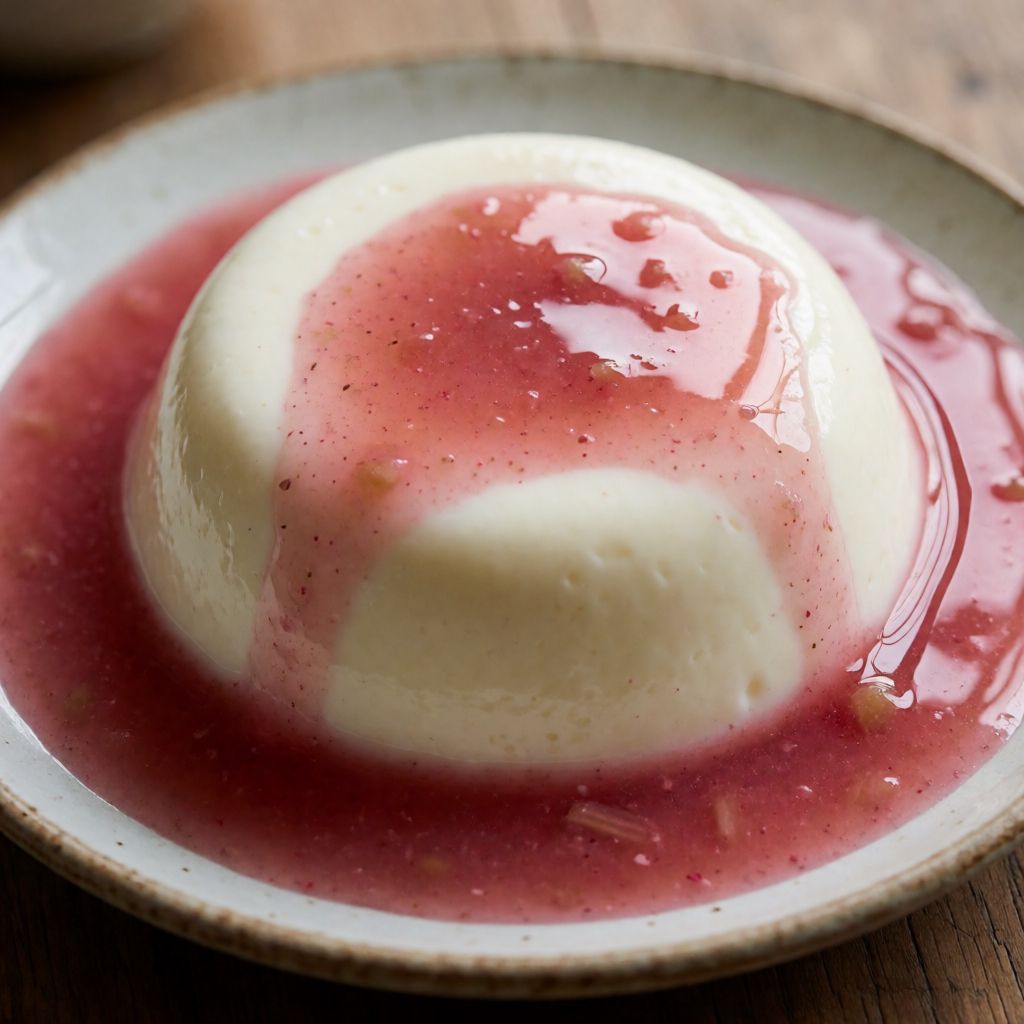
Rhubarb Panna Cotta
A classic vanilla panna cotta layered with tangy rhubarb jelly and topped with roasted rhubarb.
Labels are worked out automatically from the ingredients and can be wrong. Check the packaging if it matters to you.
Ingredients
- 1 pcs vanilla pod
- 60 g caster sugar
- 500 ml double cream
- 100 ml whole milk
- 3 pcs gelatine leaves
- 100 g rhubarb cut into small dice
- 100 ml water
- 20 g caster sugar
- 1 pcs gelatine leaf
- 2 pcs rhubarb cut into 2 cm pieces
- 1 tbsp maple syrup
- 0.5 tsp vanilla sugar
- 40 g white chocolate flaked





Steps
Soak the gelatine leaves one at a time in a bowl of cold water.
Put the vanilla seeds, sugar, double cream, milk and the scraped vanilla pod into a saucepan and bring almost to the boil.
Squeeze the water from the gelatine and add it to the hot liquid.
Stir well until the gelatine has completely dissolved.
Remove the vanilla pod and leave the vanilla cream to cool on the counter for 30-45 minutes.
Stir the cream well and pour into serving glasses.
If the panna cotta is to be served at an angle, carefully pour it into the glasses and set them on a plate in the fridge.
Chill in the fridge for 3 hours before pouring on the jelly.
Rhubarb jelly: soak the gelatine in a bowl of cold water.
Put the water, rhubarb and sugar into a saucepan and bring to the boil until the sugar dissolves.
Strain the hot juice into a bowl.
Squeeze the water from the gelatine, add it to the bowl of rhubarb juice, stir well and leave to cool on the counter to room temperature.
Carefully pour the rhubarb jelly over the panna cotta and chill the dessert again for at least 2 hours.
Roasted rhubarb: toss the rhubarb pieces with the maple syrup and vanilla sugar and spread on a baking tray lined with baking parchment.
Bake in a preheated oven at 175°C for 15 minutes, then leave to cool to room temperature before placing on top of the rhubarb panna cotta.
Panna cotta means "cooked cream" and that's the whole confession right there — it's not a custard, nothing sets it but gelatine and cold. No eggs, no oven, no whisking over a water bath watching for a coat-the-spoon moment. You heat cream to just short of boiling, dissolve gelatine into it, and let the fridge do the actual work. That simplicity is exactly why it's unforgiving: there's nowhere to hide a mistake with egg yolks or flour, so the two things that matter are gelatine quantity and how cold you let it go before it sets hard.
Here you've got three separate little jobs stacked on top of each other — a vanilla cream, a tart rhubarb jelly, and a tray of roasted rhubarb for the top — and each one sets or cooks completely before the next touches it. That's not fussiness, that's physics: pour a warm jelly onto a soft-set cream and you get a pink marble swirl instead of two clean layers. The whole dessert is really a lesson in patience disguised as a recipe.
What decides whether it works isn't skill, it's restraint. Restraint from boiling the cream (which cooks out its sweetness and can split the fat), restraint from rushing the chill time, restraint from over-soaking the gelatine. Get those right and a child could make this. Get them wrong and you've got either a cream so loose it won't hold a spoon mark, or one so stiff and rubbery it bounces.
Start with "bring almost to the boil" — and mean it. Cream at a rolling boil scalds; the proteins and fat start separating, and you get little flecks of butterfat floating free instead of a silky liquid. You're watching for the first lazy bubbles nudging up at the edge of the pan, cream starting to climb the sides. That's your cue, not a clock. Some say you have to boil cream to "activate" it for panna cotta — no, you don't, you're not cooking anything, you're just getting it hot enough to melt gelatine completely and let the vanilla pod release its oils into the fat.
Gelatine leaves, not powder, because leaves bloom evenly and don't clump — drop a leaf into a bowl of properly cold water (not iced, not warm — warm starts dissolving it before you want it to) one at a time so they don't stick together into a rubbery parcel that never fully softens. Squeeze them dry before they go in the hot cream; the water left clinging to a leaf is enough to throw off your ratio if you're sloppy about it. No leaf gelatine in the cupboard? Powdered works, bloomed in a few tablespoons of cold water per sachet, same principle — just know it sets slightly firmer gram for gram, so go a touch lighter.
Vanilla pod, scraped and then dropped whole into the pan rather than discarded — the seeds give you the speckled look and the strongest flavour, but the spent pod still carries real aromatic oil in its walls, worth every minute it steeps. No pod? Vanilla paste or a good extract added off the heat will do, but you lose the visual — those black specks are doing some of the selling here, not just the flavour.
The rhubarb itself splits into two different jobs with two different goals. For the jelly, you're boiling it hard with water and sugar until it collapses and gives up its juice — you're not trying to preserve the rhubarb, you're extracting colour and sharpness, so straining it afterwards and throwing the fibrous pulp away is correct, not wasteful. For the topping, it's the opposite: you want the rhubarb pieces to survive the oven as pieces, so they go in dry-ish, just coated in maple syrup and vanilla sugar, roasted until they've softened and started to caramelise a little at the edges but haven't collapsed into mush — look for pieces that bend and glisten, not ones that have gone to liquid on the tray.
Rhubarb itself is a vegetable playing a fruit's part, and it's sour enough that it needs sugar to be anything other than medicinal — that's not tradition, that's just chemistry: high oxalic acid, low natural sugar. Forced (pink, early-season) stalks are milder and need less sugar than the thick green field stalks that turn up later; if yours looks pale and slender, you can ease back on sugar a touch, if it's thick and deep green, don't.
On the layering itself — the jelly has to go in at room temperature, not hot and not fridge-cold. Hot, and it melts the set cream underneath into a mess where the two layers meet. Cold and half-set already, and it won't pour smoothly, it'll sit in clumps instead of flooding evenly over the surface. Room temperature liquid jelly poured gently down the back of a spoon onto a fully-set cream is what gives you that clean line between white and pink that makes people think more effort went in than actually did.
This is four small glasses, dessert-cup size, nothing more — it's rich, and double cream plus a jelly layer plus roasted fruit is plenty per person. No kazan, no special kit — a saucepan, a sieve, a baking tray and a fridge with enough room to leave four glasses standing undisturbed for the better part of a day between stages. That last part is the real limiting factor in a normal kitchen: not skill, just whether your fridge is free long enough for three separate cooling and setting stages to happen one after another without you getting impatient and rushing the next layer on too soon.