
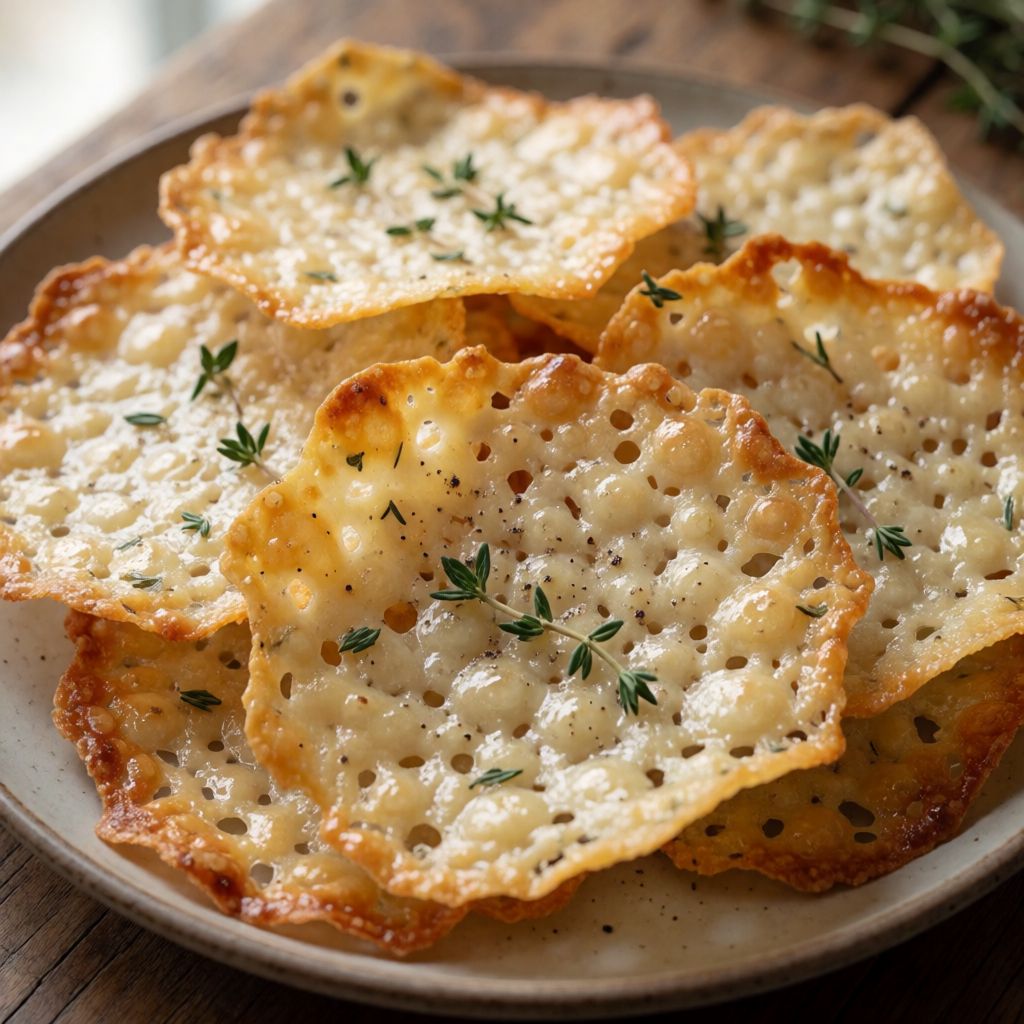
 AI photo
Parmesan Crisps
Baked Parmesan crisps flavoured with thyme and rosemary, lovely alongside a welcome drink.
Labels are worked out automatically from the ingredients and can be wrong. Check the packaging if it matters to you.
Ingredients
- 100 g Parmesan freshly grated
- 1 tsp Thyme fresh, finely chopped
- 1 tsp Rosemary fresh, finely chopped
- to taste Black pepper freshly ground




Steps
Mix the Parmesan — it does need to be freshly grated — with the thyme, rosemary and black pepper, then spoon the mixture into small rounds on a baking tray lined with baking parchment.
Bake in the oven for 6–8 minutes at 160°C, conventional setting.
7 minKeep a close eye on them — the cheese should melt but they must not brown.
Remove from the oven and let cool completely on the parchment before serving, perhaps alongside a welcome drink.
This isn't a cracker with cheese melted onto it - it's cheese on its own, cooked until it turns from a soft grated heap into something closer to glass. No flour, no egg, nothing holding the shape together but the cheese's own fat and protein. You spoon little mounds of grated parmesan onto a tray, and the oven does the rest: the fat melts and spreads each mound into a thin disc, the protein sets as it cools, and what you lift off is lacy, brittle, almost see-through at the thin edges.
What decides whether it works is the exact point you pull the tray out. Melted cheese has a narrow window between "set into a crisp" and "scorched." There's no sugar here to caramelise kindly the way a crust does - this is milk protein, and browned milk protein just tastes bitter and burnt, not toasty. So you're not counting to seven minutes and stopping, you're watching colour: pale gold, maybe the faintest blush at the rim, and out. The eight minutes in the recipe is a floor, not a verdict - your oven, your tray, your cheese's own age all push it earlier or later.
The other failure point is patience, or the lack of it. Pull a crisp off the parchment while it's still warm and it won't come off clean - it'll stretch and tear, because hot cheese is still liquid, just a slow one. The actual crunch only arrives once the fat re-hardens at room temperature. Cooling on the tray isn't the garnish step at the end, it's the second half of the cooking, and rushing it is the single easiest way to end up with floppy, gummy discs instead of crisps.
Start with the cheese itself, because it is the whole dish. Grate it fresh, off the block, close to when you need it - not from a bag. Bagged pre-grated parmesan is dusted with starch or cellulose so the shreds don't fuse together in storage, and that same anti-caking dust stops it melting into a smooth lace in the oven. Instead of one even disc you get a gritty, patchy mess that sets unevenly and burns at the drier spots first. It's two minutes with a grater against a block - not worth skipping.
Why parmesan specifically, and what else would do the job: it's hard, it's low in moisture, and it's high in fat relative to that moisture, which is exactly the state you want going into dry heat. The crunchy white flecks you sometimes find in a well-aged wedge are amino acid crystals from the ageing - a sign the cheese is already partway toward dry and crystalline, which is the direction you're pushing it in the oven anyway. So the substitution rule is: any hard, aged, low-moisture cheese. Grana padano works, a firm aged pecorino works, even a finely grated mature cheddar will crisp, with a different flavour but the same mechanism. A young or soft cheese - mozzarella, a mild cheddar, anything with real moisture in it - won't crisp at all. It'll just boil in its own water and burn at the edges before it ever sets.
Fresh thyme and rosemary, not dried, and this matters for the same reason flour doesn't belong here. Dried herbs are already dehydrated; another seven minutes of dry oven heat on top of that turns them to ash with nothing left to taste but char. Fresh herbs still hold water and oil, so they cook gently into the melting cheese instead of scorching on its surface before the cheese is even ready. Any hardy, woody herb behaves the same way, so sage is a fair stand-in. A soft, leafy herb like basil is not - it would blacken long before the cheese sets.
One reason to use the still, conventional setting rather than fan: a thin disc of melting fat and protein has almost no mass, so moving air hits it harder than it hits a joint of meat or a loaf. A fan would dry and colour the rim while the centre is still soft grains of cheese, giving you a burnt lace around a gummy middle. Still heat lets the whole disc warm and melt together, which is what you actually need for an even crisp.
And leave enough room between the mounds on the tray - they spread as they melt, and if they're too close they don't stay as twenty crisps, they fuse into one odd sheet that cooks unevenly across its width. None of this needs special kit: a tray and baking parchment is the whole apparatus, no kazan, no lid, nothing you don't already have in an ordinary flat kitchen. The only ingredient you can't substitute is time spent waiting - watching the colour in the oven, then watching nothing happen on the counter while they cool. Both matter more than the clock does.