
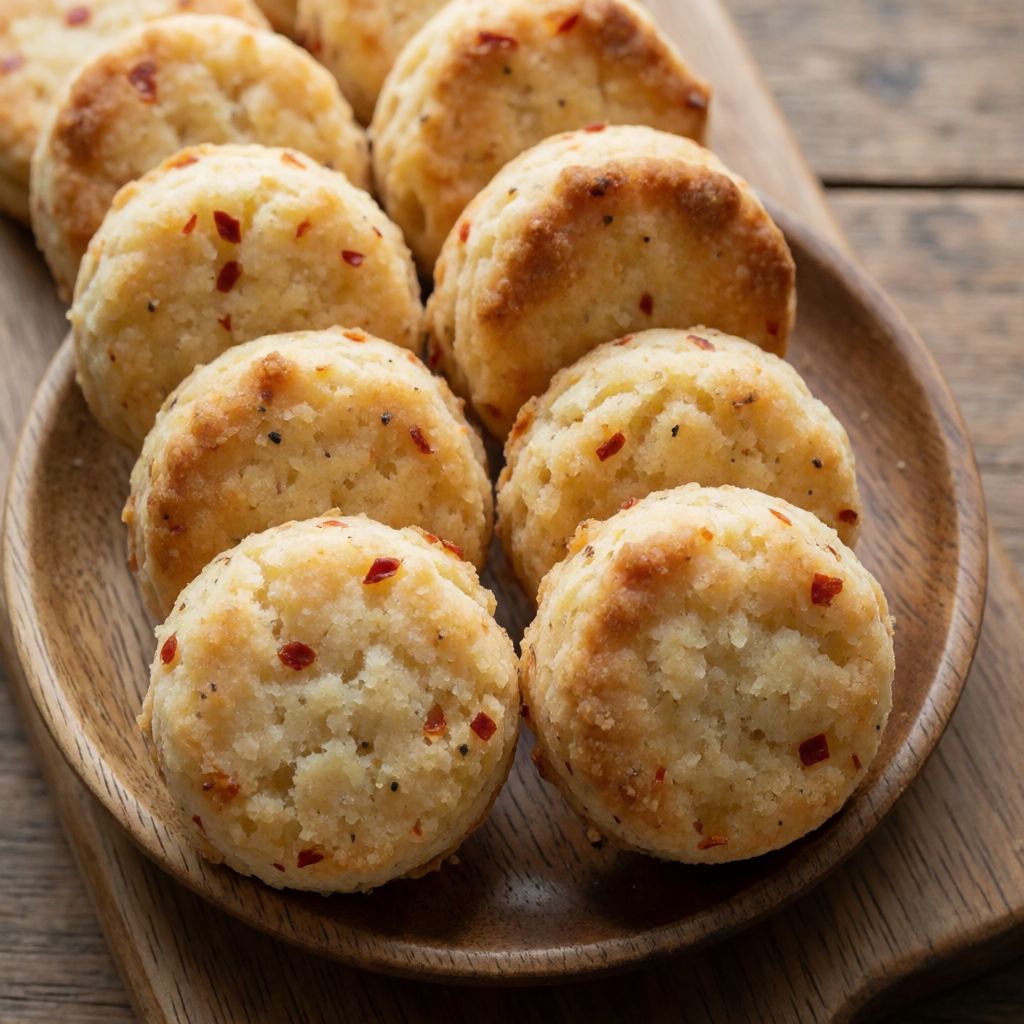
 AI photo
Savoury Parmesan Biscuits, Perfect for an Aperitif
Crisp, cheesy savoury biscuits that are perfect to serve with drinks before a meal.
Labels are worked out automatically from the ingredients and can be wrong. Check the packaging if it matters to you.
Ingredients
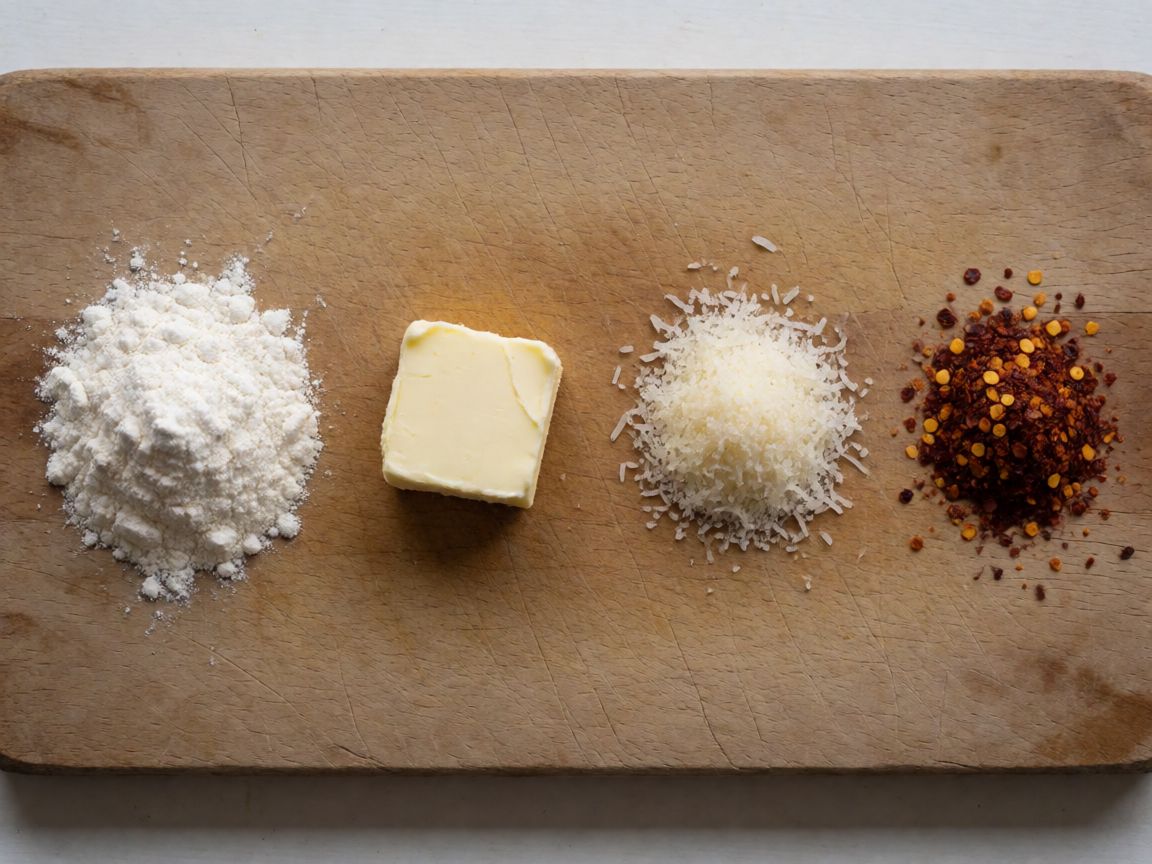
- 140 g Plain flour
- 90 g Butter cold
- 110 g Parmesan
- 1 pinch Chilli flakes ground
- Salt to taste
- Black pepper to taste






Steps
Preheat the oven to 180°C.
Carefully rub the cold butter into the flour and work it with your hands until you get a rough, crumb-like mixture.
Add the ground chilli flakes and the Parmesan. Season with salt and pepper to taste.
Keep working the mixture until it comes together into a compact block of dough.
Dust the work surface with flour and roll out the dough to about 1 cm thick, then cut out circles with cutters. Gather the trimmings, knead, roll out and cut more.
Place the biscuits on a baking tray lined with parchment paper and bake in the oven for 10-15 minutes at 180°C, until the tops turn golden.
12 min
This is a sablé, dressed as a cheese biscuit. The flour is really just scaffolding — everything you taste comes from the butter and the Parmesan melting into it, and the whole point is never letting that fat go smooth. Keep the butter cold enough that your fingers are the only warm thing in the room, and it stays in little flakes between the flour grains, so when it bakes those flakes puff and separate instead of gluing into a dense biscuit. The moment it turns to paste — warm hands, too much kneading — the thing that gives you "short" instead of "tough" is gone, and no extra time in the oven brings it back.
What decides whether it works is the rubbing-in, not the oven. Some people think dough needs working until it's smooth, the way you'd handle bread or a shortcrust for a pie — no, because here smooth is the enemy. You want it rough right up to the moment it just holds together as a block. Push past that and you've built gluten you didn't need, and the biscuit chews instead of snapping.
The 180°C does two separate jobs, not one. It melts the butter fast enough that steam gets trapped and lifts the crumb before the structure sets — that's the shortness. And it's hot enough to brown the sugars and proteins in the Parmesan, which is why the top goes gold rather than staying the colour of raw dough. Watch the colour, not the clock: small domestic ovens run hot in the corners and lie about their own dial, so 10 minutes in one tray is 15 on another.
Flour: plain, not strong bread flour, not self-raising. You don't want extra gluten (that's bread flour's whole purpose, and you're avoiding it) and you don't want a raising agent fighting the butter's own lift. 140g gives just enough structure to hold the fat and cheese together — more, and you dilute the cheese; less, and the dough tears when you roll it.
Butter: cold, and that's not fussiness, it's the mechanism itself. Cold butter stays as solid lumps as you rub it in, each one coated in flour; in the oven those lumps melt and leave tiny gaps, and that gap is what "short" means on the tongue. Soft or melted butter blends into the flour as a paste, closes the gaps before they form, and you get something dense and slightly greasy instead. If your kitchen's warm — and it often is, with the oven already going for a roast — cube the butter, keep it in the fridge till the last second, and don't linger over the rubbing-in.
Parmesan: it's doing three jobs — salt, savoury depth, and the colour on top. It's hard and low in moisture, and that matters more than people think: a wet, soft cheese would add liquid to the dough and push it toward gluten development, exactly what the cold-butter method is trying to avoid. Grate it yourself if you can — the pre-grated bagged kind is often drier still and sometimes dusted with anti-caking starch, which blunts the flavour. Out of Parmesan, any other hard, aged, dry grating cheese works on the same principle — Grana Padano, an aged Gouda, mature Cheddar at a pinch — just taste before you add salt, since they're not all salted the same.
Chilli flakes: a pinch, not a seasoning in its own right. Its job is to needle through the richness of all that butter and cheese so the biscuit doesn't sit flat on the tongue. Leave it out and the biscuit still works — it's just quieter.
Rolling and cutting: 1cm is the thickness that lets the centre cook through before the edges darken too far. Thinner, and the edges catch before the middle firms up; thicker, and you get a pale, slightly raw middle under a finished top. Any round cutter does it, or the rim of a glass if you don't own one — shape has no bearing on the eating, only on how neatly they sit on a plate. Re-roll the trimmings once, maybe twice, no more: each pass warms the butter a little more in your hands, and that's shortness you're spending and won't get back.
Tray and oven: domestic ovens, especially the smaller end of a British kitchen, rarely heat evenly — corners and the back run hotter, and there's no fan-forced consistency to lean on. Trust your eyes over the dial: turn the tray if one side is colouring faster, and pull them the moment the tops go gold, not brown. Parchment matters mainly because that much Parmesan sheds fat as it bakes, and a bare tray under it is how you end up scrubbing instead of eating.