
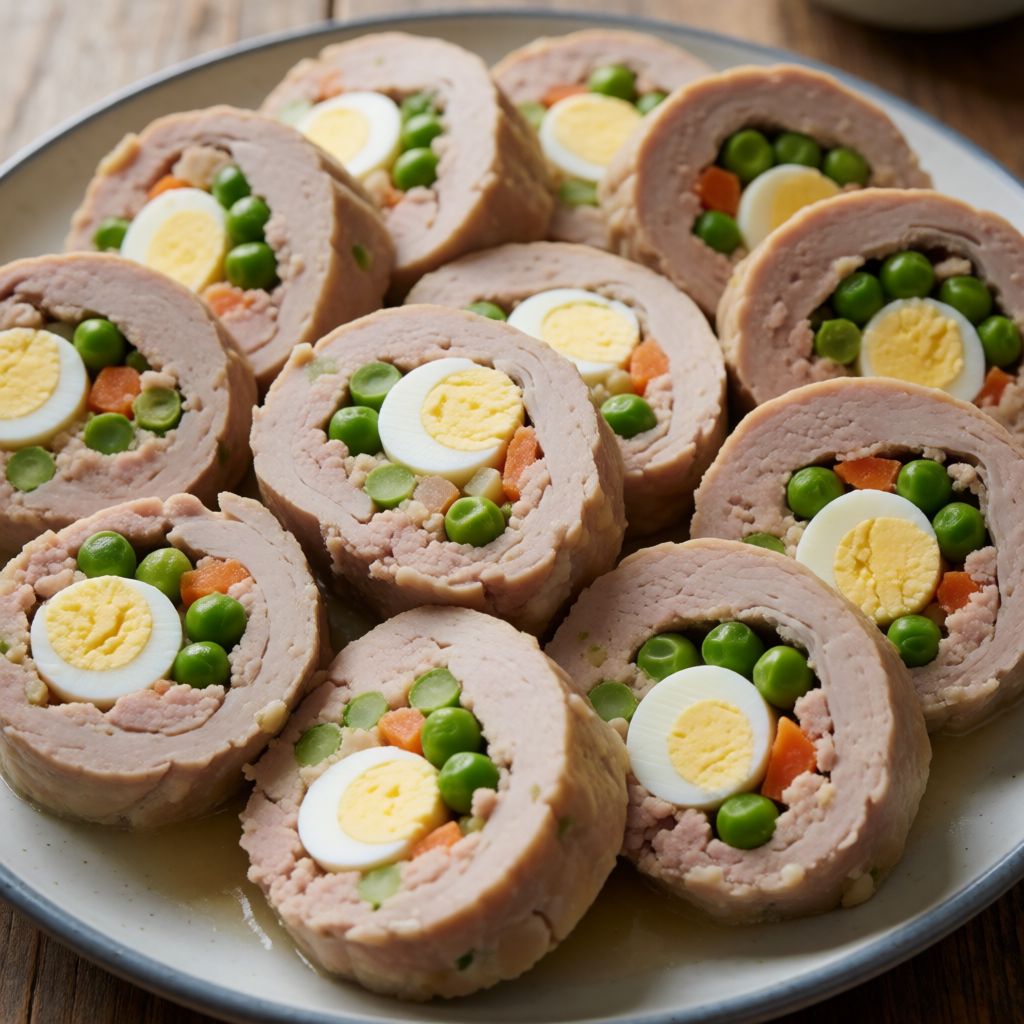
 AI photo
Cima alla Genovese (Stuffed Veal Breast)
A classic Genovese dish: veal breast stuffed with a rich filling, poached slowly, then served cold in slices.
Labels are worked out automatically from the ingredients and can be wrong. Check the packaging if it matters to you.
Ingredients
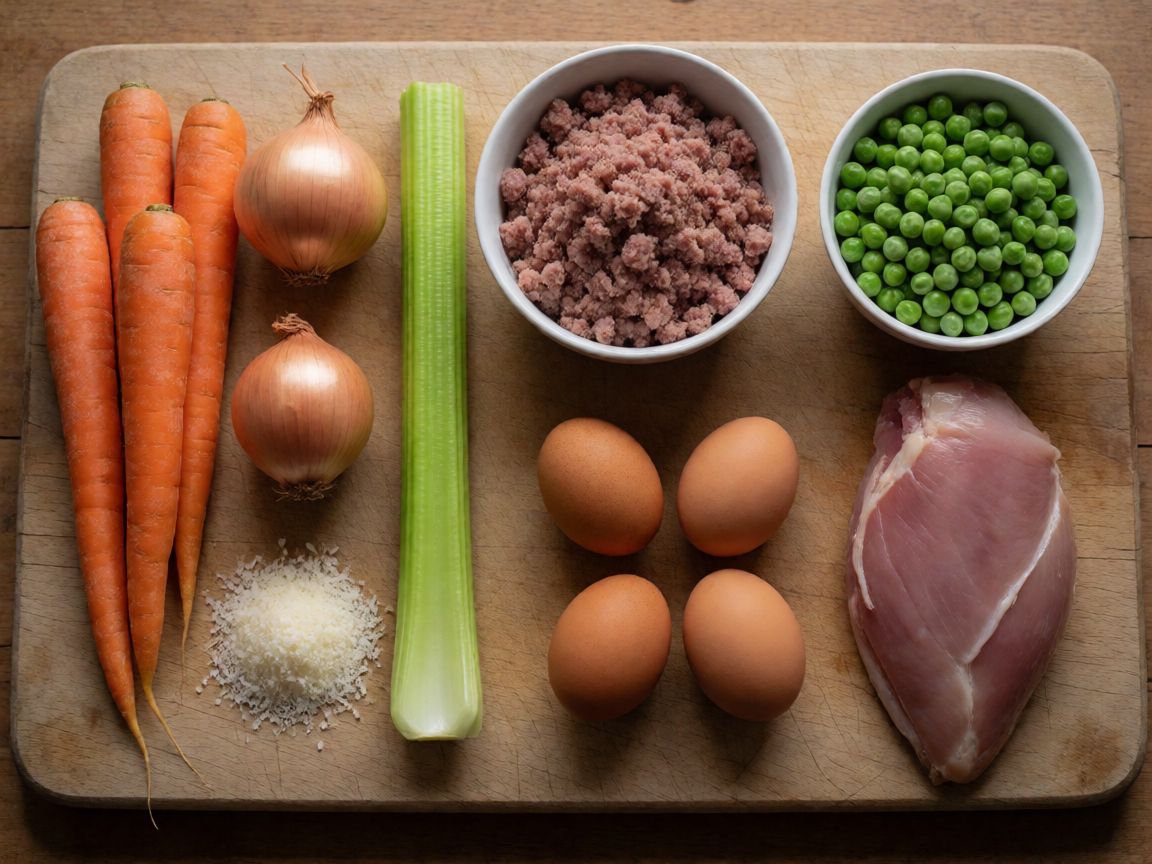
- 3 pcs Carrots
- 1 pcs Onion
- 1 pcs Celery stalk
- 150 g Minced veal and pork
- 150 g Peas
- 3 pcs Eggs
- 50 g Parmesan
- Salt to taste
- Black pepper to taste
- 1 kg Veal breast







Steps
In a bowl, mix the minced veal and pork with the peas, add the lightly beaten eggs, salt, black pepper and Parmesan. Mix until smooth and fairly loose.
10 minMake a cut in the veal breast to form a pocket, without cutting all the way through to the bottom.
5 minFill the pocket with the prepared stuffing, leaving at least a couple of centimetres from the edge.
5 minSew the edge of the pocket closed with kitchen string using a thick needle.
5 minPlace the meat in a large pot together with the vegetables, cut into large chunks. Add water to cover the meat. Season with salt.
5 minBring to the boil and simmer on low heat for about 2 hours, turning the meat occasionally. Check with a thermometer — the internal temperature should reach 71°C.
120 minTransfer the meat to a board and let it cool, placing a weight on top to press out the juices and shape it into an oval.
10 minWrap the meat tightly in cling film and leave to rest in the fridge for at least 3–4 hours.
240 minSlice and serve cold with sauces of your choice.
5 min
Cima alla Genovese is a cold terrine disguised as a roast joint — a pocket of veal breast stuffed with a meat-and-egg filling, poached, pressed, chilled, then sliced thin like a pâté. It's Ligurian, built for feast days when meat was precious and had to stretch and keep: one breast feeds six because the stuffing is doing half the work, and the dish is just as good — arguably better — the next day, which tells you something about how it was designed.
What decides whether it works is not the cooking, it's the geometry and the patience afterwards. The pocket has to hold its shape without bursting, which means you don't overfill it and you don't skip the sewing — a loose or open seam lets the egg-bound filling weep out into the broth, and you end up with a greyish lump and a cloudy soup instead of a clean slice with a marbled custard-like cross-section. The real test of success isn't the two hours in the pot; it's whether the slice holds together when the knife goes through it cold.
Some say you can skip the pressing and chilling and eat it warm. You can — but then you're eating boiled stuffed meat, not cima. The whole point of this dish is the texture you only get from pressure plus cold: the egg sets the filling into something sliceable, but only once it's been squeezed flat and firm in the fridge for hours. Cutting it warm and loose defeats the dish on its own terms.
Think of the veal breast as a flat, fatty, well-worked muscle sheet — exactly the cut you want for this, because it's thin enough to cut a pocket into without collapsing, and because it has enough connective tissue to turn soft and almost gelatinous after two hours of gentle simmering. A thick, lean joint from elsewhere on the animal won't take a pocket the same way and won't give you that yielding bite. If your butcher doesn't do veal breast, ask for breast of veal specifically (not shoulder) — failing that, a thin piece of pork belly with the bone removed will behave similarly, though the flavour shifts.
The mince filling is really an egg custard with meat and peas suspended in it, not a sausage mixture — that's why it should be "loose," not firm. Firm mince packed tight leaves no room for the egg to bind it into one connected mass; it just stays a collection of separate crumbs once sliced, and the slice falls apart. The egg is the actual engineer here: three eggs for 150g of mince is a lot of egg precisely because it needs to set like a flan around the meat and peas when heat hits it. Parmesan does two jobs — salt and a savoury backbone — so if you're out, use any hard, aged, grating cheese with real bite; a mild cheddar won't give you the same depth.
Peas go in whole, not for flavour so much as for the cut surface — when you slice the cima cold, the peas sit like green coins in the pale filling, which is the visual signature of the dish and tells you at a glance that the stuffing hasn't curdled or separated. If fresh peas aren't in season, frozen are genuinely fine here; they're blanched and frozen at peak ripeness and you're boiling the whole thing for two hours anyway, so there's no texture to lose.
The carrot, onion and celery in the pot aren't for show — they're there because an hour or two of nothing but water and bone would strip flavour from the meat into the broth without giving anything back. The vegetables buffer that exchange and also give you a decent broth afterwards, which traditionally wasn't thrown away — it became soup another day. That's the economics behind this whole dish: nothing here is wasted, not the trim, not the broth, not the leftover slices, because this was feast food built by people who couldn't afford to waste meat.
On a domestic hob, "simmer for about two hours" means water doing nothing more dramatic than a slow, lazy bubble at the edge of the pot — if it's rolling and knocking the meat around, you're cooking it too hard and the outside of the breast will toughen before the inside is done, and the seams are more likely to burst under the agitation. A thermometer reading 71°C in the thickest part of the stuffing is your real finish line, not the clock; the two hours is just the minimum time it reliably takes to get there with a joint this size.
The pressing step is where most people cut corners, and it's the wrong corner to cut. Without weight on it while it cools, the cima keeps its rounded breast shape and the slices come out as awkward, uneven lozenges that don't sit flat on a plate. A few tins of beans stacked on a board, or a heavy chopping board itself, does the job — you don't need a proper press. The fridge rest afterwards isn't bureaucracy either: cold is what finishes setting the egg custard inside to a sliceable firmness, the same reason you don't cut a quiche the moment it leaves the oven. Rushing this stage doesn't save you time — it just gives you a worse slice for your trouble.