
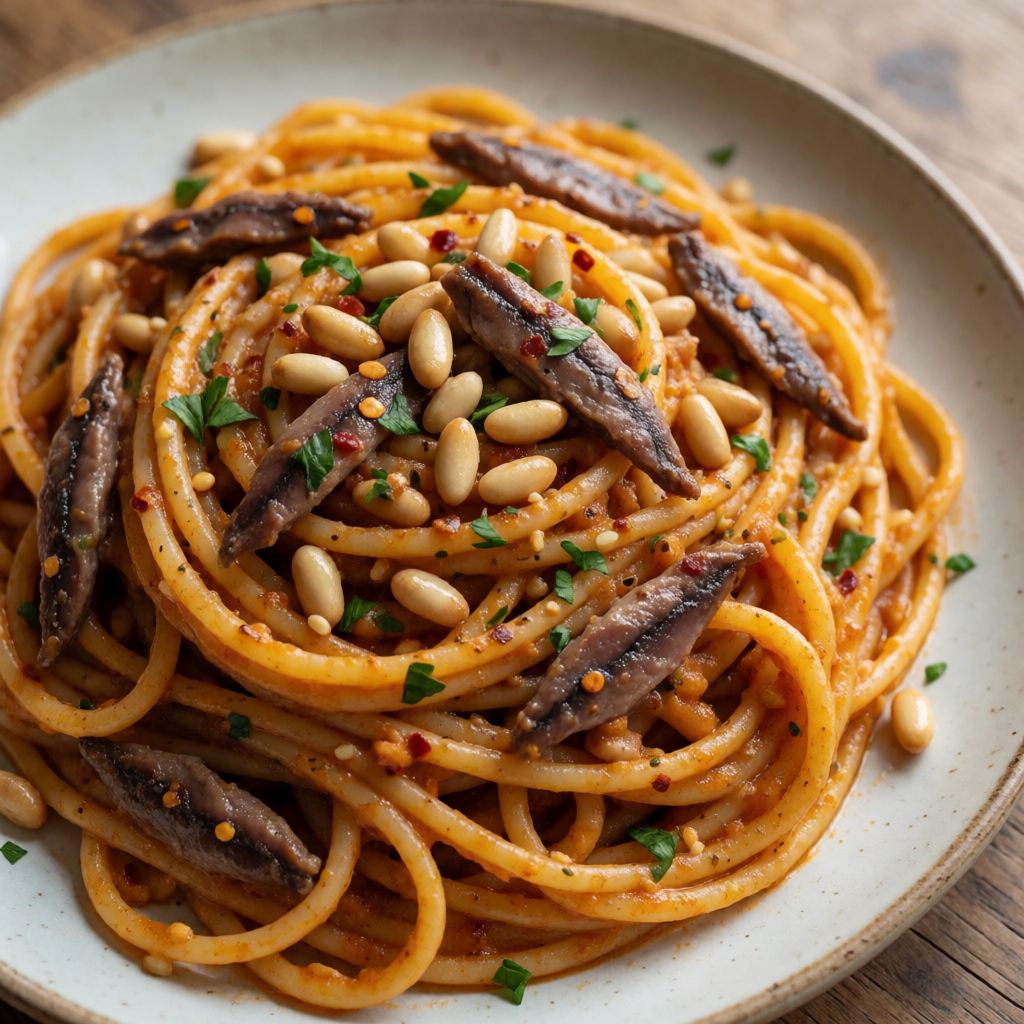
 AI photo
Pasta with Anchovies
A quick pasta tossed with anchovies, pine nuts, tomato paste, garlic, chilli flakes and parsley.
Labels are worked out automatically from the ingredients and can be wrong. Check the packaging if it matters to you.
Ingredients
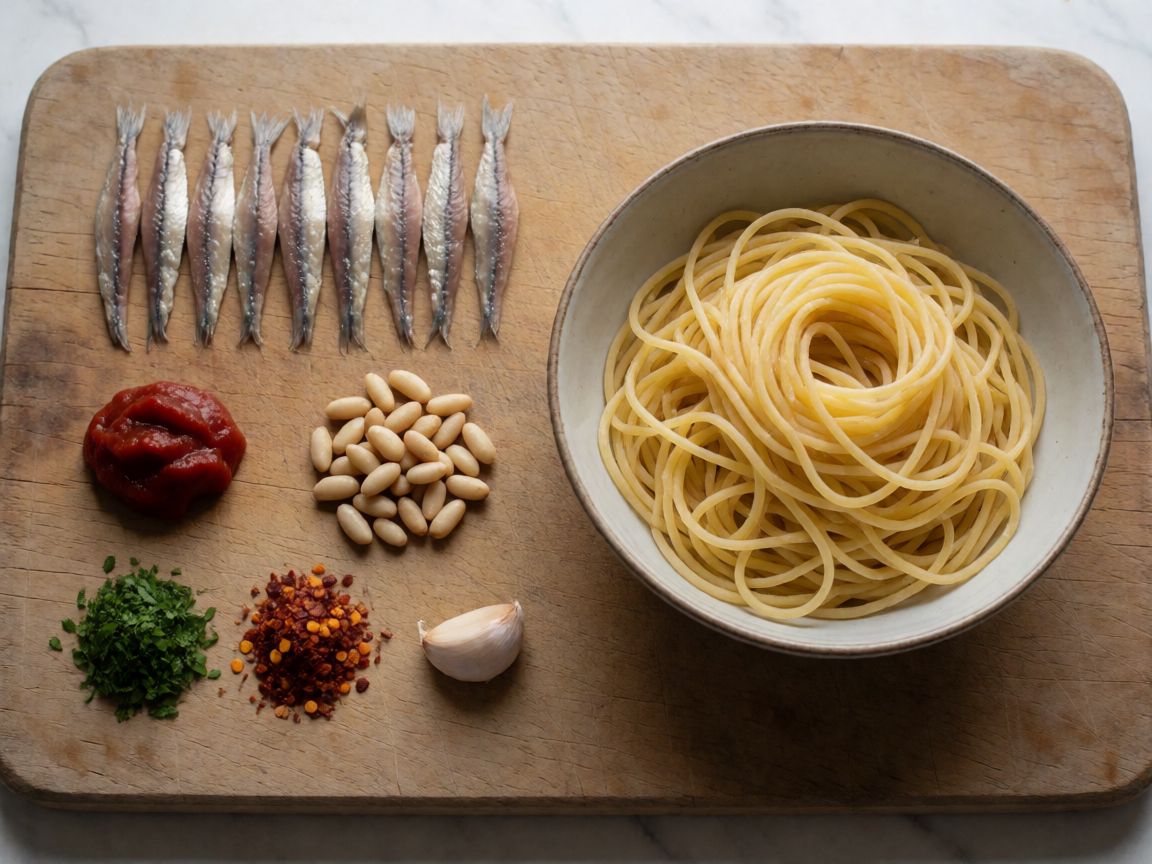
- 400 g Pasta
- 10 pcs Anchovies
- 30 g Pine nuts
- 3 tbsp Tomato paste
- 1 bunch Parsley
- 1 pinch Chilli flakes
- 1 clove Garlic
- Olive oil to taste
- Salt to taste






Steps
Wash the parsley, pat it dry with a paper towel and chop it finely.
Peel and finely chop the garlic, and add it to the parsley.
Finely chop the pine nuts and crumble in the chilli flakes.
Mix the chopped ingredients together, then add 5 anchovy fillets, drained of their oil and chopped.
Pour a little olive oil into a frying pan, add the remaining 5 anchovies whole and fry over high heat.
Stir in the chopped mixture and the tomato paste diluted in hot water.
Let the sauce simmer gently while you bring a pot of water to the boil for the pasta.
Salt the boiling water and tip in the pasta.
Cook the pasta until al dente, following the timing on the packet, then drain.
Toss the pasta into the sauce in the pan, making sure everything is heated through to 63°C.
Mix well and leave over high heat for a few seconds to bring everything together.
The pasta is ready — serve it up, with a scattering of parsley if you like.
This is a pasta where anchovies don't taste like fish — they taste like salt with a backbone, like something that's been there a long time. That's the whole trick, and it's worth understanding before you open the tin, because half the people who hate anchovies have never actually had one cooked properly.
What decides whether this works is heat management on a domestic hob that doesn't really do "high heat" the way a Neapolitan trattoria range does. You fry five whole anchovies hard and fast at the start — this isn't to crisp them, it's to break them down into the oil, so they dissolve into a savoury base rather than sitting there as little fish shapes on your plate. If your pan doesn't hiss when the anchovies hit it, your oil wasn't hot enough and you'll get stewed fish instead of a seasoned oil. That's the difference between "anchovy pasta" and "pasta that tastes of anchovy."
The second batch of five, chopped and folded raw into parsley, garlic, pine nuts and chilli, does a different job — they melt into the tomato sauce rather than fry, so you get two textures of the same ingredient: one cooked hard, one dissolved slow. Some say anchovies make a dish "too fishy" — no, because true fishiness is the smell of something going off, and a good anchovy in oil or salt is cured, not decaying; the smell you're worried about is staleness, not the fish itself, so buy from a tin or jar with decent turnover, not one that's sat at the back of a cupboard since a previous house move.
The ingredients split into two jobs: things that season, and things that carry.
Anchovies are the engine, not a garnish, and this is where most people go wrong with the whole dish category. The myth is that you're adding fish flavour. You're not — properly cured anchovies, salted or in oil, have lost most of what makes a fish taste "fishy" (that's trimethylamine, which breaks down in curing) and what's left is glutamate and salt, the same chemistry that makes Parmesan or soy sauce taste deep rather than fishy. If you genuinely can't get past the idea, a dark soy or even a good stock cube dissolved in the oil will get you partway there, but you lose the backbone texture the whole-fried fillets give.
Tomato paste, diluted in hot water rather than used straight from the tube, is doing something specific: it lets the concentrated paste cook out its raw tang over gentle heat without catching and burning on a thin layer in the pan. This is the one place "high heat" from the frying step needs to drop — once the paste and water go in, you want a quiet simmer, a surface that blips rather than spits, because scorched tomato paste turns bitter and no amount of pasta water will save it afterward.
Pine nuts and parsley aren't decoration here, they're the counterweight. Pine nuts bring a soft fat and a faint sweetness that cuts the salt-forward anchovy base; if you haven't got them, a toasted flaked almond or even a sunflower seed does the same structural job — something with fat and a bit of crunch, chopped small enough to melt into the sauce rather than sit on top of it. Parsley, added raw into the chopped mixture and again at serving, gives you a green, grassy lift against all that savoury depth — without it the dish tips entirely into salt and umami with nothing to balance it, which is why it appears twice in the method, not once.
Chilli flakes are a pinch, genuinely — this isn't a spiced dish, it's a seasoned one, and chilli here is there to wake up the palate before the anchovy hits, not to compete with it. Garlic, raw and finely chopped into the parsley mix rather than fried first, stays sharp rather than mellow — it cooks gently once it's in the pan with the tomato, which is enough to take the raw edge off without losing its bite entirely.
On olive oil: "to taste" here really means "enough to fry the anchovies without them sticking and enough left to carry flavour into the tomato." Any oil with no smell of its own will do the carrying job — a flavourless vegetable oil works for the frying, though you lose the faint bitterness olive oil adds, which is part of the dish's character, not an accident.
And on timing: 400g of pasta for four people is a standard British packet-and-a-bit, so don't eyeball it short. Patience here isn't passive — it's the ten minutes the sauce spends barely simmering while your water comes to the boil, letting the tomato lose its rawness and the anchovy fully disappear into the base. Rush that and you'll taste tomato paste and fish as two separate things instead of one sauce. That's the point of step 10's nod to getting everything properly hot through — it's not really about a thermometer reading, it's about making sure the pasta and sauce have actually met each other, not just been introduced on the way to the plate.