
 AI photo
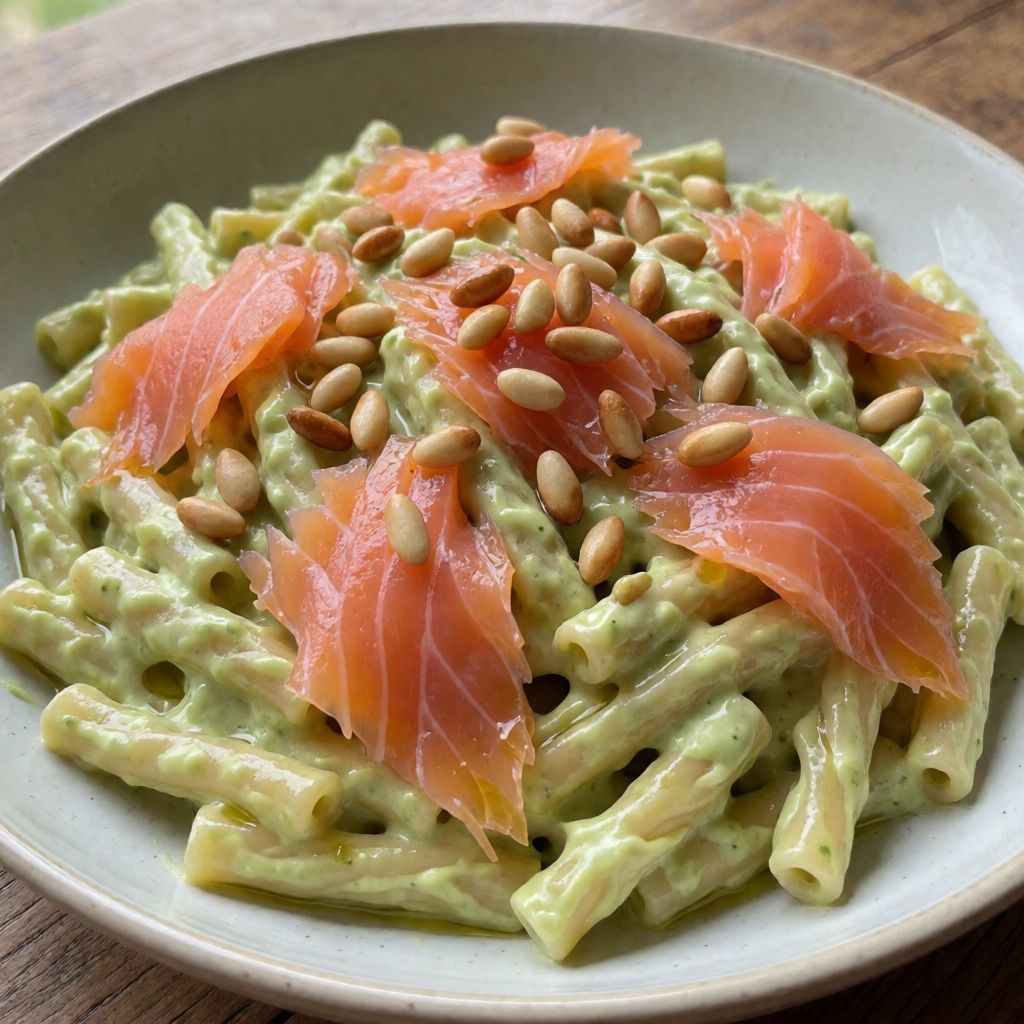
Pasta with Avocado Cream and Smoked Salmon
A creamy pasta with blended avocado, cream cheese and pine nuts, topped with smoked salmon.
Labels are worked out automatically from the ingredients and can be wrong. Check the packaging if it matters to you.
Ingredients
- 320 g Short pasta
- 2 pcs Avocado about 400g
- 20 g Pine nuts
- 100 g Cream cheese
- 100 g Smoked salmon
- Olive oil to taste
- Salt to taste
- Black pepper to taste







Steps
Bring a large pot of water to the boil. Peel the avocados and cut them into small pieces.
Transfer the avocado to a blender, add the cream cheese, pine nuts and a little olive oil.
Blend everything until smooth and creamy, adding a little water if needed. Season with pepper and mix.
When the water boils, add salt and the pasta. Cook for the time stated on the packet.
Drain the pasta, reserving a few ladlefuls of the cooking water.
Add the avocado cream to the pasta, pouring in a little cooking water for a creamier consistency.
Add the chopped smoked salmon, mix, plate up and serve.
This is not a sauce you cook — it is a sauce you build, cold, in a blender, while the pasta does all the work on the stove. Avocado and cream cheese are the base: fat and more fat, loosened at the very end by the pasta's own hot, starchy water. That water isn't a rinse-off, it's glue — it's what turns a thick paste clinging to the blade into something that coats each piece of pasta evenly.
What decides whether this works is heat, and the lack of it. Avocado fat is delicate — push it past warm into hot and the emulsion breaks, the cream turns grainy and bitter, and no amount of oil will fix it. So the cream never sees the hob at all; it's finished entirely by the borrowed heat of the drained pasta. Some say a pasta "sauce" has to simmer to earn the name — no, because here it's built cold and warmed only by what's folded into it.
The other thing that decides it is ripeness. An avocado that fights your knife, that squeaks rather than yields, blends into something grassy and thin, not creamy. You want flesh that gives gently under a thumb near the stem — not mush, just give. Speed matters too: avocado starts oxidising the second it's cut, so blend close to serving, not an hour ahead sitting virtuously on the counter going khaki at the edges.
Smoked salmon goes in last, off any heat whatsoever, chopped and folded through — not cooked, barely warmed, because its texture is the entire reason you reached for raw-cured fish instead of a pan-fried fillet.
Pasta: short shapes — penne, fusilli, something with a groove or a tube — because this cream is thick, not silky, and a flat ribbon would just let it slide off onto the plate. The tube or ridge holds it. Salt the water properly; the old line about it needing to "taste like the sea" is more memorable than useful, but the principle underneath is sound — pasta cooked in under-salted water never tastes seasoned afterward, whatever you do to the sauce. For 320g dry pasta, feeding four, use a proper pot of water, more than feels necessary on an ordinary flat's hob — too little and the starch concentrates, the pasta turns gluey and clumps before it even reaches the colander. Doneness is a bite, not a clock: the time on the box is your lower bound, start testing before it goes off, you want resistance, not crunch and not mush.
Avocado — 400g, two medium fruits — is the engine of the whole dish. Buy them a few days ahead if they're still hard and let them sit on the counter; a rock-hard avocado forced into service will never blend smooth, just watery and bitter. If you genuinely can't get a good one, don't force it — there's no honest substitute for what avocado fat does here, though in a pinch soaked cashews blended with a little extra oil will at least give you the creaminess, minus the flavour.
Cream cheese does two jobs: it thickens the blend so it isn't just pulped fruit, and its mild tang cuts the grassiness avocado can have. Any soft, full-fat, mild cheese works on the same principle — mascarpone, ricotta pressed through a sieve, even a soft goat's cheese if you want it sharper. The criterion is softness and mildness, not the name on the tub.
Pine nuts bring a faint resinous sweetness and a little body — and they're expensive for a reason: they're hand-harvested from pine cones that take years to mature, not a crop you can simply sow more of to meet demand. If the price puts you off, use any raw, mild nut that blends without leaving fibrous bits — blanched almonds, cashews. Walnuts work too but bring their own bitterness, so use less.
Olive oil here is "to taste" because its job is partly mechanical — it helps the blender turn solid fat into a pourable cream, and it leaves a bit of shine when it's done. Use any oil with no competing smell of its own if you want avocado to be the only thing you taste; olive oil is chosen mostly because it's already in the kitchen and sits comfortably alongside the rest.
Smoked salmon is doing a different kind of work — salt and smoke instead of heat. Cold-smoked salmon, the sliced kind you'd put on toast, stays silky and barely firms up; hot-smoked salmon is already cooked through and will flake instead, which changes the mouthfeel but not the principle. Either is fine, just know which one is in your hand. Because the salmon is already salted by its cure, go easy on salt elsewhere — season the cream mainly with pepper, and taste again before reaching for the salt cellar.
Patience, finally, is the ingredient nobody lists. Not patience with heat — there isn't much of that here — but patience with timing: have the sauce blended and a few ladlefuls of pasta water set aside before you drain, so you're not scrambling to loosen a seizing cream with a jet from the cold tap, which dilutes flavour instead of rescuing texture.