
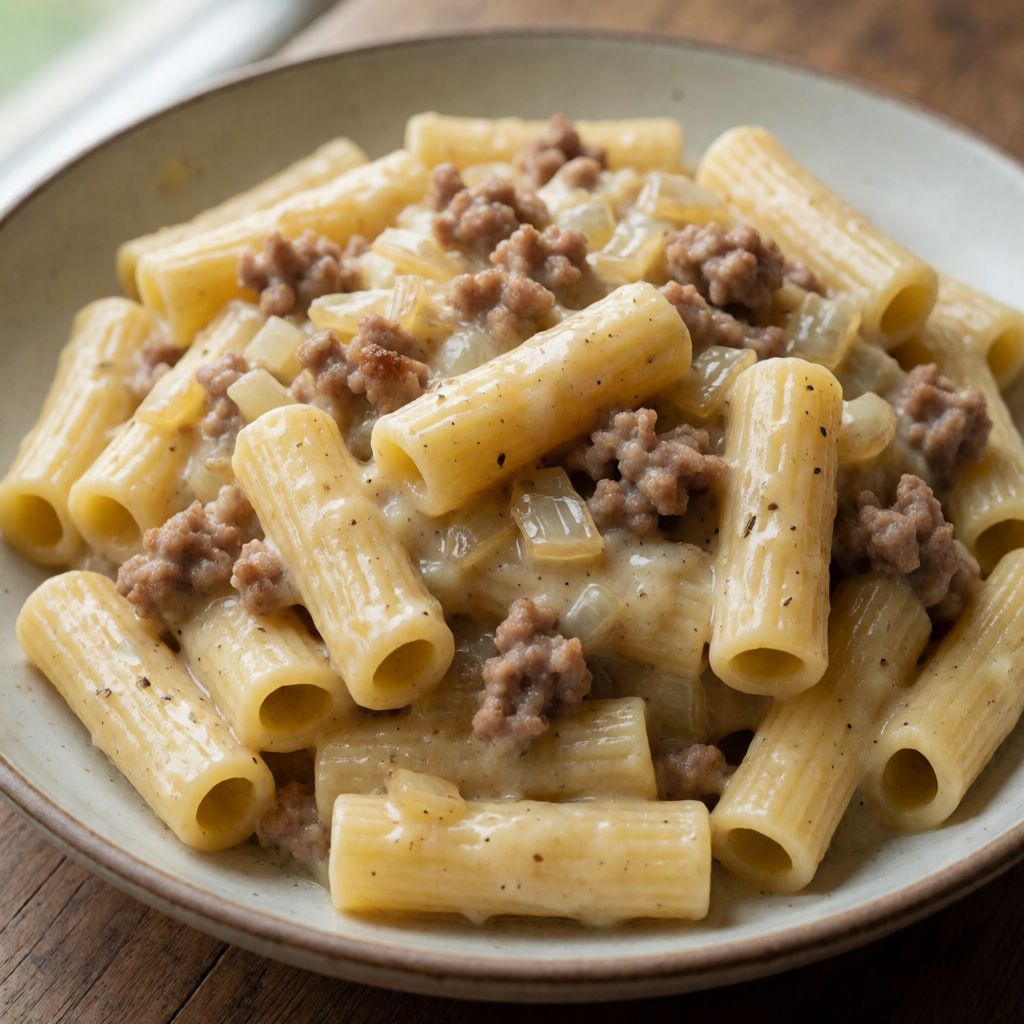
 AI photo
Pasta with Creamy Potato Sauce and Sausage
A comforting pasta where boiled potatoes are blended with Parmesan into a silky cream, tossed with sausage and tortiglioni.
Labels are worked out automatically from the ingredients and can be wrong. Check the packaging if it matters to you.
Ingredients
- 400 g Boiled potato cooked
- 100 g Parmesan
- 320 g Tortiglioni
- 200 g Italian sausage
- 0.5 pcs Onion
- Olive oil to taste
- Salt to taste
- Black pepper freshly ground, to taste
- Parsley chopped, to taste
- Water to taste










Steps
Bring a large pot of lightly salted water to the boil.
Peel the boiled potatoes and place them in a blender jug, then add the Parmesan.
Cook the tortiglioni, and a few minutes before they are done, scoop out a little of the boiling water and add it to the potato and cheese.
Blend until smooth and creamy, adding water as needed to reach the desired consistency.
In a wide pan, fry the chopped onion in olive oil until soft.
Add the crumbled Italian sausage and cook over high heat for a few minutes until browned.
Drain the tortiglioni al dente, transfer to the pan with the sausage and fry together for a few minutes.
Add the potato cream, mix well and if needed add some pasta water to loosen the sauce.
Garnish with freshly ground black pepper and chopped parsley, and serve immediately.
What was changed
Swapped in Tortiglioni, a ridged tube pasta, to match the shape called for in the original recipe.
This is a pasta sauce built on an unlikely idea: boiled potato, blitzed with Parmesan, standing in for cream. No cream, no butter, no flour — the sauce still comes out thick enough to coat tortiglioni, because potato starch does the job those three would normally do. That is the whole mechanism of the dish, and once you see it, the rest is just assembly.
What decides whether this works is the potato itself. It has to be boiled, cooled or warm but cooked through, and starchy — the kind that falls apart a little when you prod it, not the waxy salad type that holds its shape in a bowl. Waxy potato blends to a paste that stays gluey and thin; starchy potato blends to something that thickens as it sits, almost like a béchamel that nobody stood over a stove to make. That is the whole trick, and it is why this sauce costs almost nothing: potato is cheap, Parmesan does the savoury heavy lifting in small quantity, and you skip the dairy fat that classic creamy sauces lean on.
The sausage is there for fat and for bite, not for bulk. Crumbled and fried hard and fast, it browns rather than stews — that browning is where the flavour actually comes from, not from the meat itself. If you let it go soft and pale in the pan, you've steamed it, not fried it, and the sauce will taste of potato and not much else. Push it, let it catch a little colour, and only then does the sausage earn its place.
Start with the potato, because it is doing a job cream normally does, and it has to be chosen for that job, not for eating on its own. You want a floury, starchy variety — the kind sold for mash or baking, which falls apart under a fork. In the UK that's King Edward or Maris Piper, not a salad or new potato, which is waxy and holds together wet and slippery rather than breaking down soft. Boil it whole or peeled, let it cook right through — if a knife meets resistance in the middle, it isn't ready, and the blender will leave lumps no amount of water fixes afterwards. Some say any boiled potato will do for a sauce like this — no, because waxy potato lacks the starch that actually thickens the liquid; without that starch you've just made warm potato-flavoured water.
Parmesan here isn't a garnish, it's the savoury backbone standing in for the salt and umami that cream alone can't give you. Buy a wedge and grate it yourself if you can — the pre-grated bags often have anti-caking starch in them that changes how it melts, and a little cellulose does nobody's sauce any favours. If you're out of Parmesan, any hard, aged grating cheese with real salt and sharpness works — Grana Padano, a mature Pecorino if you want more bite, even a strong mature Cheddar in a pinch, though it will push the flavour away from Italian and towards something more "cheese on toast," which isn't a disaster, just a different dish.
Tortiglioni is chosen for its ridges and its tube — it's a pasta built to carry a sauce rather than let it slide off, which matters more here than with a thin, watery sauce, because this one is thick and needs somewhere to sit. Any short ridged tube pasta does the same job — penne rigate, rigatoni, even fusilli at a push. Smooth pasta like plain penne or spaghetti will work but you'll taste the difference: less sauce clings, more pools at the bottom of the bowl.
Italian sausage means one seasoned with fennel, garlic, sometimes chilli — not a British breakfast sausage, which is milder and padded with rusk. If that's what's in your fridge, it won't ruin anything, but add a pinch of fennel seed and a crack more black pepper to get back some of what you're missing. Crumble it by hand rather than slicing — you want ragged pieces that brown on several sides, not neat rounds that mostly steam.
The onion is background, not a feature — cooked gently in olive oil until it turns from sharp and white to soft and translucent, not browned. If it catches colour and goes dark before the sausage goes in, it'll taste bitter and fight the sweetness of the potato rather than supporting it. Olive oil here just needs to carry heat and a little flavour of its own; any neutral oil works if that's what you have, you'll only lose a background note most people wouldn't name if you didn't tell them.
Patience shows up twice and both times it's cheap. Once while the potato cools enough to handle and blend without turning your kitchen counter into a crime scene, and once at the pan, letting the sausage actually brown instead of rushing it in with the sauce straight away. Skip either and you'll taste the shortcut — a sauce that's merely warm rather than one that's been given the chance to come together.