
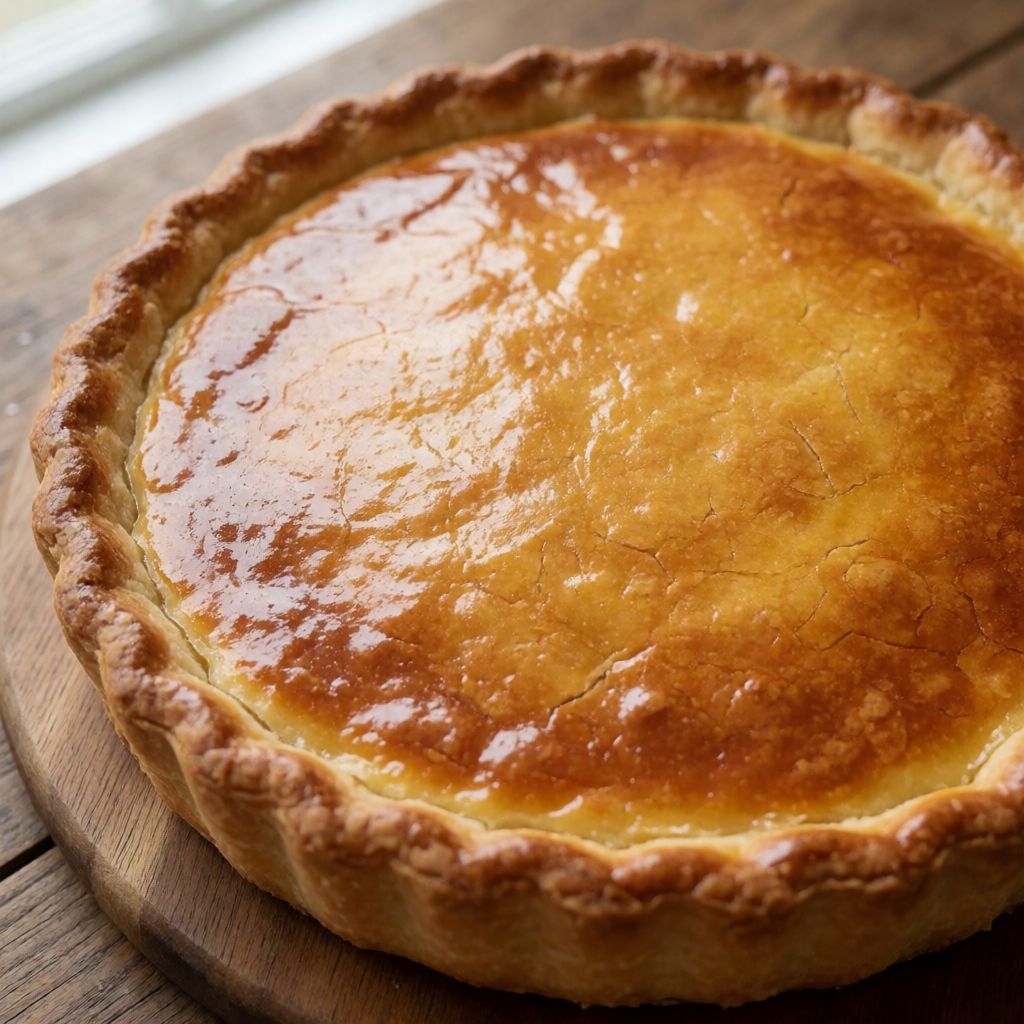
 AI photo
Savoury Pastiera
A savoury version of pastiera: a shortcrust tart filled with wheat berries, ricotta, cheese and eggs.
Labels are worked out automatically from the ingredients and can be wrong. Check the packaging if it matters to you.
Ingredients







Steps
Put the cooked wheat berries in a saucepan with the milk, salt and butter. Cook over low heat, stirring, until the milk is absorbed. Set aside.
Mix the flour with the butter and lard until it forms fine crumbs. Add the egg and yolk and knead. Shape into a ball and wrap in cling film.
Leave the dough to rest in the fridge.
30 minDice the halloumi and caciocavallo.
Mash the ricotta in a large bowl, add the eggs and the cooled wheat berries. Mix in salt and black pepper, then fold in the diced halloumi and caciocavallo.
Roll out the dough on a lightly floured surface. Line a shallow round tin, about 26-28 cm, with the dough and trim off the excess.
Spoon the ricotta and wheat filling into the centre, spreading it evenly.
Shape the remaining dough into 7 strips and lay them crosswise over the filling to form a lattice.
Bake the savoury pastiera at 170°C in the oven for at least 70-80 minutes, making sure the centre is cooked through and reaches around 70 degrees.
80 minRemove from the oven and let it cool in the tin before taking the pastiera out.
This is a savoury twin of the Neapolitan Easter pastiera — same idea, grain and dairy baked inside a shortcrust lattice, but with cheese and pepper standing where sugar and candied peel usually sit. Don't let anyone tell you pastiera has to be sweet. The sweet version is the famous one, the one that got a legend attached to it (mermaids, convents, take your pick), but the structure — cooked grain bound with dairy, cased in a short egg-pastry, topped with woven strips — is older than the sugar. It's simply a vessel. Put cream and candied fruit in it and it's dessert. Put ricotta, hard cheese and black pepper in it and it's a main course for the Easter table, built the same logic: use what's abundant after Lent — fresh eggs, new ricotta, cheese from the dairy that's just started moving again.
What decides whether this works isn't the list of ingredients, it's three small checks along the way.
First: does the grain actually drink the milk, or does it just sit in it while the milk reduces and catches at the bottom? That's why it's cooked low and slow and stirred — not to cook the wheat (it's already cooked), but to let the starch on its surface swell and pull the milk in gradually. Rush the heat and you get a scorched film under half-dry berries — the fix isn't more milk, it's less heat.
The two cheeses inside are doing different jobs, and that's the point of using two. Halloumi is a brined, high-acid curd that's deliberately made not to melt — it keeps its dice shape and gives you a salty, slightly squeaky bite scattered through the filling. Caciocavallo is a stretched-curd cheese, closer kin to provolone or scamorza, and it does the opposite: it softens and half-melts, pulling the filling together between the halloumi cubes. Lose one of the two and you lose the contrast — all-melting cheese gives you a flat, uniform paste; all-firm cheese gives you something gritty with no glue. If you can't get halloumi, look for any firm, salty, brined cheese that holds a cube shape under heat — a Greek-style kefalotyri works. If caciocavallo isn't on the shelf, any semi-hard cheese that stretches when warm — young provolone, scamorza — does the same job.
Ricotta is the binder, not a flavour in its own right — it carries the eggs and the two hard cheeses without fighting them, which is exactly why you mash it smooth before adding anything else. Lumpy ricotta means lumpy filling, no amount of baking fixes that afterwards. Buy the drained, firm kind sold for baking, not the very wet tub kind meant for spreading on toast — if that's all you have, tip it into a sieve over a bowl for an hour first, or your filling will never set at the temperature this recipe aims for.
The grain — cooked wheat berries — is there for texture, a soft, slightly chewy bead running through the cheese, something to bite against. It's sold ready-cooked in jars in Italian delis precisely because cooking raw wheat berries soft takes most of a day, and nobody making an Easter pie wants to start that far in advance. If you genuinely can't find it, cooked pearled spelt or pot barley, drained well, gives you the same bite — it isn't traditional, but the mechanism it's serving (a cooked grain that holds its shape and takes up dairy) is the same either way.
The pastry is a standard pasta frolla, built on the same principle as any British shortcrust: fat coats the flour before water gets near it, so gluten can't form a strong net, and the result shatters instead of chews. The reason for two fats, butter and lard, is mostly about what each one does at room temperature rather than flavour. Lard stays firmer for longer once you're rolling and shaping — useful here because you're cutting thin strips for a lattice and laying them across a filled tart, and a dough that's gone soft and buttery will just droop and tear. Butter brings flavour that lard doesn't have. If lard isn't something you keep in, you can go all-butter — you'll lose a little of that structural stiffness, so handle the strips fast and cold, straight from a short stint back in the fridge if they start to go limp.
One egg plus one extra yolk in the dough is just enough liquid to bring the crumbs together without soaking the flour — too much egg and you're back to building gluten, the thing the fat was there to stop. And don't throw away your trimmings: they become the lattice. It's not thrift for its own sake, it's just that there's no reason to roll a second batch of dough when the first one has leftovers exactly the right size.
For an 8-person pie in a shallow 26–28 cm tin, this is a proper weekend bake, not a weeknight one — the dough needs its fridge time, the grain needs its slow milk, and the finished pie needs to cool fully in the tin before you try to lift it, because the filling is still firming as it drops in temperature, the same way a cheesecake is. Cut it warm and it slumps; let it sit and it holds a clean slice. That cooling time isn't dead time, it's the last ingredient doing its work.