
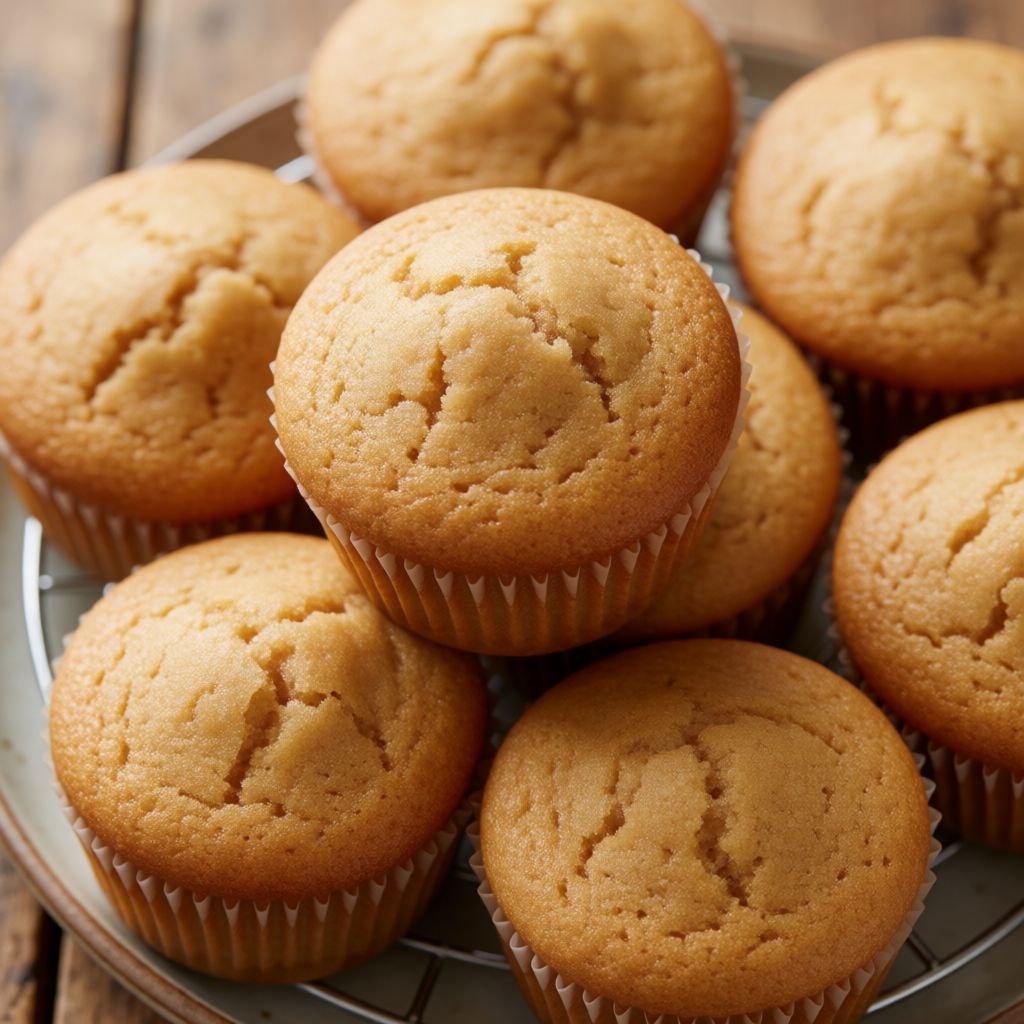
 AI photo
Peanut Butter Cupcakes
Soft vanilla cupcakes piped with a rich peanut butter buttercream, served on a tray with a cup of tea.
Labels are worked out automatically from the ingredients and can be wrong. Check the packaging if it matters to you.
Ingredients
- 120 g Plain flour
- 120 g Butter room temperature
- 2 pcs Eggs
- 120 g Caster sugar
- 1 tsp Vanilla extract
- 2.5 tbsp Baking powder
- 1 pinch Salt
- Milk as needed
- 250 g Peanut butter room temperature
- 200 g Icing sugar
- 200 g Butter room temperature










Steps
Beat the sugar and the room-temperature butter with an electric mixer until smooth and creamy.
Add the eggs one at a time, along with a pinch of salt and the vanilla extract, continuing to beat with the mixer until smooth.
Add the flour and baking powder and mix with a wooden spoon until the batter is smooth; add milk if needed.
Spoon the batter into cupcake cases, filling each no more than halfway.
Preheat the oven to 180°C and bake the cupcakes on the fan setting.
25 minBeat the butter and the room-temperature peanut butter with an electric mixer, then add the icing sugar and beat until thick.
Once the cupcakes have cooled, pipe the buttercream on top using a piping bag.
Serve the cupcakes on a tray with a cup of tea.
What was changed
Vanillin has been replaced with Vanilla extract, the standard vanilla flavouring found in local kitchens.
A cupcake is a small, selfish cake — it exists so you don't have to slice and share. What decides whether it works is two separate jobs: a crumb that's light but not dry, and a topping that holds a peak without weeping butter all over the plate. Get the crumb wrong and no amount of peanut butter frosting saves it; get the frosting wrong and you've just made a passable sponge with a puddle on top.
2.5 tablespoons of baking powder for 120g of flour is a lot — roughly four times what most sponge recipes use. That's not a typo you should quietly correct. It's doing the lifting that a kazan-style steady oven does for a bread dough: in a small domestic oven with uneven heat, you want insurance. The trade-off is a faint bitter, metallic edge if you overdo it further, so measure the tablespoon level, not heaped.
Some say you fill cupcake cases to the top for a "fuller" result — no, because the batter needs somewhere to go. Baking powder produces gas, gas needs room to expand upward without spilling over the case walls and welding itself to the tray. Halfway full gives you a proper dome; three-quarters full gives you a muffin top stuck to its neighbour and a case that's turned into a wick, with batter crawling down the outside.
The peanut butter buttercream is just a buttercream with a second fat added — butter alone, whipped, traps air; peanut butter brings its own oil and protein, which is why you beat it before the icing sugar goes in, not after. Add the sugar too early and you're trying to aerate something already stiff with starch — it'll look grainy and never truly fluff.
Butter and sugar beaten first — not melted, not just stirred — because the point is air, not just fat coating the flour. Creaming works mechanically: sugar crystals are sharp-edged, and as the mixer drags them through soft butter they cut thousands of tiny air pockets into it. Those pockets are what the baking powder's gas inflates later. Skip this stage, or use cold butter that won't yield to the sugar, and you get a dense, close cupcake no matter how much rising agent you throw in — the defect isn't "needs more baking powder," it's "nothing to inflate." Room-temperature butter means it gives under a thumb without being greasy; if your kitchen's cold, a few minutes cut into cubes on the worktop does more than any microwave shortcut, which just melts the edges and ruins the structure you're trying to build.
Eggs go in one at a time for the same mechanical reason, not tradition for its own sake. Butter and egg are an emulsion — fat and water-based liquid refusing to mix smoothly in one go. Add both eggs at once to a butter-sugar base and you risk it splitting, looking curdled, little flecks of butter floating in liquid egg. One at a time, beaten in fully before the next, keeps the emulsion holding. If it does split anyway — too-cold eggs are usually why — a spoonful of the flour you're about to add brings it back together; that's not failure, that's the fix.
Flour and baking powder are mixed with a wooden spoon, not the electric mixer, and this matters more than it looks. Flour develops gluten with agitation, and gluten is for bread, not cake — too much of it in a cupcake gives you something chewy and tough instead of tender. The wooden spoon is a deliberate downgrade in power: stir until just combined, stop the second you don't see dry streaks. Milk "as needed" is there to loosen a batter that's gone stiff — plain flour varies batch to batch in how much liquid it drinks, so there's no fixed number of tablespoons, only a texture: it should fall off the spoon in a slow ribbon, not plop in a lump.
Fan setting at 180°C is specified because fan ovens move hot air directly past the cakes rather than relying on radiant heat alone, which cooks faster and more evenly across a whole tray — useful in a British kitchen where the oven is also doing Sunday roast duty and you want to trust it without opening the door every five minutes to check. The 25 minutes is the floor, not the answer. The real test is the cupcake springing back when you press it lightly, or a skewer coming out clean — rely on the clock alone and you'll catch some cupcakes raw in the middle on a day your oven runs cool, overbaked and dry on a day it runs hot.
Peanut butter at room temperature, same logic as the butter above — cold, straight from the fridge, it won't blend into butter smoothly, it'll sit in cold lumps that the mixer just pushes around rather than incorporates. Use a smooth, not crunchy, peanut butter unless you want texture in the frosting, and ideally one without added sugar swinging the sweetness further — you've already got 200g of icing sugar doing that job. If peanut butter isn't to hand or someone's allergic, any thick nut or seed butter of similar oil content substitutes on the same principle: enough natural oil to loosen the whipped butter, enough body to still hold a peak once the icing sugar stiffens it. Icing sugar itself is chosen over caster sugar here because it's fine enough to dissolve into fat without any grit — caster sugar in a buttercream, not baked, stays crunchy on the tongue.
Piping the buttercream rather than spreading it with a knife isn't showing off — a piping bag controls how much goes on and keeps the dome shape of the cake instead of squashing it flat under a palette knife. If you don't own one, a sandwich bag with a corner snipped off does the same job; it's a bag with a hole, not a specialist tool, and no cupcake has ever asked where its frosting came from.