
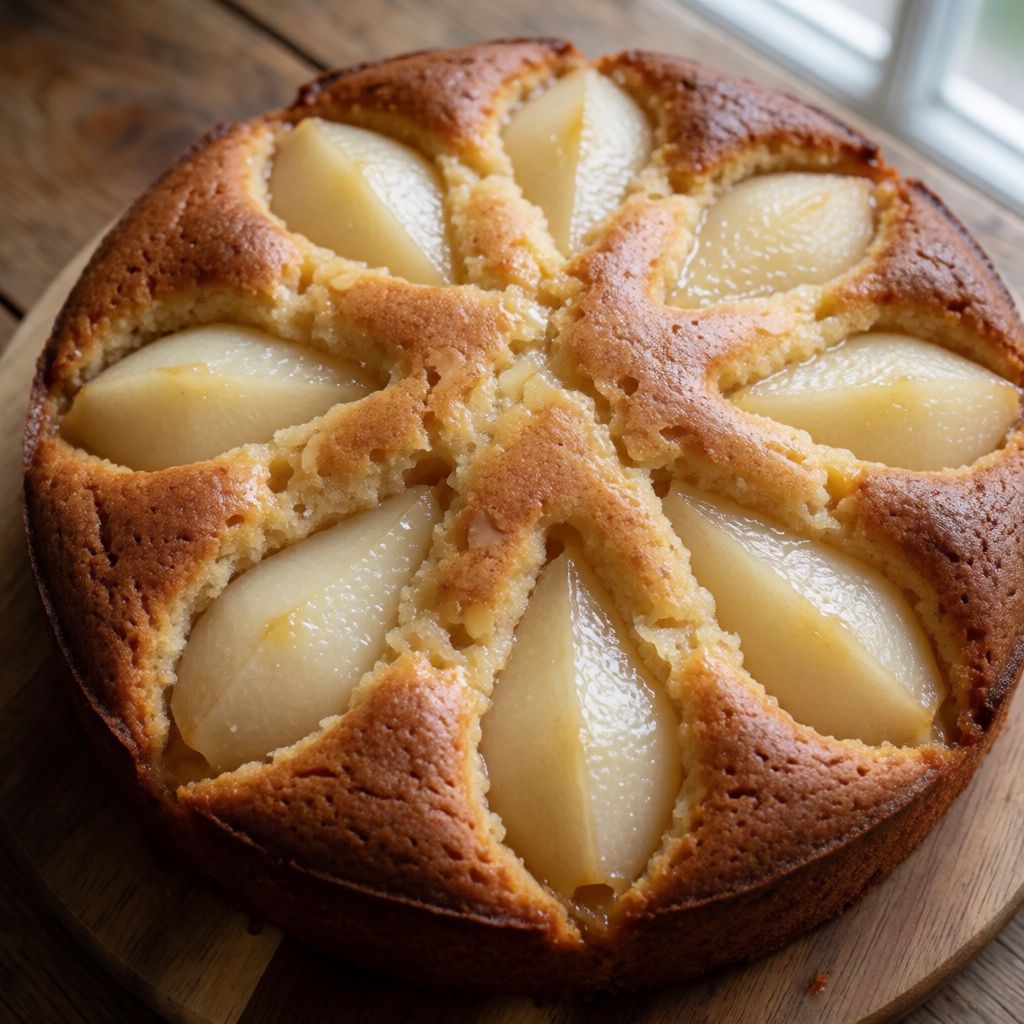
 AI photo
Pear and Marzipan Cake
A rich pear and marzipan cake with a chocolate-studded sponge, perfect for an English tea table.
Labels are worked out automatically from the ingredients and can be wrong. Check the packaging if it matters to you.
Ingredients
- 200 g Marzipan coarsely grated
- 200 g Butter softened to room temperature
- 175 g Caster Sugar
- 4 pcs Eggs
- 200 g Plain Flour
- 2 tsp Baking Powder
- 1 pinch Salt
- 50 g Dark Chocolate roughly chopped
- 150 g Pear sliced
- 25 g Sugar for sprinkling on top
- 30 g Icing Sugar for dusting on top









Steps
Beat the marzipan, cubed butter and sugar together until light and smooth.
Then beat in the eggs one at a time.
Mix the flour, baking powder and salt, then sift this mixture into the batter along with the chopped chocolate.
Spoon the batter into a greased 20cm springform tin lined with baking parchment on the base.
Arrange the pear slices over the surface, pressing them gently into the batter.
Sprinkle with sugar and bake the cake in a preheated fan oven at 180°C for 50–60 minutes, or until cooked through.
55 min
What was changed
The oven temperature was rounded to the nearest 10°C step used for UK ovens .
What you've got here isn't a light British sponge — it's closer to a continental almond cake that's had pear and chocolate billeted on it. Marzipan is doing real structural work: it's ground almonds and sugar already bound into a paste, so beating it into the butter gives you the density and keeping-moist quality a flour-only sponge can't manage. That's the whole point of this cake — it won't dry out by Tuesday the way a Victoria sponge will, because the almond paste holds water the way flour never does.
What decides whether it works is whether the marzipan actually disappears into the butter, and whether the pear crust sets on top before the pear's water pools underneath it and goes soggy. Those are the two failure points, and everything else in the method is defending against one or the other.
Some say marzipan is only for Christmas cake icing or little almond fruit decorations — no, because here it's not decoration, it's the fat-and-flavour backbone, doing the job that ground almonds plus extra sugar would do in a classic frangipane. Grating it coarsely before you beat it isn't fussiness — a cube of marzipan dropped straight into softened butter will survive the whole bake as a rubbery lump, because marzipan doesn't melt the way sugar crystals do, it just softens. Grate it and you give it surface area; skip that and you get little gummy nuggets through the finished crumb, which is the defect people blame on "bad marzipan" when really it's a knife-and-grater problem.
Marzipan itself is almond paste stiffened with sugar, sometimes a little glucose syrup to keep it pliable — that's a 20th-century commercial habit, not tradition for tradition's sake, it's what stops it drying into a brick on a supermarket shelf. If you can't get marzipan, the criterion is a dense, moist almond-and-sugar paste you can actually grate — homemade almond paste (ground almonds, icing sugar, a little egg white worked together) does the same job. Don't reach for almond extract instead; that gives you the smell of almonds with none of the substance, and this cake needs the substance — the moisture and the density, not just the flavour.
Butter has to be properly soft, not just left out on the side for ten minutes looking hopeful. Cold butter won't take in air when you beat it with the marzipan and sugar, so the whole foundation of the cake's lift is lost before the eggs even go in — and if the butter's too cold, the eggs that follow won't emulsify into it either, they'll sit on top and the batter will look curdled and grainy. That curdling isn't the egg's fault, it's a temperature mismatch, and it's fixed by patience at the start, not panic halfway through. Any solid, creamable fat with a clean taste will do if you're out of butter — a baking margarine works, you just lose the flavour butter brings for free.
Caster sugar rather than granulated is about grain size, nothing more romantic than that — the finer crystals dissolve into the butter and marzipan as you beat, instead of sitting there gritty, which matters more here because marzipan is already dense and doesn't want to be fought with undissolved sugar on top of it. The eggs go in one at a time for the same reason the butter needs to be soft: too much liquid added at once to a fat-based mixture and it splits, the fat can't hold it in suspension, and you end up baking a cake that was already fighting itself before it saw the oven.
The chocolate is chopped roughly, not melted and not grated fine, because the whole point is pockets — bites where you hit a soft collapsed piece of chocolate against the almond crumb, rather than a uniform mocha flavour running through everything. Choose a dark chocolate you'd happily eat off the bar; cheap compound chocolate bulked out with vegetable fat instead of proper cocoa butter won't melt the same way in the oven, it stays slightly waxy and sits apart from the crumb instead of softening into it.
Pear needs to be firm, not falling-over ripe — a ripe, soft pear collapses into the batter and gives you a soggy ring under the slices instead of a crust; something like a Conference a day or two before its best is better behaved here. No pear, use a firm apple on the same logic — flesh that holds its shape under its own weight is the criterion, not the specific fruit. The sugar sprinkled on top before baking isn't decoration either — it's there to caramelise with the pear's released juice and form a thin, slightly crisp skin that keeps the moisture problem contained. The icing sugar at the end is the one purely cosmetic ingredient in the list, and it only goes on once the cake's properly cool — dust it onto a warm cake and it just melts into the surface and vanishes, which is a small, avoidable disappointment.
A springform tin and parchment on the base matter more than they look like they should, because this is a dense, damp-centred cake with fruit sitting right on top of it — a solid tin without the loose base means you're trying to tip out something heavy and fragile at once, and that's how the pear topping ends up on the worktop instead of the cake. Let it sit in the tin a good while once it's out of the oven before you even think about slicing — cutting into it warm, before the crumb has set properly around all that marzipan moisture, gets you something gummy at the knife rather than cleanly sliced. That wait is not wasted time, it's the cake finishing a job the oven started.