
 AI photo
Pearl Barley Tortino with Vegetable Tartare and Aromatic Oil
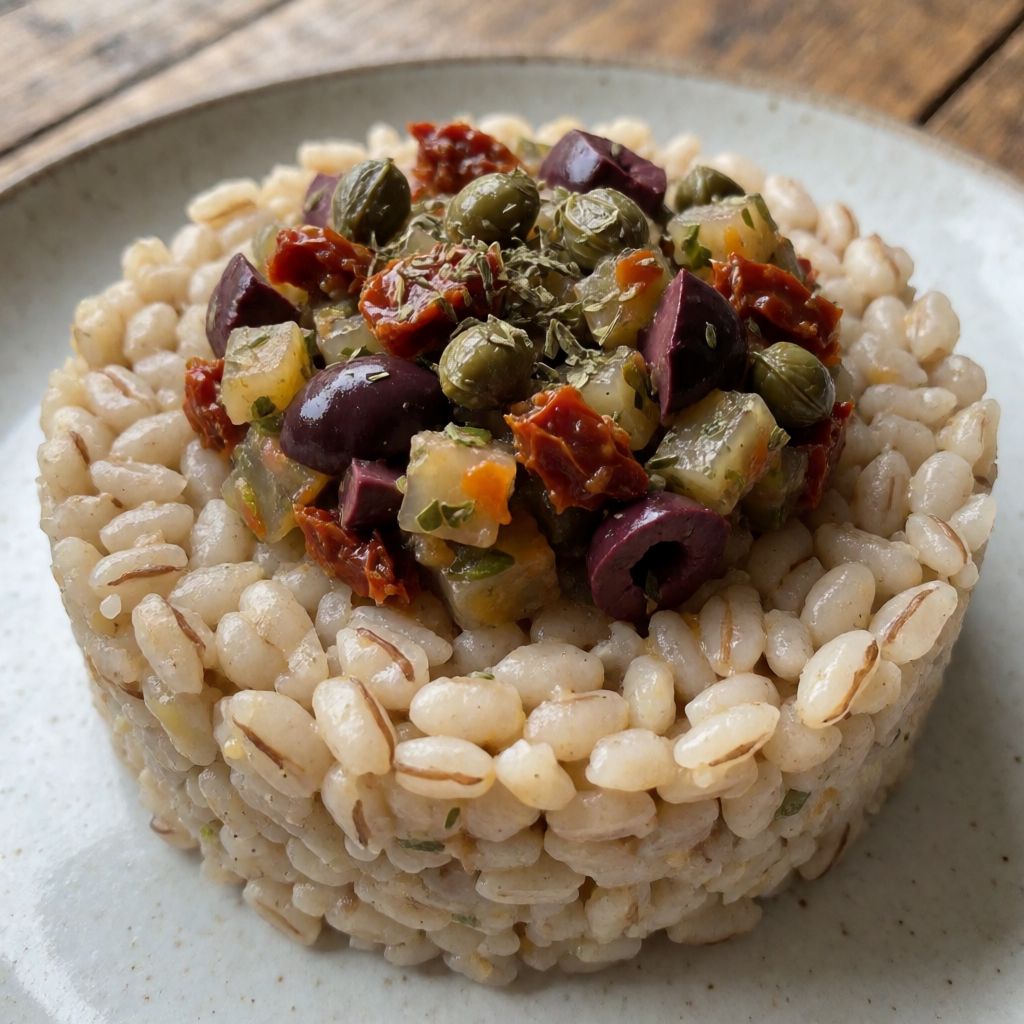
A barley 'tortino' topped with a finely diced vegetable tartare and a herb-infused oil, finished with orange zest and mint.
Labels are worked out automatically from the ingredients and can be wrong. Check the packaging if it matters to you.
Ingredients
- 80 g Pearl barley
- Taggiasca olives
- 2 pcs Sun-dried tomatoes
- Capers
- Aromatic herbs thyme, bay leaf, mint, rosemary, marjoram
- Salt
- Black pepper
- Orange zest
- 1 pcs Shallot
- 1 pcs Carrot half
- 1 pcs Courgette half, preferably the green part
- Olive oil







Steps
Cover the aromatic herbs and a piece of shallot with olive oil and let infuse over a low heat.
Cook the pearl barley in plenty of unsalted water.
30 minFinely chop a few pitted Taggiasca olives, a few capers and the sun-dried tomatoes for the brunoise.
Finely dice half a carrot and half a courgette.
Season the brunoise with salt, black pepper and grated orange zest.
Salt the barley, mix well and drain.
Add a small part of the vegetable mix to the barley along with one tablespoon of the aromatic oil.
Using a cooking ring, press the barley base down firmly with a spoon.
Arrange the vegetable tartare on top.
Garnish with orange zest and mint leaves, drizzle with the aromatic oil and remove the ring.
A tortino is just Italian for "little cake" — nothing baked about it here. It's a disc of pearl barley pressed in a ring mould, topped with a raw vegetable tartare, finished with an oil that's been quietly flavouring itself on the hob while you do everything else. What decides whether this works is not the barley cooking — that's the easy, forgiving part — but two things: how dry the barley is when you press it, and how fine the brunoise is cut.
Pearl barley doesn't hold a shape because it's sticky like risotto rice. It holds because the grains, swollen and slightly broken at the edges after a long simmer, lock together under pressure the way gravel compacts under a boot. If you drain it wet and press it straight away, the water pools at the base of the ring and the whole thing slumps the second you lift the mould. So: salt it, mix it, drain it properly — not a token tip into the sieve, but drained and left a moment, because that waiting is as much a step as the stirring.
The vegetable tartare is called that for a reason, and it's the reason that tells you what to do. Tartare means raw, cut small, dressed — not cooked down. Carrot and courgette here stay crunchy and bright; they're brunoise, not a cooked side dish, and the knife work matters more than any heat. Cut them coarsely and you get a vegetable salad sitting on barley. Cut them fine — true small-dice, matchstick-then-across — and you get something that behaves like a dressing with texture, clinging to the olives and capers and sun-dried tomato instead of falling off the top.
The aromatic oil is the one thing you start first and should treat like background music — it needs low heat and time, not attention. Olive oil carries fat-soluble aromatics far better than water does, which is why herbs sitting in warm (not hot) oil for the length of time the barley takes to cook will give you something genuinely infused, not just oil with leaves floating in it. Keep the heat low enough that the oil never shimmers or smokes — if it's hissing or colouring, you're frying the herbs, which kills their aroma instead of releasing it. On a UK hob, this is your lowest ring, full stop, and a small saucepan rather than a wide pan, so the herbs stay submerged.
Pearl barley itself needs no salt while it cooks — that's not a quirk, it's because barley, like most whole grains, takes up salted water unevenly and can toughen the outer layer before the inside's done, giving you a grain that's chalky in the middle and leathery outside. Salt goes in after, once it's cooked and still warm, when it seasons the surface you're about to compress rather than fighting the cooking itself. Thirty minutes is the floor, not the target: the real cue is a grain that's lost its hard, glassy centre and gone soft enough to bite without resistance, with a slight give rather than a crunch. Taste one.
Taggiasca olives are small, oil-cured, mild and faintly sweet rather than aggressively brined — that softness is the point, since you want flavour, not a salt bomb competing with the capers. If you can't get them, use any small black olive that's been cured in oil rather than brine, and go easier on the quantity, because brine-cured olives (like a standard supermarket Kalamata) are sharper and will throw the seasoning off balance. Capers do the opposite job — they're there purely for that vinegary, briny snap against the sweetness of the orange zest, so don't rinse all the brine off them or you've removed their reason for being there.
Sun-dried tomatoes bring concentrated sweetness and a chewy contrast to the raw crunch of carrot and courgette — if yours are the very dry, leathery kind rather than oil-packed, soften them a few minutes in warm water first, or they'll sit in the brunoise like little pebbles instead of folding in.
Courgette: the brief says "the green part" for a reason that's about colour and texture, not snobbery. The skin and the layer just under it hold their shape and colour raw; the pale, seedy core is wetter and goes limp and translucent once salted, which can turn your crisp tartare soggy on the plate within minutes. If you're dicing a whole courgette, use the outer flesh for this dish and keep the watery core for something that's getting cooked anyway.
Shallot goes into the oil, not the tartare, deliberately — it's there to perfume the fat with a background sweetness that a raw chunk of shallot in the tartare would deliver as a sharp onion bite instead. If you've only got a regular onion, a small piece will do the same infusing job; it just won't be quite as sweet, so taste the finished oil and decide if it needs a touch more.
The cooking ring is standing in for what, in a restaurant kitchen, might be a small plating mould — at home, an empty food tin with both ends cut off, or a wide pastry cutter, does exactly the same job. Press with the back of a spoon, firmly and evenly across the whole surface, because an uneven press is the single most common reason these things collapse sideways the moment the ring comes off — one side thick and holding, one side thin and crumbling. Lift the ring straight up, slowly, rather than sideways; patience here is the difference between a tidy disc and a shapeless hill of barley that tastes exactly the same but looks like a mistake.