
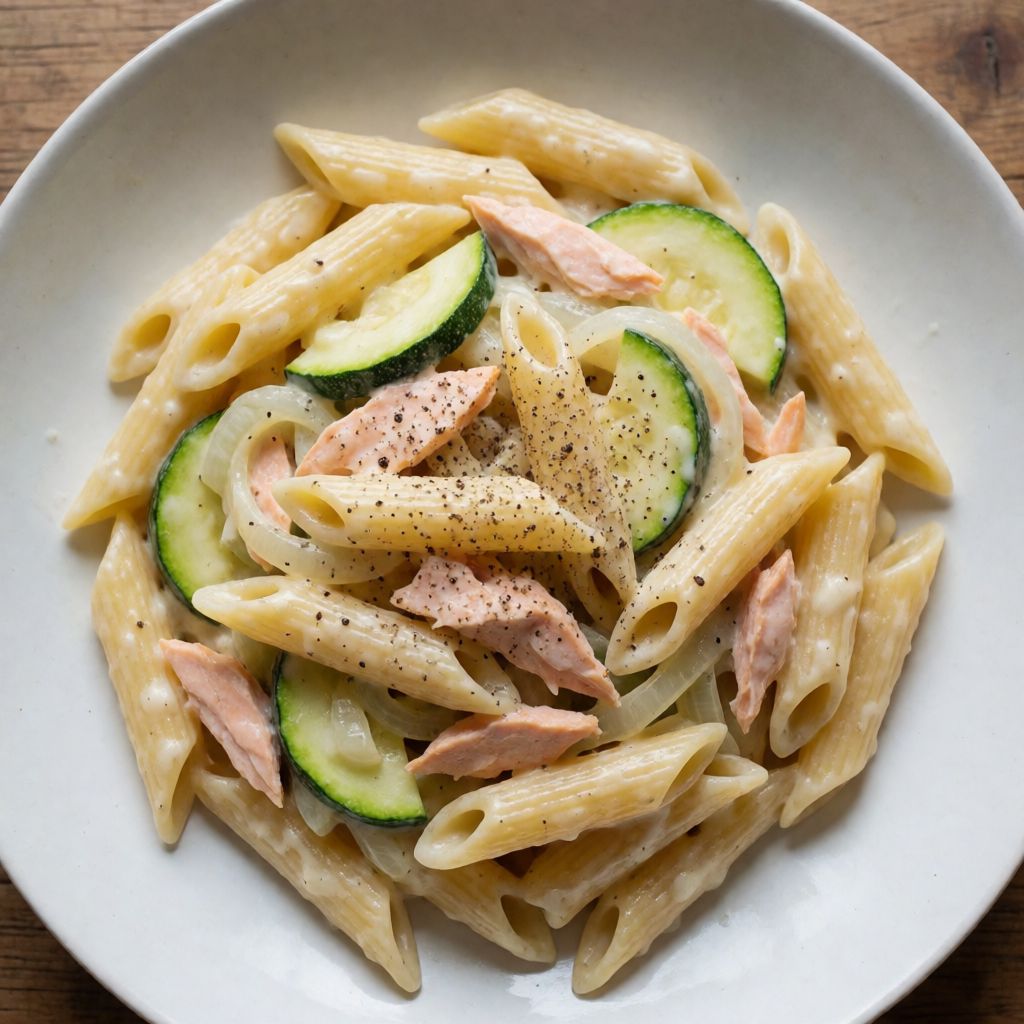
 AI photo
Penne Carbonara with Salmon and Courgette
Creamy penne carbonara made with smoked salmon, courgette and egg yolks instead of the classic bacon.
Labels are worked out automatically from the ingredients and can be wrong. Check the packaging if it matters to you.
Ingredients
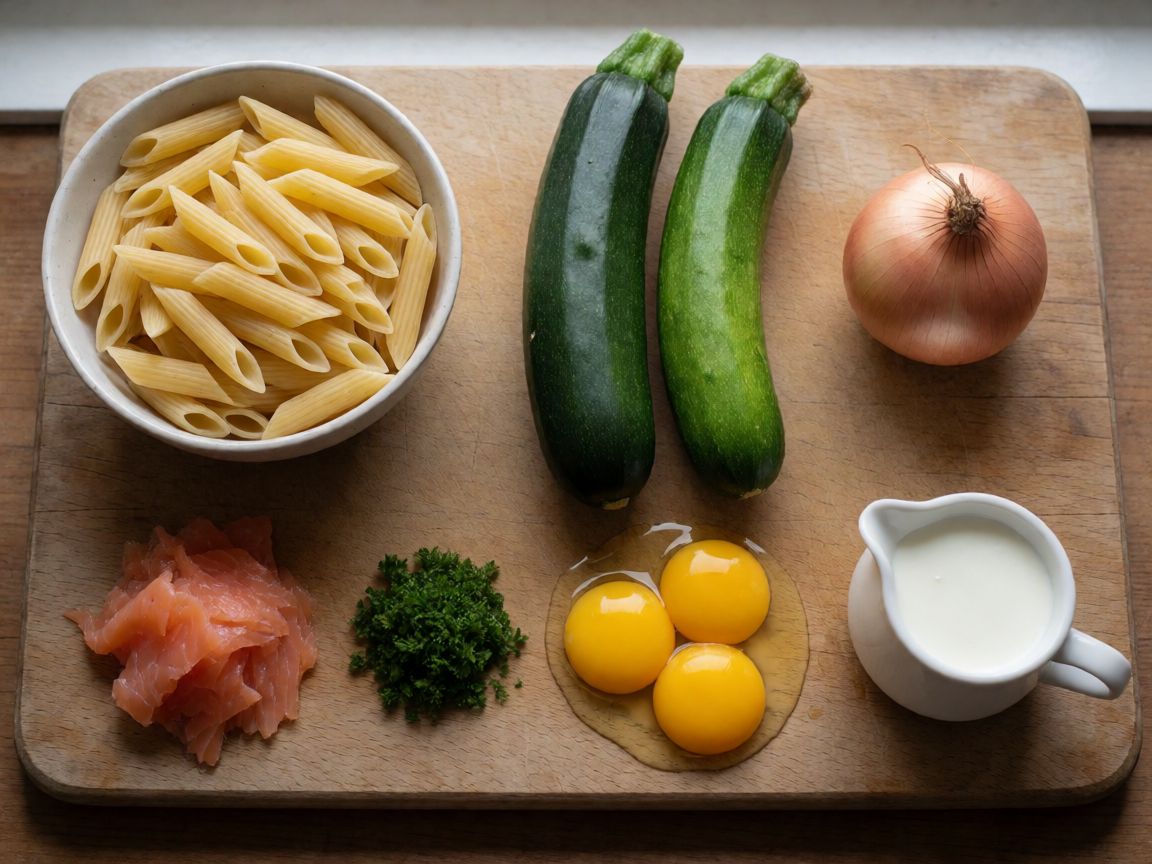
- 400 g Penne
- 2 pcs Courgette
- 1 pcs Onion
- Olive oil to taste
- Salt to taste
- Black pepper to taste
- Parsley to taste
- 200 g Smoked salmon
- 3 pcs Egg yolk
- 2 tbsp Double cream










Steps
In a frying pan, heat 2 tbsp of olive oil and sauté the onion.
Add the courgette and a little warm water, cover with a lid and simmer gently.
10 minMeanwhile, cook the penne until al dente.
In a bowl, whisk the egg yolks with the cream, then add black pepper and parsley.
Drain the pasta and tip the penne into the pan with the salmon and the egg mixture.
Mix thoroughly and serve, sprinkled with parsley.
Carbonara — whatever you put in it — is not a sauce you cook, it's a sauce you set. The yolk thickens from the heat already sitting in the pasta and the pan, nothing more. Too hot, and the proteins clump into little flecks of scrambled egg scattered through your penne. Too cool, and you've made a bowl of pasta dressed in raw egg that slides off instead of clinging. Every choice in this version — the courgette, the salmon standing in for pork, the spoon of cream — sits downstream of that one narrow window of heat.
Some will tell you this isn't carbonara at all, because there's no guanciale, no pecorino, no pork fat rendered down first. No — because carbonara isn't defined by its cast, it's defined by its mechanism: hot starch, raw yolk, residual warmth, done. The Roman version used what a shepherd or a charcoal-burner had in his bag — cured pork cheek, hard sheep cheese. You've got smoked salmon and a tub of double cream from the corner shop. Same physics, different larder.
The courgette is doing a quieter job. It's nearly all water, so simmering it under a lid — or here, a plate, since not every pan in a British flat comes with its own fitted lid — is really steaming it in its own juice plus a splash more. You're not browning it, you're softening the cell walls until a slice bends instead of snapping. Skip that gentle covered sweat and fry it hard instead, and you get crunchy green batons fighting a silky sauce, which is the wrong fight to pick.
Penne isn't sacred here — any short pasta with a hollow or a ridge works, because the sauce needs somewhere to sit rather than just slide off a flat strand. Fusilli, rigatoni, whatever's in the cupboard, as long as it holds.
Courgette: pick ones that feel heavy and firm, no soft give at the ends — that softness is water already breaking down the vegetable before you've even started, which just means it'll collapse to mush faster than you want. If you've none, swap for something else that's mostly water and mild, not sharp — leek, or peas thrown in at the last minute — the job is sweetness and moisture, not crunch.
Onion goes in first and wants to turn soft and translucent, not browned. Browning builds a deep, sweet-bitter edge that's lovely in a roast gravy but wrong here — this dish is delicate, built on cream and smoke, and a caramelised onion would shout over it.
Smoked salmon is already cooked by curing and smoke, not by your pan. It only needs folding through at the end to warm — give it real heat for any length of time and the fat renders out, the flesh turns rubbery and dry, and you lose exactly the silkiness you added it for. If you can't get it, smoked trout behaves the same way; if you want to go back to something closer to the Roman original, diced bacon fried properly does the fat-and-salt job instead, but then you've changed dishes, not just ingredients.
The yolks are the whole engine of the sauce, so let them come to room temperature before they meet the hot pasta if you can — a cold yolk straight from the fridge meets hot starch and seizes unevenly, giving you patches of set egg next to patches still raw. The cream is there as a buffer: fat raises the point at which the yolk proteins clump, which is exactly why cream turns up in British and American versions of carbonara so often — it's not tradition, it's insurance for a cook who isn't yet confident reading the pan by eye. Any cream with real fat in it does the job — crème fraîche works, even a knob of butter stirred through does something similar in a pinch, though with less margin for error.
The olive oil at the start is just there to carry the onion and courgette through their first few minutes without catching — it isn't flavouring the final dish in any noticeable way, so any oil with no strong smell of its own will do the same work. Salt carefully and late: the salmon is already salted by its curing, the pasta water should be salted too, and if you season at every stage without tasting as you go, you'll find the whole bowl over the edge before the parsley even goes on. Add the parsley at the very end, off the heat — it's there for colour and a clean, grassy lift against all that richness, and it fades to nothing if it sits in a hot pan too long. Three yolks and two tablespoons of cream for four people is a light hand with the sauce, which is forgiving — there's enough slack in the quantities that a slightly uneven set here or there won't ruin your dinner.