
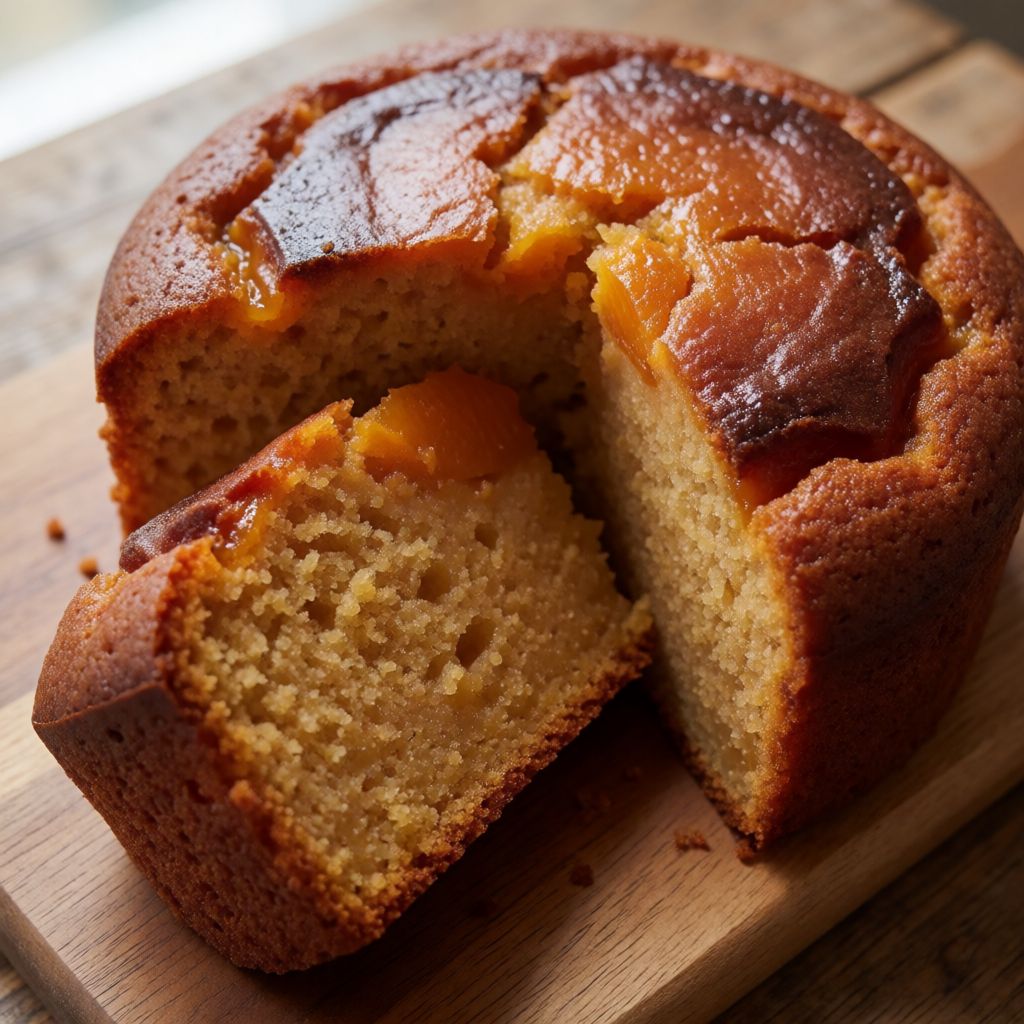
 AI photo
Persimmon Cake
A soft persimmon cake with ground almonds, flavoured with orange zest and baked until golden.
Labels are worked out automatically from the ingredients and can be wrong. Check the packaging if it matters to you.
Ingredients
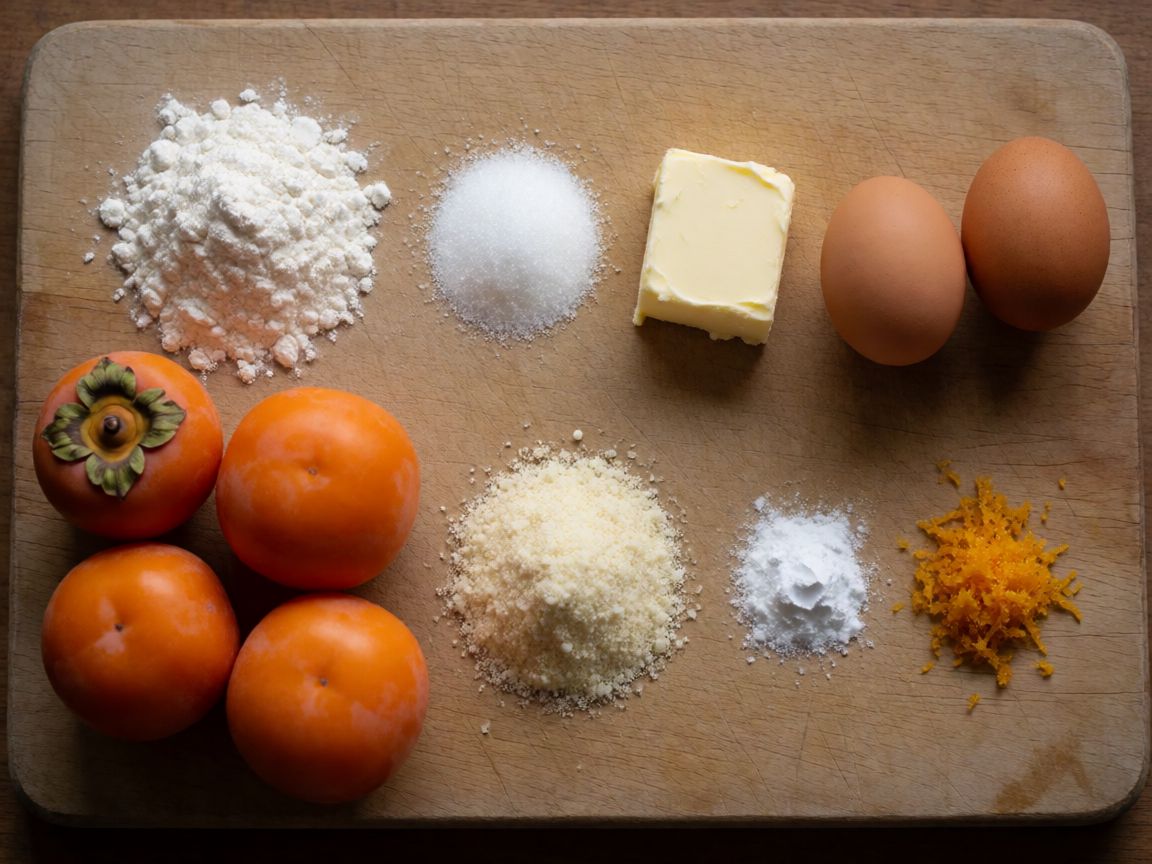
- 300 g Plain Flour
- 150 g Caster Sugar
- 70 g Butter softened
- 2 pcs Eggs
- 3 pcs Persimmon about 700g in total
- 50 g Ground Almonds
- 15 g Baking Powder
- 1 pcs Orange zest only








Steps
Beat the softened butter with the sugar using a mixer until smooth.
Continuing to beat, add the eggs one at a time.
Peel the persimmons and blend them in a blender until smooth, then add to the butter mixture.
Flavour the batter with the zest of 1 orange.
Gradually add the sifted flour, stirring so no lumps form.
Add the baking powder, then finally fold in the ground almonds. Mix the batter well until smooth.
Transfer the batter into a 24 cm tin, greased with butter and dusted with flour.
Bake in a preheated fan oven at 170°C for about 80-85 minutes.
82 minCheck it's done with a wooden skewer — it should come out dry.
Let the cake cool slightly before serving.
This is not really a sponge with fruit added on top — it's a cake built around persimmon pulp as the main liquid. No milk, no water: the purée does that job, and that one swap decides almost everything about how the thing bakes and tastes.
What makes or breaks it is the persimmon itself. Some say any persimmon will do once it's orange and soft-looking — no, because an under-ripe one is still full of tannins, and tannins are what pucker your mouth dry. You want the fruit so ripe it's basically a bag of jam, skin slack, flesh collapsing when you press it. Squeeze it like you'd squeeze a ripe peach, not a tomato. If it resists, it's not ready, however pretty the colour.
The second thing that decides the result is the bake itself: long and gentle, not hot and quick. A wet, fruit-heavy batter this deep in a 24 cm tin needs time for the heat to walk all the way to the centre. Crank the oven thinking you'll save twenty minutes, and you get a cake that's set and even slightly dry at the edge while the middle is still raw paste — the classic 'gummy centre' complaint, and it's never the oven's fault, it's impatience.
Butter and sugar creamed properly, eggs beaten in one at a time, almonds folded in last — none of this is ceremony. It's how you keep the butter-and-egg emulsion from splitting, which is what gives you a close, moist crumb instead of a greasy, separated one.
Persimmon: buy it jelly-soft, or buy it firm and let it sit on the windowsill for a week until it is. In British shops you'll often find it labelled Sharon fruit — that's a non-astringent variety bred so you can eat it while still firm, which takes some of the guesswork out, but check it anyway by feel, because firm-and-sweet Sharon fruit still behaves differently in the blender than one gone properly soft and watery. You need the watery stage here — it's doing the job milk does in an ordinary cake.
Butter: it has to be soft enough to beat into the sugar until the mixture lightens and turns almost fluffy — that's air being trapped, and that air is half your rise, baking powder being the other half. Any fat that creams this way will do the same job; margarine will work, though it carries more water and less flavour. Oil won't — it can't trap air the same way, so if that's all you have, you're really making a different cake and need a different method, not a straight swap.
Eggs one at a time, beating between each: this isn't fussiness, it's preventing the mixture from curdling. Butter and egg are an emulsion, fat and water trying to stay friends, and dumping both eggs in at once is the easiest way to break that truce — you'll see it as a mixture that looks grainy and separated instead of smooth and glossy. If it does split a little, a spoonful of the flour stirred in will usually bring it back.
Ground almonds: here for fat and body, not flavour. Persimmon purée is wet with almost no fat of its own, and the almonds quietly hold moisture in the crumb so the cake stays soft a day or two later instead of drying into something like stale bread. Any finely ground mild nut does the same work — hazelnuts, for instance. Ground oats or semolina will bulk the batter but won't hold moisture the same way, so expect a slightly drier result.
Orange zest is the one ingredient here doing no structural work at all — it's there because ripe persimmon on its own tastes flat and one-note, sweet without edge. The zest's oils cut through that. Leave it out and the cake isn't wrong, just a bit muted.
On the oven: 170°C fan means exactly that — fan, not conventional, because a fan oven moves hot air and cooks faster and more evenly than a static one at the same dial number. If yours is conventional, you're looking at a somewhat higher setting and a watchful eye, not a straight substitution of numbers. Trust the skewer over the clock: push it into the centre, and it should come out clean, no wet batter clinging to it. Eighy-odd minutes is where to start checking, not where to stop.
Let it sit once it's out — persimmon batter is loose enough that the crumb is still settling in the first twenty minutes out of the oven, and cutting into it too early gets you a slice that collapses rather than holds. That's patience doing its job, not the recipe failing you.
As for history: fruit cakes like this one exist because someone had persimmons going soft faster than they could be eaten raw, and baking is the oldest way of not wasting fruit that's tipped past its best. Nothing mystical in it — it's kitchen economics, the same reason banana bread exists.