
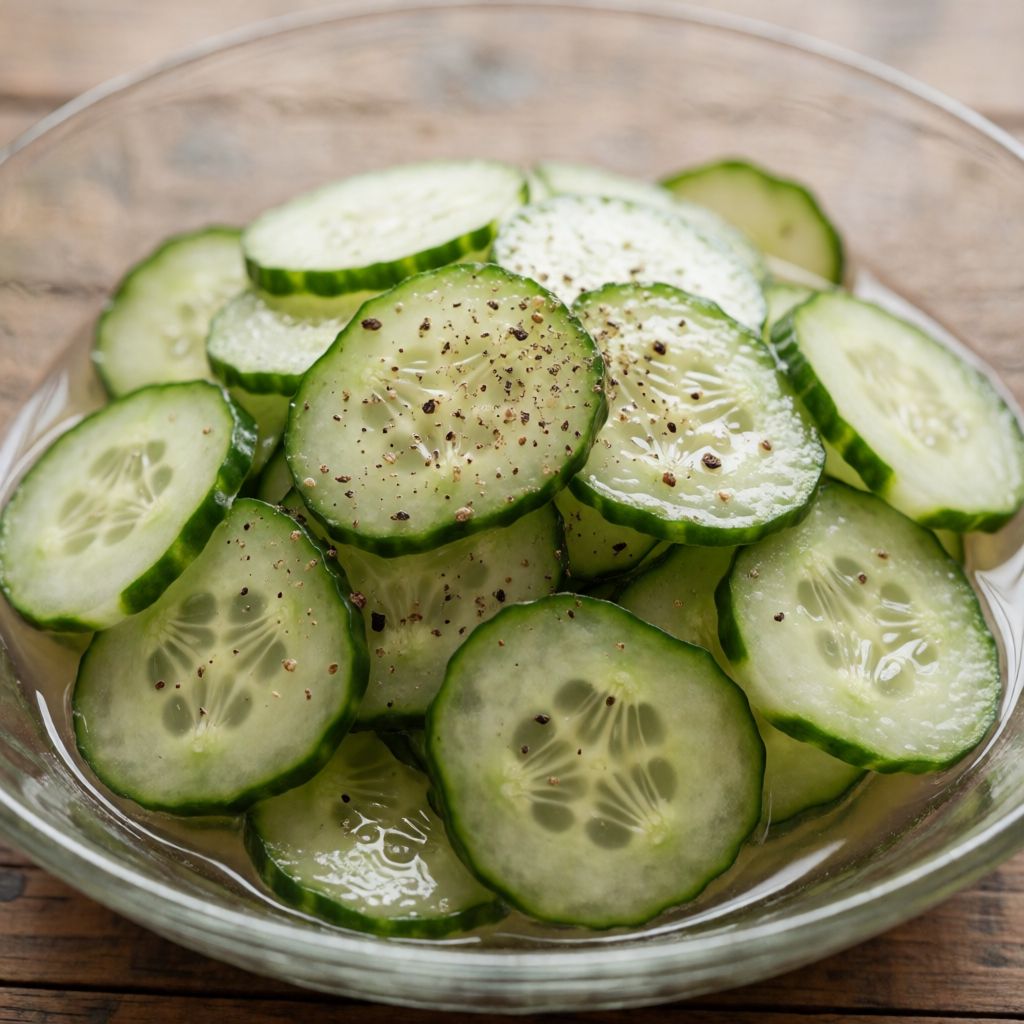
 AI photo
Pickled Cucumbers – Cucumber Salad
A quick, tangy cucumber salad pickled in a sweet vinegar brine.
Labels are worked out automatically from the ingredients and can be wrong. Check the packaging if it matters to you.
Ingredients
- 1 pcs Cucumber
- 200 ml Apple cider vinegar or regular vinegar
- 100 g Sugar
- 1 tsp Black pepper
- Salt to taste
- 50 ml Water
- 1 bunch Dill in season, fresh
- 2 pcs Bay leaf






Steps
Stir the sugar and salt into a bowl of boiling water. Add the vinegar, whole black peppercorns and flavourings.
Slice the cucumber very thinly, place in a jar and pour over the marinade.
Leave to marinate for at least 30 minutes.
30 min
Call this what it is: not a pickle that sits in a crock for weeks, but a cucumber that's been persuaded, in half an hour, to taste like one. The whole trick is osmosis, not time — the sugar-salt-vinegar mix is stronger than the liquid inside the cucumber's own cells, so water leaves the cucumber and flavoured liquid moves in to take its place. That's the entire mechanism. There's no bacteria doing slow work here, no bubbling crock in a cold pantry — just a concentration gradient doing its job quickly because you've helped it.
And "helped it" means one thing above all: cut the cucumber thin. Not for looks — for distance. A slice you can see light through lets the marinade reach the middle in minutes. A chunk half a centimetre thick keeps its centre raw and watery no matter how long you leave it, because the exchange has further to travel. If a batch ever tastes sharp on the outside and flat in the middle, that's not a timing fault, that's a knife fault.
Some say pickling takes days — no, because that's fermentation you're thinking of, a different process entirely, where lactic bacteria slowly convert sugars into acid and the jar needs its weeks in a cool dark spot. This is a marinade. It's finished when the cucumber bends slightly, loses its raw snap, and smells of vinegar right through rather than just on the surface. Thirty minutes is the floor, not a deadline — give it longer if the slices came out thicker than you meant, shorter won't help no matter how much you want dinner now.
The cucumber itself matters more than people assume. An English cucumber — long, thin-skinned, mild — needs nothing extra; the skin is thin enough that the marinade gets through it without a fight. If what you've got is a stubby ridge cucumber from the garden or a market stall, it can carry real bitterness just under the skin, and salting the slices for ten minutes first, then patting them dry before they meet the marinade, will draw that bitterness out as water rather than leaving it to argue with the vinegar.
The water is boiled for one reason only: to dissolve the sugar and salt completely. A rolling boil, not a simmer — undissolved sugar sits as grit at the bottom of the jar and you bite into it later, which is its own small disappointment. Notice the order: the vinegar goes in after, not boiled alongside the water. Boil vinegar and you cook off some of its volatile acid along with the sharp smell that makes it vinegar in the first place — you'd end up with something flatter and need more of it to get the same bite. Add it once the water's already done its dissolving work and the sourness stays honest.
Vinegar itself is a category, not a brand. What you need is acidity around the usual 5% you'll find in a supermarket bottle; apple cider gives a faint fruitiness that suits dill, a plain white or white wine vinegar gives something cleaner and more neutral. Malt vinegar — the one already in most British kitchens for chips — will work in a pinch, but it brings its own deep, toasty flavour that will sit over the dill rather than beside it, so use it only if you don't mind that trade.
The black pepper goes in whole, not ground, and that's deliberate: whole peppercorns release their oil slowly into the hot liquid, matching the pace of the rest of the process, where ground pepper would dump its flavour and colour into the brine all at once and cloud it. The bay leaf works the same slow way — its bitterness needs a little heat and a little time to come forward, which is why it goes into the hot liquid with the peppercorns rather than raw into the jar.
Dill is the one ingredient that doesn't go anywhere near heat. Its smell comes from oils that disappear fast under warmth, so it's added fresh, with the sliced cucumber, and lets the warm (not boiling, by the time you pour it) marinade work around it rather than through it. Dried dill is a real substitute only in the sense that it's dill-flavoured dust — fine if that's all you have, but expect less of the bright, grassy lift that makes this worth doing with fresh.
The quantities as given make more liquid than one cucumber strictly needs to flavour — that's fine, even useful, since what matters is that every slice is fully submerged, not that you hit some exact ratio. One cucumber this way gives you a decent bowl for two as a side, more if you're spreading it thin across a table already carrying a roast, gravy, and everything else a Sunday needs balancing out.