
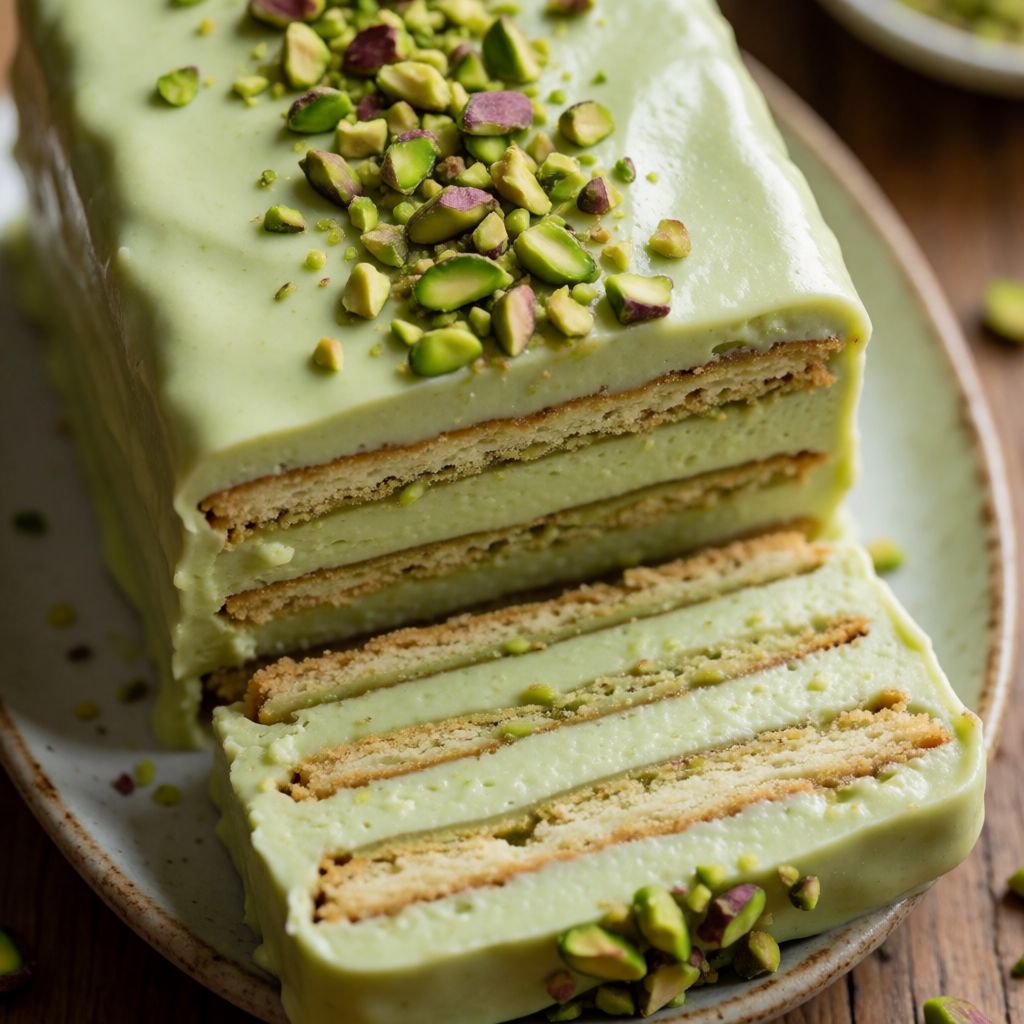
 AI photo
Cold No-Bake Pistachio Cake
A chilled no-bake pistachio cake with a sponge finger crust, a creamy cheese filling and a pistachio cream topping.
Labels are worked out automatically from the ingredients and can be wrong. Check the packaging if it matters to you.
Ingredients
- 150 g Sponge fingers (ladyfingers)
- Milk to taste
- 500 g Cream cheese
- 100 g Icing sugar
- 300 ml Double cream
- 200 g Pistachio cream
- 250 ml Double cream
- 100 g Pistachio cream
- Pistachios crushed, to taste






Steps
Line a tin with cling film. Dip the sponge fingers in milk and arrange them in a ring around the sides and over the base.
Using an electric mixer, beat the cream cheese with the icing sugar. Separately whip 200 ml of double cream and fold it into the cheese mixture.
Spread half of the cream mixture over the biscuit base and smooth it out.
Whip 100 ml of double cream and combine it with the pistachio cream. Spread it over the top of the cake.
Fold the edges of the biscuits inward and cover the cake with another layer of sponge fingers dipped in milk.
Wrap in cling film and refrigerate.
240 minWhip the remaining cream for the coating and combine it with 100 g of pistachio cream.
Open the tin, cover the cake with a plate and turn it over. Remove the cling film and decorate.
What was changed
The biscuits have been swapped for Sponge fingers (ladyfingers), which are easy to find in UK shops.
Forget the oven here — this is architecture, not baking. You build a ring of soaked sponge fingers as a wall, pour two different creams into it, seal it with another soaked lid, chill it hard, then flip it so the floor becomes the roof. It's the same logic as a charlotte russe: biscuits give you a mould you don't have to buy, cream gives you the mass, and cold does the job a flame would do in a baked cake — it sets the structure.
What decides whether it stands up when you unmould it is moisture, not flavour. The milk you dip the fingers in isn't there to be tasted — it's there to let the biscuit bend without falling apart and bond to the cream without turning to paste. Some people think more milk means a softer, better cake. No — too much milk and the biscuit loses its backbone; it goes from "soft wall" to "wet sponge" and the whole ring slumps before it ever reaches the fridge. A quick dip, in and straight out, is the whole trick.
The two cream layers are built the same way for the same reason: you whip the cream separately, then fold it in, never beat it together with the cheese from the start. Beating cream cheese with liquid cream in one go collapses the air you were trying to trap and you end up with something closer to soup than mousse. The air is the only thing giving this cake lift, since there's no egg, no gelatin, no heat to set a custard.
Sponge fingers (ladyfingers) are chosen for being dry and a little stale by design — that dryness is their job. A fresh, soft sponge would turn to mush the second it met milk. The dry biscuit can take on just enough liquid to go pliable and still hold its shape as a wall. If you can't get proper ladyfingers, a thin sheet of plain dry sponge, cut into strips, will do roughly the same work, but it won't hold the dip as cleanly — ladyfingers were basically invented for exactly this kind of soaking.
Cream cheese: use the dense block kind, the one firm enough to hold a knife mark, not the loose spreadable tub meant for toast. The spreadable versions carry more water, and that water has nowhere to go once the cake is cold and cut — it weeps, and your clean layers turn soggy at the edges. Icing sugar, not granulated, because you're not cooking anything here to melt sugar crystals; icing sugar dissolves into the cold cheese on contact, no grit, no extra beating that would knock the air back out.
Double cream is the only cream that whips reliably stiff enough to carry cheese and pistachio paste without collapsing — its fat content is the structural one. Keep it properly cold before you whip it; warm cream whips to a sulk, not a peak, because the fat needs to be solid enough to trap air, not liquid. Fold it into the cheese gently — a spoon, not the mixer — because at this point you're not combining ingredients, you're protecting air you've already made.
Pistachio cream (crema di pistacchio) is ground pistachios cooked down with sugar and a little neutral oil until smooth — think of it as a pistachio version of a hazelnut spread, but less sweet and more savoury-green in flavour. In the UK it's sold in delis, Italian grocers, or online baking suppliers; if you genuinely can't find it, you can grind unsalted pistachios with a touch of neutral oil and icing sugar yourself, though a jar made for the purpose will be smoother and greener. Don't substitute pistachio ice cream topping — that's syrup with colouring, no nut in it at all.
The crushed pistachios on top are for bite, not decoration — the inside of this cake is entirely soft, so you need one place where the teeth actually do something. Chop them by hand or pulse briefly; a long spin in a food processor warms the nuts from friction, their oil comes out, and you get pistachio paste instead of pistachio crumb. Buy them raw and unsalted if you can — the salted snacking kind will fight the sweetness of the cream rather than sitting next to it.
Line the tin with cling film for the same reason the biscuits form a ring — you don't own a charlotte mould, and you don't need one. Any round tin with a removable base, or even a bowl, lined with film, gives you the same clean release when you turn it out. That's the whole economics of this cake: no oven, no special tin, no gelatin — just cold, fat, and time doing what heat usually does.