
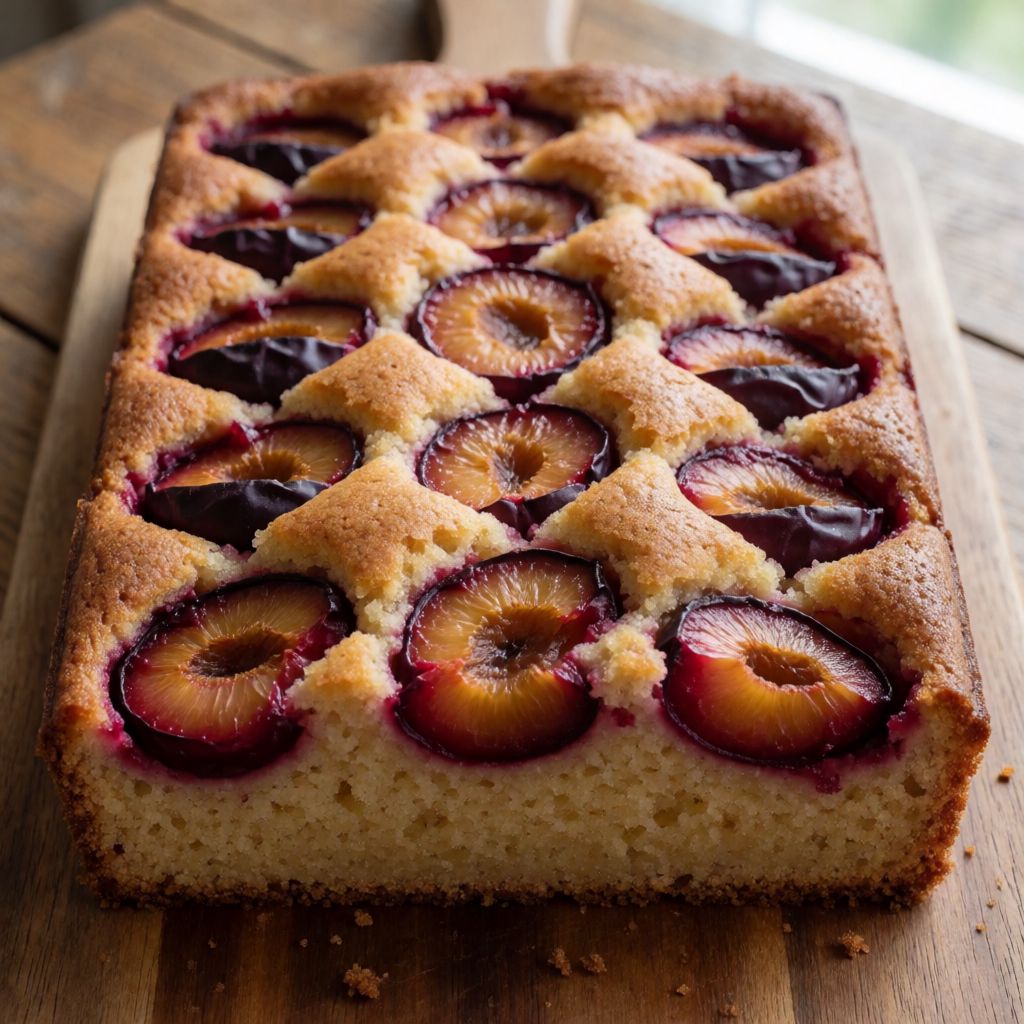
 AI photo
Plum Cake
A moist marzipan sponge cake topped with juicy plums and crunchy hazelnuts.
Labels are worked out automatically from the ingredients and can be wrong. Check the packaging if it matters to you.
Ingredients
- 200 g Marzipan coarsely grated
- 75 g Caster sugar
- 200 g Butter softened
- 4 pcs Eggs
- 70 g Plain flour
- 1 tsp Baking powder
- 1 tsp Ground cinnamon
- 300 g Plums cut into quarters
- 30 g Hazelnuts roughly chopped
- 1 tbsp Caster sugar for sprinkling
- 1 tsp Icing sugar for dusting before serving










Steps
Beat the marzipan, sugar and butter together until smooth and fluffy, then beat in the eggs one at a time, continuing to whisk.
5 minMix the plain flour, baking powder and cinnamon, sift into the batter and stir well.
2 minSpoon the batter into a greased 20 cm tin lined with baking paper. Press the plum quarters into the batter in a decorative pattern, then sprinkle with the chopped hazelnuts and finally the sugar.
Bake the cake in a preheated fan oven at 180°C for 30-40 minutes. Check it's cooked through and let the cake cool slightly in the tin before turning it out. Dust with icing sugar before serving.
35 min
What was changed
The oven temperature was adjusted to the nearest display step allowed in this kitchen .
This is not really a cake in the sponge sense — it's a frangipane that happens to be baked in a tin instead of a tart shell. Look at the ratio: 200 g of butter, 200 g of marzipan, and only 70 g of flour. Flour isn't what holds this together — eggs and fat are. That changes what you're watching for at every stage, because a sponge cake and an almond cake fail in different ways.
What decides whether it works is mostly decided in the first five minutes, at the mixer, not in the oven. You beat marzipan, sugar and butter until it's smooth and fluffy — not just combined. That beating is doing the leavening here; the baking powder is a top-up, not the main act. Cold, hard marzipan straight from the fridge won't break down into the butter — it just sits there in gritty lumps that never bake out, because gluten-free almond paste has no structure of its own to stretch and blend; it has to be softened by friction and by the warmth of the creaming, not by heat from an oven. Grate it coarse first for exactly this reason — fine shreds give the beater something to grab.
Marzipan is almond paste that's already been through the work of grinding almonds with sugar and binding them, usually with a little egg white or glucose syrup, into something smooth enough to mould into fruit shapes for a Christmas cake. Using it here isn't a short cut taken out of laziness — it's one less stage of grinding and emulsifying you'd otherwise have to do with ground almonds and icing sugar separately. If you can't get a block of it, you can build the same thing: equal weights of ground almonds and icing sugar, bound with a spoonful of egg white until it holds together like dough. It'll be slightly drier than shop marzipan, so don't be afraid to beat it a touch longer to loosen it.
Butter has to be soft, not melted, because the whole first stage depends on it being solid enough to hold air bubbles as you beat it — that's the mechanical leavening I mentioned. Melted butter is just fat; it slides past the sugar crystals instead of trapping anything. If you need a substitute, it has to be something that's solid and plastic at room temperature, not liquid — a baking margarine will do the same job; oil won't, however good the oil.
Eggs go in one at a time and you keep whisking, because butter and egg don't actually want to mix — one's fat, one's mostly water. Added too fast, the emulsion splits and you get a curdled, grainy batter that bakes into a dense, slightly greasy cake instead of a light one. Adding gradually, with the mixer still running, lets each addition get absorbed before the next arrives. Eggs at room temperature help, too — a cold egg can re-harden pockets of the butter on contact, and those pockets never fully recombine.
Flour, baking powder and cinnamon are a small supporting cast here, not the backbone. The small quantity of flour means you don't need much mixing once it's sifted in — two minutes, no more — because there's barely any gluten to develop and no reason to toughen what little there is. Cinnamon with stone fruit is an old pairing, and the usual story about spices masking off flavours in less-fresh fruit is mostly true of the historical trade in spices generally, not a magic rule for this cake specifically — here it's just flavour, nothing to protect.
The plums need to be firm enough to hold their quartered shape under their own weight when pressed into the batter, and acidic enough to cut through all that butter and almond richness — ripe but not soft-collapsing. Greengages, damsons, or any firm stone fruit in season will do the same job; a too-soft peach will mostly disappear into the crumb instead of sitting proud in it. The hazelnuts and the sprinkled sugar on top aren't decoration for its own sake — the sugar caramelises into a thin crust in the oven's heat, and that crust is what keeps the surface from turning soft and wet under all the juice the plums are about to release. Any nut with enough natural oil to toast rather than just dry out will stand in for hazelnuts — flaked almonds work well, given there's already almond underneath.
Last thing: the icing sugar dusted at the end, not before baking. Dust it early and the oven's heat and the plum's moisture will dissolve it straight into the surface — you'll lose both the sugar and the look of it. It goes on at the table, right before serving, which is also roughly when you'd be pouring the tea.