
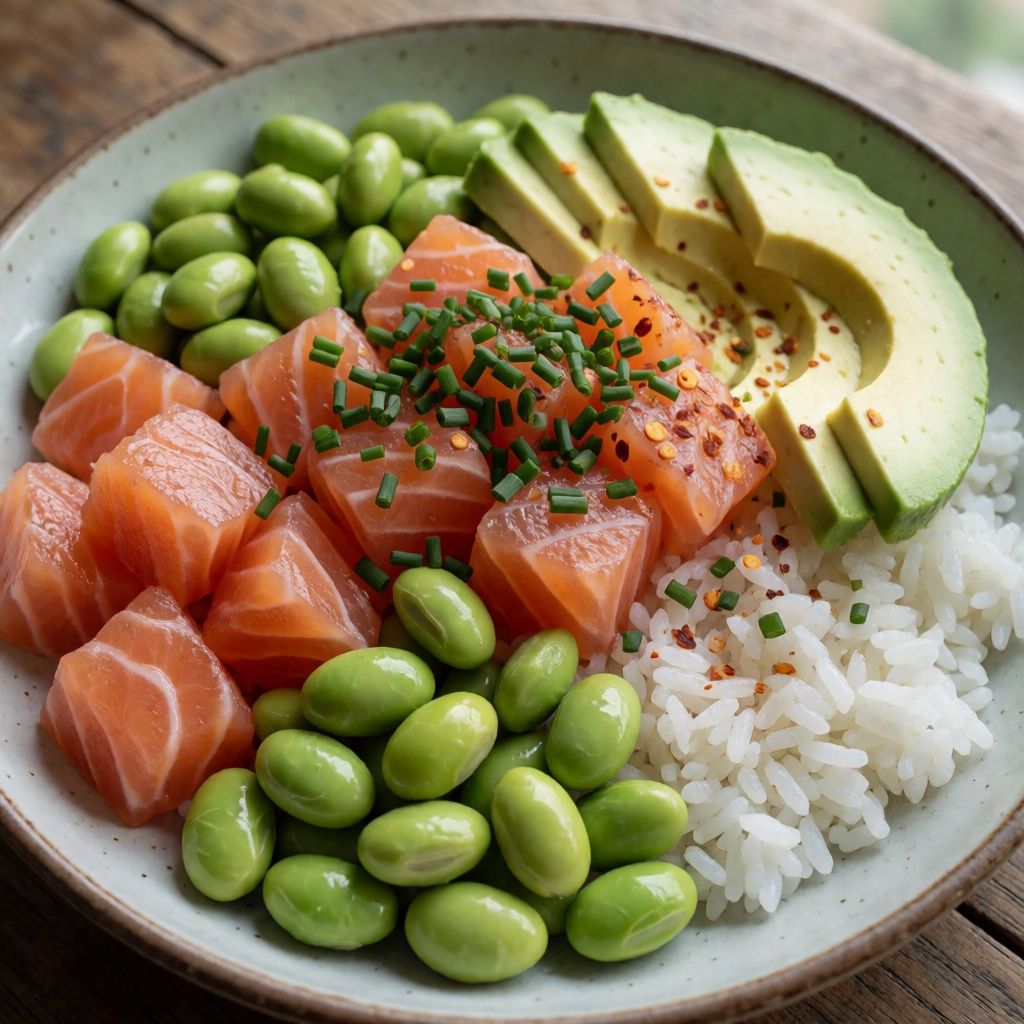
 AI photo
Poke Bowl
A fresh, colourful poke bowl with sushi rice, salmon, edamame and crisp vegetables.
Labels are worked out automatically from the ingredients and can be wrong. Check the packaging if it matters to you.
Ingredients
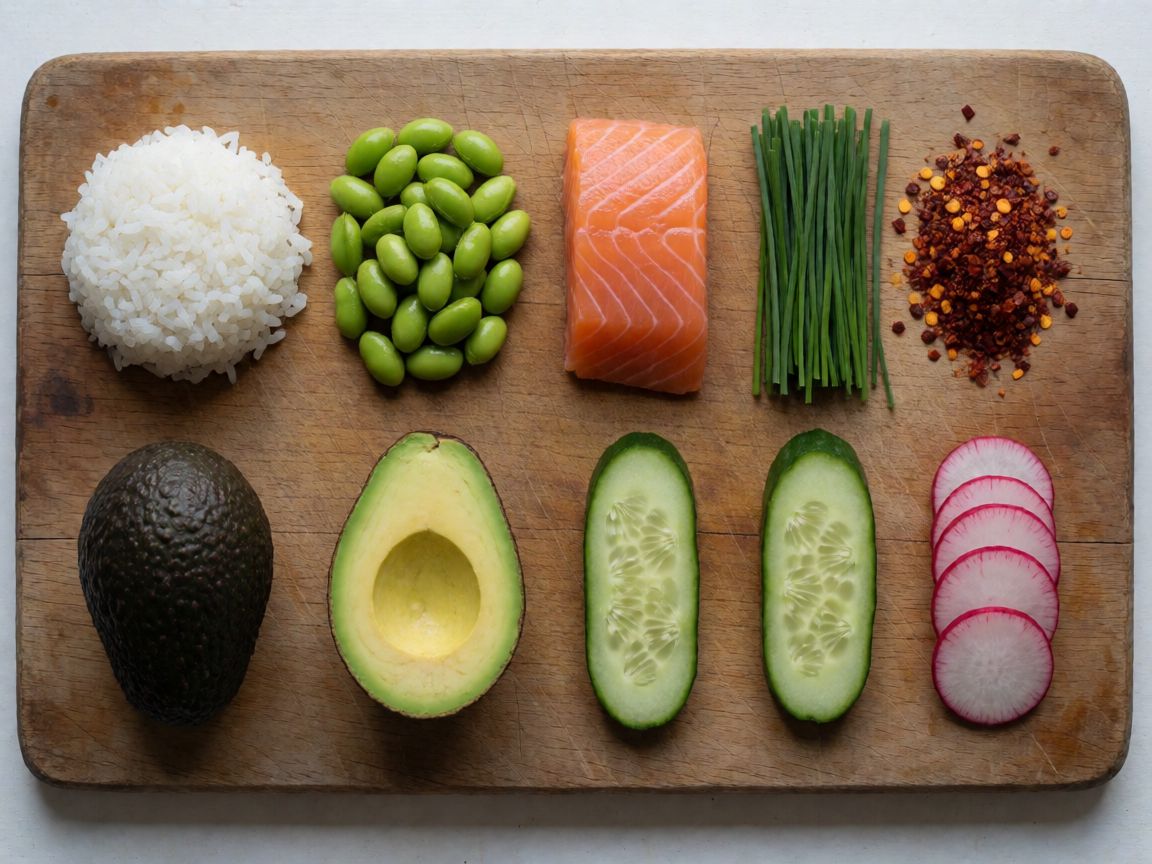
- 400 g Sushi rice
- 300 g Edamame
- 250 g Salmon or tuna
- Chives to taste
- 1 pcs Red chilli
- 1 pcs Avocado
- 1 pcs Cucumber
- 1 pcs Radish
- 1.5 tbsp Rice vinegar
- 3 tbsp Soy sauce
- Salt to taste
- Sesame seeds to taste
- Sesame seeds to taste
- Vegetable oil for drizzling












Steps
Rinse the rice in a fine sieve under running water until the water runs clear.
Transfer the rice to a saucepan and cover with water equal in weight to the rice.
Bring the rice to the boil, cover with a lid and cook on low heat for 20 minutes.
20 minRemove the rice from the heat and let it stand for 5 minutes.
5 minWarm the rice vinegar, dissolve a pinch of salt in it and add to the rice, fluffing with a wooden spoon.
Cut the salmon into even cubes and marinate for 1 hour with soy sauce, chilli, chives, sesame seeds and salt.
60 minBlanch the edamame pods for 5 minutes, cool and shell the beans.
5 minCut the avocado into cubes, and the radish and cucumber into thin slices.
Divide the rice among four bowls, levelling it gently.
Arrange the prepared ingredients in clearly separated sections.
Serve, drizzled with a thin stream of soy sauce and, if liked, oil.
A poke bowl isn't a salad with fish thrown on top — it's an exercise in architecture. Everything stays separate on the plate: rice, raw fish, vegetables, each in its own clearly bordered patch. Why does this matter? Because the moment you toss it all together, the cucumber weeps water into the rice, the avocado goes to paste, and what you get in the bowl after ten minutes is grey mush. Keep the sections apart and the diner does the mixing, bite by bite, at the table — not you, in advance, in the kitchen.
What decides whether it works is the rice and the fish, in that order. The rice has to be sticky without being wet — glued enough to hold a cube of salmon on a spoon, not so wet it turns to porridge. That's what the wash under the tap is for: you're not cleaning dirt off the rice, you're washing off the surface starch dust that, left on, cooks into gluey slop. Some say rinse until the water's "clear" — it never goes perfectly clear, that's the starch talking, not grime. You rinse until the water stops looking like skimmed milk and starts looking like water with a haze in it. Good enough.
Sushi rice is short-grain, high in the starch that makes it sticky when cooked — don't reach for basmati or a long-grain "easy cook" bag out of convenience; the dish depends on the grains clinging together, and those varieties are bred to do the opposite. The water-to-rice ratio here is by weight, not the usual cup-measuring — weigh the rice, then weigh out the same amount of water. That equal-weight rule is the whole trick: too much water and the rice turns gluey past the point of holding shape; too little and it's chalky in the middle. The seasoning step afterwards — warmed vinegar with a pinch of salt, folded in with a wooden (not metal) spoon — isn't decoration. Metal bruises and mashes the grains as you fold; wood lets you lift and turn without crushing them, which is the difference between separate glossy grains and a bowl of paste.
Edamame are blanched, not simmered to death — you want the pod to go from tight and squeaky to just yielding, bright green still, not khaki. Frozen edamame (in-pod or shelled) work exactly as well as fresh here, since fresh pods are rarely sold outside specialist Asian grocers in the UK anyway; frozen is in fact the standard, not a compromise.
Chilli, chives, sesame and soy in the marinade aren't there to overpower the fish — a poke marinade is meant to season, not disguise. If your chilli is fierce, use less of it or deseed it; the point is a background warmth, not a burn that masks whether the fish was any good to begin with.
Avocado, cucumber and radish are the textural counterweight to the soft rice and softened fish — this is why they're cut and kept distinct: cubed avocado for creaminess, thin cucumber and radish slices for crunch and a clean, slightly peppery bite. Any firm, mild, crisp vegetable can stand in for radish or cucumber if you haven't got them — thinly sliced carrot, mangetout, even raw sugar snap peas — the criterion is "crisp and not watery when sliced thin," not the specific vegetable.
The vegetable oil at the end is optional and should be something with no smell of its own — a neutral sunflower or light rapeseed oil, drizzled thin. This isn't the place for a assertive extra-virgin olive oil or a thick sesame oil; either would fight the soy and chilli instead of just carrying them. If you want that toasted-sesame note, a few drops of toasted sesame oil in with the neutral oil does the job without drowning everything else.
One more honest note for a British kitchen: there's no kazan here and no need for one — a lidded saucepan on the hob does the rice job fine, as long as you resist lifting the lid to check on it. Every peek lets steam escape that the rice needs to finish cooking evenly; that's the real reason for the 5-minute stand after the heat's off — it lets the steam trapped inside finish the job gently instead of you forcing it with more direct heat and scorching the bottom layer.