
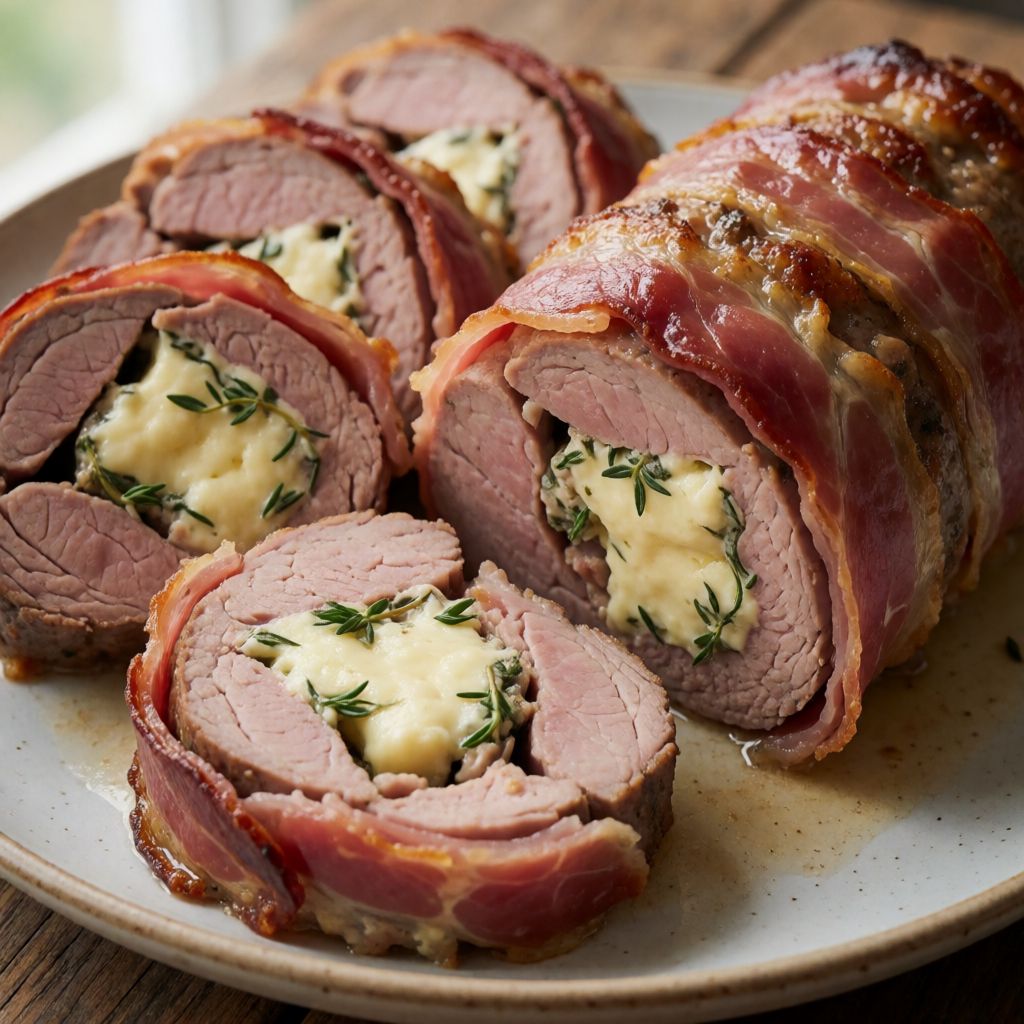
 AI photo
Pork Tenderloin with Parma Ham
Pork tenderloin spread with garlic cream cheese, wrapped in prosciutto and roasted until tender.
Labels are worked out automatically from the ingredients and can be wrong. Check the packaging if it matters to you.
Ingredients
- 700 g Pork Tenderloin
- 150 g Garlic Cream Cheese garlic-flavoured
- 2 tbsp Thyme fresh, finely chopped
- 100 g Prosciutto
- Salt to taste
- Black Pepper freshly ground






Steps
Trim away any membrane from the tenderloin, if there is any.
Rub the meat with salt and pepper, then spread it with the garlic cream cheese.
Sprinkle fresh thyme over the whole surface, then wrap the tenderloin in prosciutto so that it is completely covered.
Place in a greased ovenproof dish and roast for about 25-30 minutes at 170°C with the fan function.
28 min
Pork tenderloin is a muscle that does almost nothing but move the pig — no fat marbling, no connective tissue to melt down and keep it juicy. Left alone in an oven it dries out long before you'd call it cooked. This recipe solves that with two layers: a soft cheese spread underneath that melts and bastes the meat from the inside, and a jacket of prosciutto on the outside that renders its own thin fat and seals the surface so the inside steams in its own juice rather than drying in the air of the oven.
What decides whether it works is restraint, not technique. Trim the membrane first — that thin silvery skin shrinks faster than the meat under heat, and if you leave it, the fillet bows into a crescent and cooks unevenly, tight on one side, pale and underdone on the other. Then don't chase a long cooking time out of fear. A tenderloin this size is done when it gives slightly under a press — firm, springy, not rock-hard — and the prosciutto has gone from wet-pink to tight and a little crisp at the edges. That's your real signal, the oven clock is only a floor, not a verdict.
Some say pork must be cooked through to grey, no blush of pink anywhere, or you'll get sick. That was true when pigs were fed on scraps and trichinosis was a real risk. Modern pork, raised on controlled feed, doesn't carry that danger the way it once did — a faint rose at the centre of a tenderloin is not raw, it's correctly cooked. Chase it to grey and you'll get a dry, stringy disappointment, because this cut has no fat reserve to forgive the extra minutes.
Pork tenderloin, sometimes called fillet, is the long thin muscle that sits under the spine — not to be confused with loin, which is wider and carries a fat cap. You want the tenderloin precisely because it's lean and uniform; a fattier cut wouldn't need the prosciutto jacket at all, and this whole method is built around compensating for leanness, not working around fat.
The garlic cream cheese does two jobs: it seasons the meat from the inside with garlic and salt, and it melts just enough at oven heat to baste the surface under the prosciutto, keeping that inner layer moist. Any soft, spreadable fresh cheese that holds its shape cold but softens with heat will do — mascarpone with a crushed clove worked in, or a plain cream cheese with garlic paste stirred through, is the same mechanism with a different label.
Thyme goes on fresh for a reason beyond flavour — its oils are strongest raw, and a short roast doesn't give dried thyme time to rehydrate and release anything. If fresh isn't to hand, dried will work, just use less, it's concentrated, and expect a flatter, dustier note rather than the bright one fresh gives.
Prosciutto is doing the heavy lifting here. It's a dry-cured ham, thin-sliced, with just enough fat along its edge to render under heat — that render is what glazes and protects the lean meat underneath, the same principle Italian cooks use wrapping veal in saltimbocca. It became the standard wrap for lean meats not by magic but by economics: curing ham in salt was originally about preserving a slaughtered pig through winter, and thin-sliced cured meat happened to be perfect for lining other foods, cheap insurance against drying out, long before anyone called it elegant. If you have none, pancetta slices or streaky bacon — not back bacon, it's too thick and won't crisp evenly — give you the same fat-and-salt jacket.
On the oven: fan ovens circulate air and cook more evenly and a touch faster than a conventional static oven, which is exactly why this temperature reads low — 170°C with the fan is doing roughly the job 185–190°C would do without one. If your oven doesn't have a fan function, nudge the temperature up a little and keep your eye on the prosciutto rather than the dial; it will tell you more than the thermostat will.
A kazan or a lidded roasting dish would hold moisture in nicely, but you don't need either — a plain ovenproof dish, lightly greased so the prosciutto doesn't stick and tear when you lift it out, is enough. Two average tenderloins at 700g, wrapped this way, feed four generously alongside the kind of vegetables that usually sit next to a Sunday roast — this dish is really a weeknight version of that same instinct, a joint of meat and something green, just finished in under half an hour instead of most of an afternoon.