
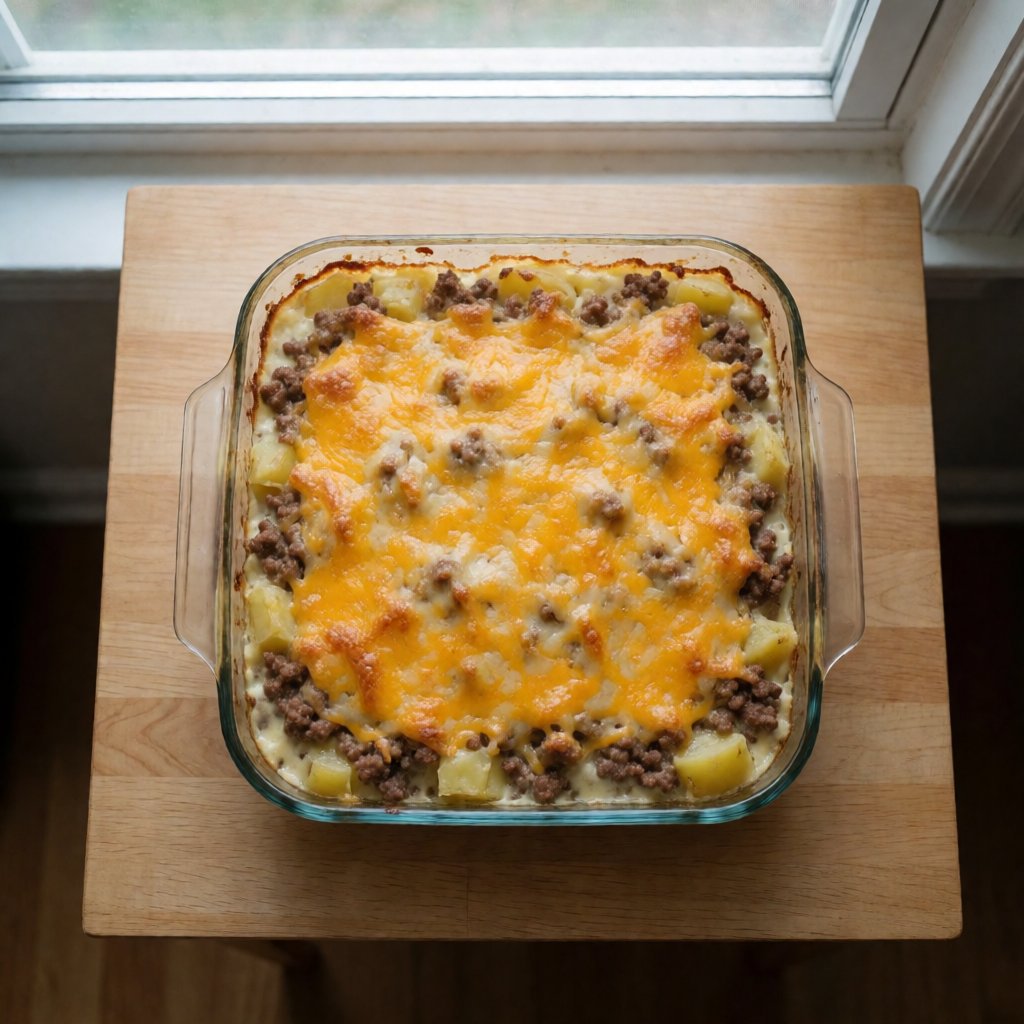
 AI photo
Potato and Minced Beef Bake
A simple potato and minced beef bake, finished with melted cheddar on top.
Labels are worked out automatically from the ingredients and can be wrong. Check the packaging if it matters to you.
Ingredients
- 400 g potatoes boiled and mashed
- 50 ml milk
- 10 g butter
- 250 g minced beef
- 0.5 pcs onion finely chopped
- 1 pinch salt to taste
- 1 pinch black pepper to taste
- 40 g mature cheddar grated








Steps
Mash the boiled potatoes with the milk and butter until smooth.
Spread the minced beef with the onion and seasoning in a thin layer in the baking dish.
Spread the mash evenly on top and sprinkle with the grated cheddar.
Cover the dish with foil and put it in the oven for 15 minutes.
15 minRemove the foil and bake for a further 20 minutes, until the mince reaches an internal temperature of 71°C.
20 minTake the dish out of the oven.
What was changed
The hard cheese was replaced with mature cheddar, the everyday choice for local shoppers.
This is a cottage pie built backwards. The classic version takes already-cooked meat — usually the leftovers from Sunday's roast — and tops it with mash just to warm through and brown. Here the mince goes in raw. That changes everything about what the oven has to do: it is not reheating, it is cooking two things at once, meat from underneath and crust from above, with nothing but foil standing in for a lid you don't own.
What decides whether this works is the thickness of that mince layer and whether you trust your eyes less than a thermometer. Spread thin, on purpose — heat has to travel all the way through a solid slab of raw meat in the time you've got, and a thick lump in the middle will still be grey and sulky when the top is golden. Some say mince, like a steak, is fine a bit pink in the middle. No — a steak is one surface sealed around a solid muscle; mince has been through a blade that drags whatever lived on the outside right through to the centre. You're not cooking to taste here, you're cooking to 71°C, measured, not guessed.
Start with the potato, because mash is where this dish is won or lost before it ever sees the oven. Use a floury variety — Maris Piper, King Edward, that sort — because floury potatoes carry more starch and less water, and the starch cells burst cleanly when boiled, giving you that soft, dry crumble you mash into smoothness. Waxy potatoes hold their shape because they don't want to give up that starch; mash them and you get something closer to wet glue than fluff. And don't reach for an electric mixer thinking it'll save your arm — it shears the starch granules instead of just breaking them, and sheared starch turns gluey, wallpaper-paste mash. A hand masher, maybe a ricer if you own one, nothing that spins fast.
The milk and butter in the mash aren't there to add flavour so much as to manage moisture and fat without drowning the potato. Butter coats the starch and keeps the grains separate instead of clumping; milk loosens without soaking. If you're out of milk, a splash of the pan juices later works, or cream if you want it richer — the criterion is a liquid with some fat in it, not water, water just makes mash wet without making it soft.
For the mince, don't go lean out of some idea that it's healthier here — ordinary mince, somewhere around 15–20% fat, is doing a job no other ingredient in this recipe does: it's the only source of moisture and lubrication the meat layer gets, because there's no oil added anywhere in the method. Very lean mince under a mash lid, with nothing else basting it, bakes dry and a bit like sawdust. The fat that renders out as it cooks is what keeps it from going tough.
The onion goes in raw and finely chopped, not softened in a pan first — deliberately, because this whole method is built to need exactly one dish and one washing-up. Raw onion under mince stays sharper, a bit more bite than the sweet, jammy onion you'd get from frying it down first. If that bothers you, you can soften it in a dry pan for a few minutes before you start — but that's an extra step and an extra pan, and the whole point of this version is that it doesn't ask for either. Any allium you've got does the job the same way: shallot, a bit of leek, spring onion in a pinch.
Mature cheddar earns its place over mild for one reason: age dries a cheese out a little and breaks its proteins down, so it holds less water and browns instead of just going stringy and wet under heat. Mild cheddar under foil-then-bare heat will melt fine but won't give you that freckled, slightly crisp top. Anything hard that browns rather than just softens will do the same work — Red Leicester, an aged Gouda, a strong Lancashire. And last — your oven thermostat is a liar, it always has been, every domestic one runs a few degrees off true. Don't trust the dial for this dish. The only honest tool in the kitchen for raw mince cooked inside a crust you can't see into is a probe thermometer, pushed into the thickest part of the meat layer. Everything else — gold going to ginger, a crust setting, time passing — is a lower bound. The thermometer is the only upper one.
·