
 AI photo
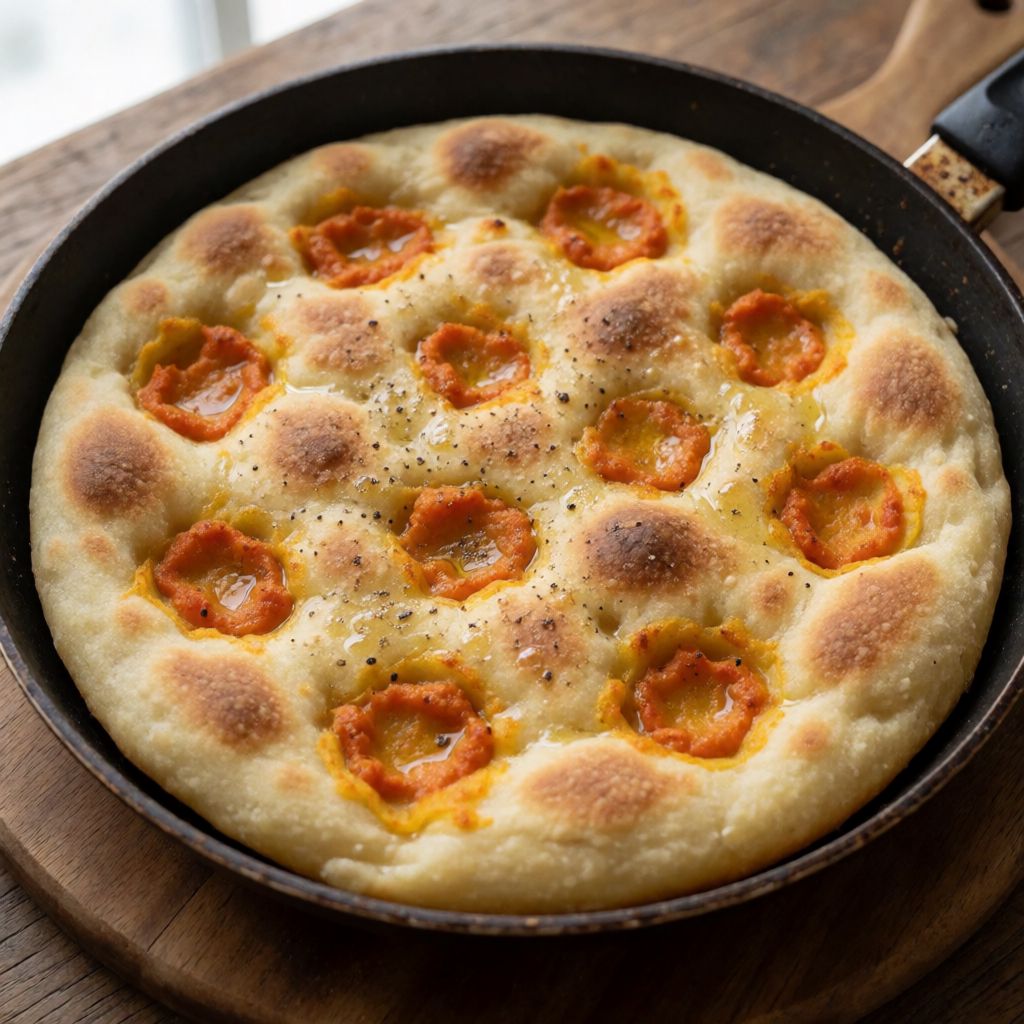
Potato Focaccia in a Frying Pan (No-Prove)
A simple potato focaccia cooked in a frying pan, with no yeast or rising time needed, filled with tomato purée and melted cheese.
Labels are worked out automatically from the ingredients and can be wrong. Check the packaging if it matters to you.
Ingredients
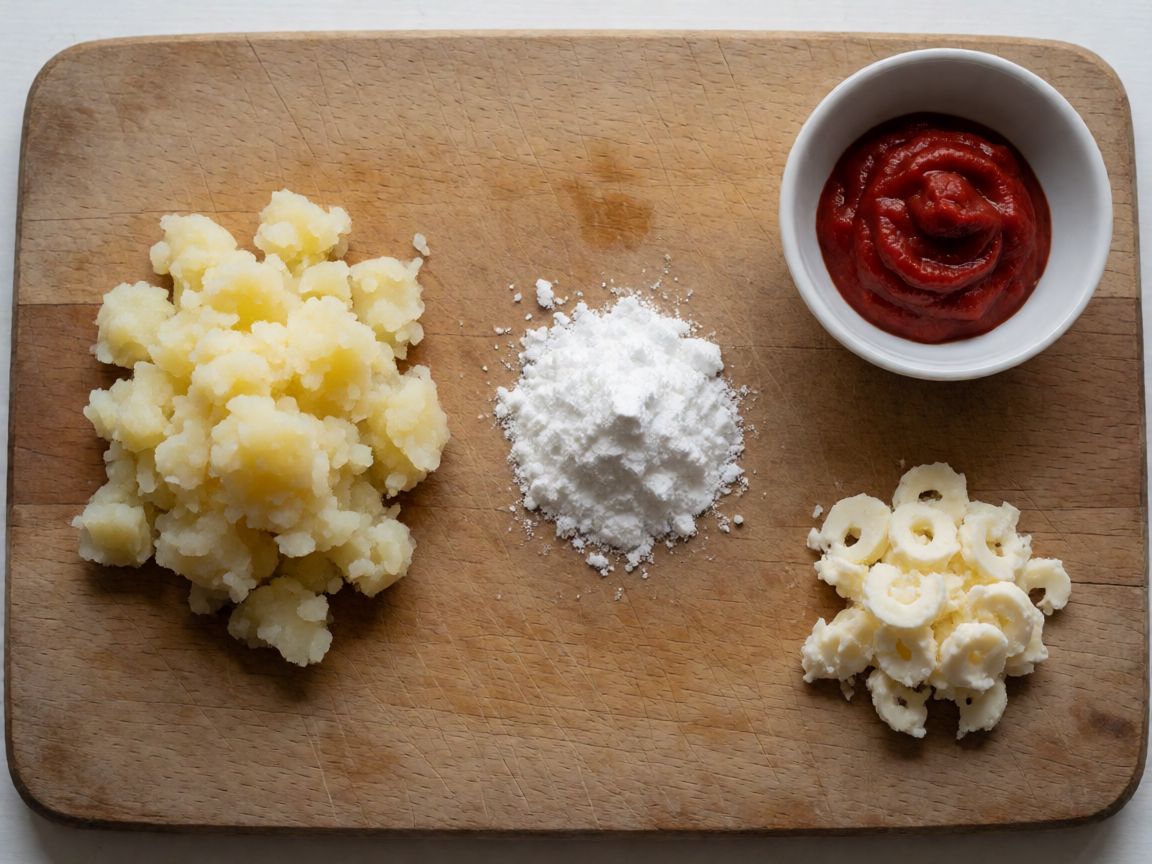
- 800 g Potato cooked
- 70 g Potato Starch
- Salt to taste
- Black Pepper to taste
- Olive Oil to taste
- Tomato Purée to taste
- Smoked Scamorza to taste, sliced





Steps
Bring a pot of water to the boil, add salt and cook the potatoes in their skins until tender.
Let the cooked potatoes cool, peel them, then pass them through a potato ricer.
Add salt, black pepper and potato starch, and knead by hand until you get a smooth dough.
With the stove switched off, pour olive oil into a frying pan and spread half of the dough into a circle.
Fill with the seasoned tomato purée and the sliced smoked scamorza.
Cover with the rest of the dough, sealing the edges.
Cook on the stove.
7 minBrush the surface with olive oil and flip the focaccia.
Cook for a few more minutes.
8 min
Call it what it actually is: not bread, a potato disc folded over a filling and cooked entirely on the hob. There's no yeast anywhere on that ingredient list, so put out of your mind the image of focaccia proving under a tea towel for an hour. It keeps the name because it finishes up looking like one — round, oiled, golden — but the dough underneath is built by a completely different mechanism.
Some say you need strong flour and a slow rise to get that soft, holding-together crumb. No — because there's no crumb here at all, no gluten to trap any gas, nothing is rising. What binds this disc is potato starch swelling and setting as it meets heat, the same thing that thickens a gravy when you add a spoon of cornflour, not the thing that leavens a loaf. That's why this goes from the pot to the plate inside the hour, with no waiting for anything to double.
What actually decides whether it works: a dry dough, not a wet one. Boiled potato is holding more water than it looks like, and if you don't manage that, your filling leaks through a soggy base and you've made a fried puddle, not a pie. Second thing: the seal around the rim. Skip it properly and the melting cheese finds the gap, runs into the oil, and burns — what you taste then is char, not smoke, and they are not the same flavour at all. Third: the flip. One disc, no oven to finish the top in, means it has to turn cleanly in one go, and that's a job for a plate, not for nerve.
Start with the potato, because the whole dish stands or falls on it. You want a floury variety — Maris Piper or King Edward, the same bag you'd buy for Sunday roast potatoes or mash — never a waxy one like Charlotte or a new potato. Waxy potatoes hold their water inside dense cells and keep it there; floury ones are mostly starch granules that burst open under heat and let the water go as steam. Boil them in the skin, not peeled — the skin is the only thing stopping the boiling water soaking straight into the flesh, which is exactly how you end up with a gluey, wet mash instead of a dry one. Let them cool before you peel and rice them: warm potato feels easier to work, but the starch hasn't settled yet, and a dough made from it stays tacky and impossible to fold without tearing.
Use a ricer, not a masher, if you have one — it's not snobbery, it's mechanics. A ricer pushes the potato through fine holes and breaks the cells cleanly, so the starch stays locked inside them. A masher crushes and shears the cells open, releasing loose starch onto the surface, and that surface starch is what turns a mash gluey when you beat it too hard. No ricer in the house? A coarse sieve and the back of a spoon does the same job, slower. If you only have a masher, use it lightly and stop the second there are no lumps — don't keep going for a smoother finish, that's exactly the overworking that causes the problem.
Potato starch does the binding, and it isn't flour's job at all — there's no gluten here to develop by kneading, so don't knead this like bread dough; you're folding it together, not working elasticity into it. The rule for a substitute is simple: any starch that gels under heat and tastes of nothing on its own. Cornflour works, tapioca starch works. Wheat flour does not meet that rule — it brings gluten with it, and gluten turns this from a smooth potato disc into something chewy and bread-like, which isn't what you're after.
Oil has two separate jobs here, and it's worth knowing which is which. In the pan, cold, before the heat goes on, it's lubrication — this dough has no fat of its own to release itself from metal the way a batter does. Brushed on top before the flip, it's finishing — helping the crust that's about to hit the pan take on some colour and gloss rather than drying out. For the frying job, use any oil with no smell of its own — sunflower or rapeseed, what's already in your cupboard for a roast. Keep the olive oil for the brushing, where it never gets hot enough for long enough to burn off and you actually taste it.
Tomato purée in the filling isn't decoration, it's there to cut the fat: melted cheese on its own, enclosed in dough, turns into an oily pool with nothing to balance it, and the purée brings back acidity and moisture. Season it before it goes in — straight from the tube it's too concentrated and flat. Scamorza is cow's milk cheese, semi-hard, and the smoked version got that way because southern Italian shepherds hung cheese over the embers to preserve it before anyone had a fridge — the smoke was never about flavour first, it was about keeping cheese edible through summer. What matters for your pan is that it melts into long stretch rather than splitting into cheese and oil the way some hard cheeses do. If your shop doesn't stock it, smoked mozzarella is the closest match; plain mozzarella with a pinch of smoked paprika stirred into the tomato gets you most of the way there too.
On the method itself: assembling with the stove off is what lets you handle a soft dough without it fighting you, and sealing the rim properly — pinching it shut, not just laying the lid on top — is what stops the filling finding the one weak spot and running. There's no stated temperature because none is needed if you watch instead: oil that loosens and shivers in the pan but doesn't smoke, an underside that turns pale gold rather than spotting dark brown too fast. The seven and eight minutes in the recipe are a floor, not a target — your pan and your hob decide the real number. For the flip, don't attempt it in the air: a flat plate wider than the pan, laid over the top, the whole thing turned in one decisive movement, slid back in. A domestic hob and a 24–26cm frying pan handle this fine; they just won't forgive hesitation halfway through the turn. And if you've got cold mash left over from Sunday's roast, this is exactly the dish that uses it up — that's not a shortcut, that's the whole economic reason potato ever got folded into dough in the first place, to stretch a meal without buying more flour.