
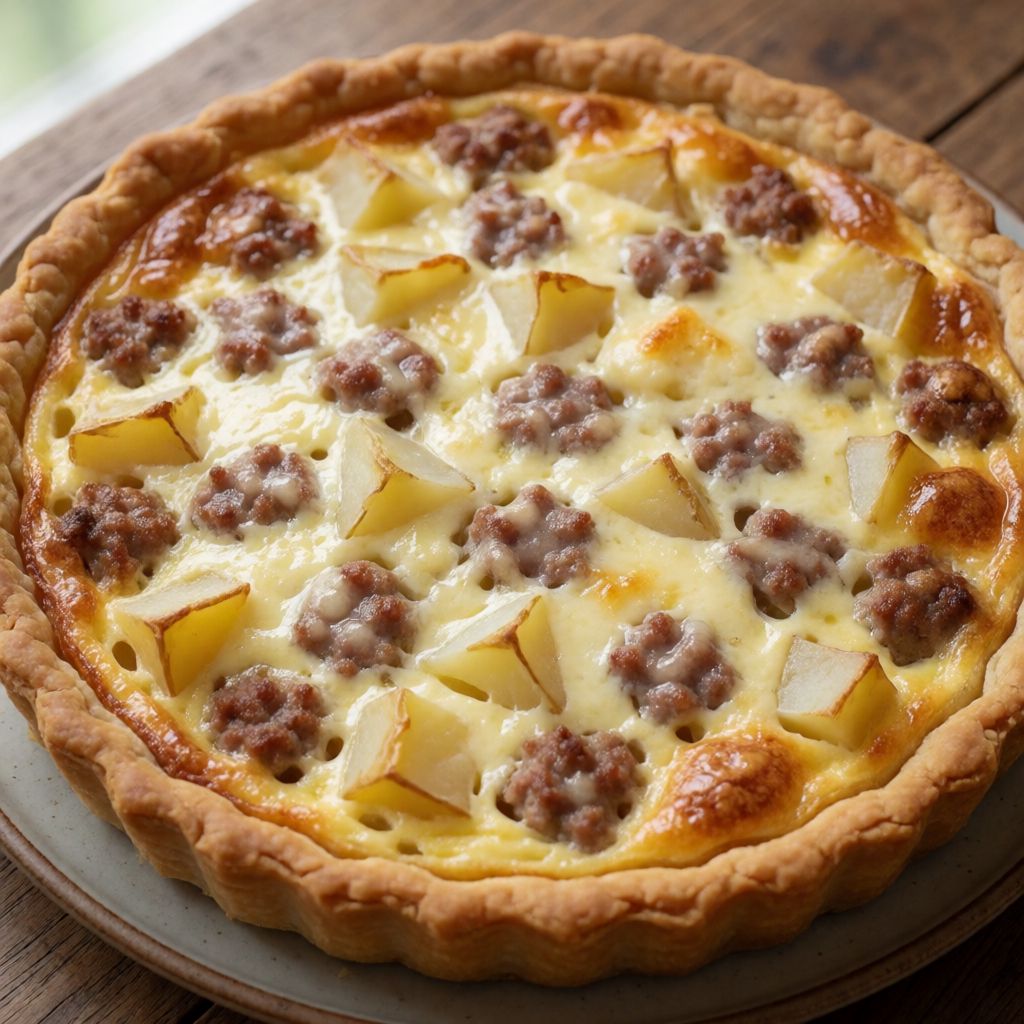
 AI photo
Potato, Sausage and Mozzarella Quiche
A comforting quiche layered with mashed potato, sausage and mozzarella, baked between two sheets of golden puff pastry.
Labels are worked out automatically from the ingredients and can be wrong. Check the packaging if it matters to you.
Ingredients
- 2 pcs Puff pastry sheets
- 1 kg Potatoes
- 2 pcs Italian sausages skinned and crumbled
- 1 pcs Mozzarella
- 2 pcs Eggs
- 1 pcs Egg yolk
- 200 ml Double cream
- 80 g Parmesan
- Nutmeg to taste
- Salt to taste








Steps
Boil the potatoes in salted water, then mash them.
Remove the sausages from their skins and crumble the meat into the mash, then add the mozzarella and eggs, mixing thoroughly until smooth.
Stir in the double cream, Parmesan and nutmeg, and mix again.
Line a baking dish with puff pastry, spread the filling evenly, cover with a second sheet of pastry and brush with egg yolk.
Bake in a preheated oven at 180°C for about 30 minutes, until golden brown.
30 min
Call this what it is before you call it a quiche. A real quiche is egg and cream held up by almost nothing — a thin shell, a thin custard, that's the whole trick. Here the custard isn't the structure, the mash is. You've built a potato brick wall and let the sausage, the mozzarella, the egg and cream fill the gaps between the bricks. That's not a complaint. It's just a different machine, and it needs different handling.
What decides whether it works is one race, run twice a bake, under the oven light where you can't see it: does the bottom pastry set and brown before the moisture sitting on top of it soaks through and turns it to wet paper? The filling is carrying water from three directions — the potato itself, the double cream, the mozzarella sweating as it melts. Raw puff pastry under all of that for half an hour at a modest heat is not a sure thing. It wins only if you've taken the water out of the filling before it ever meets the pastry.
Some say two pastry layers on a wet filling is asking for a soggy bottom, no matter what. Not quite — that rule is written for the French quiche, where the filling under the crust is raw, pourable custard that soaks straight into dough. Yours isn't pourable. It's mash, already cooked, already dry if you've done it right, acting as a buffer between the wet cream and the pastry floor. The two-crust approach only survives because the filling underneath it behaved like a wall, not like a puddle.
Start with the potato, because it decides the whole outcome before the oven even gets involved. You want a floury potato — Maris Piper or King Edward, the ones that already fall apart a bit when you boil them, because that's starch that mashes dry. A waxy potato, the kind sold as salad or new potatoes, holds onto water stubbornly and will leak it straight into your filling and from there into your pastry base. There's no butter or milk in this mash, and that's correct, not an oversight — anything added to loosen it works against the one job the potato has here, which is to be dry.
Let that mash cool before you stir in the eggs and the raw sausage. This is the patience part, and it's easy to skip because you're hungry and the mash smells good hot. If it's still steaming when the egg goes in, the egg starts to set on contact — you'll get fine scrambled threads through the mash instead of a smooth binder, and the raw sausage meat sitting against hot potato starts cooking unevenly before it ever sees the oven. Ten minutes off the heat costs you nothing and saves the texture.
Skinned Italian sausage is specified because that skin is built for grilling whole, holding the meat together over direct heat — it has no job once you're crumbling the meat into a mash. If you're shopping in a British supermarket, you've already got the easier route sitting next to it: sausage meat sold loose and skinless, the same stuff bought for Christmas stuffing. Either works; the criterion is coarse-ground pork with visible fat, because that fat is what renders into the mash and carries flavour through it. Bland, overly lean sausage gives you nothing to season with except salt.
Mozzarella is the cheese most likely to sabotage you here, and it's worth knowing why. Fresh mozzarella is sold sitting in its own whey precisely because it's a high-moisture cheese — that's what makes it soft and stretchy on a pizza, and it's exactly what you don't want weeping into a filling that's already fighting moisture on two other fronts. Tear it, squeeze it, let it sit on paper for a few minutes before it goes in, or buy the firmer block mozzarella sold for grating, which carries less water from the start. The criterion for any substitute is the same: a melting cheese that doesn't bring its bath water with it.
Eggs, yolk and double cream are doing the binding, not the main custard job — double cream specifically because its fat content is high enough to stabilise the mix so it sets smooth under heat rather than curdling into grain. The spare yolk brushed on top isn't decoration for its own sake; fat and protein together under oven heat is what browns, the same reaction that colours bread crust, so skipping it leaves you with pale, flat-looking pastry even if the inside is perfect. Parmesan does two things at once — salts the filling and dries it slightly, since it's a hard, low-moisture cheese losing what little water it has into the heat rather than adding any. Any mature, hard, salty cheese does the same job; a strong cheddar, which every British kitchen already has a block of, is not a downgrade here, just a different accent. Nutmeg is there for the oldest reason it's ever used near dairy — it cuts the flatness of cream and cheese with something warm and a little bitter. Grate it fresh if you can; ground nutmeg loses its edge fast sitting in a jar.
The ready puff pastry is not a shortcut to feel guilty about. Proper puff is butter laminated into dough through a dozen folds, done at a bakery's temperature-controlled pace — a home kitchen, especially on a day you're also boiling potatoes and browning sausage, isn't set up to do that well twice over. Buying the sheets is simply recognising which part of the labour is worth paying someone else for, the same economics that put sausage rolls and mince pies on every British shelf. If you're worried about the top staying pale and slightly raw-looking despite the time given, that's steam with nowhere to go — a couple of small cuts in the lid let it out and let the pastry puff evenly instead of blistering in one spot.