
 AI photo
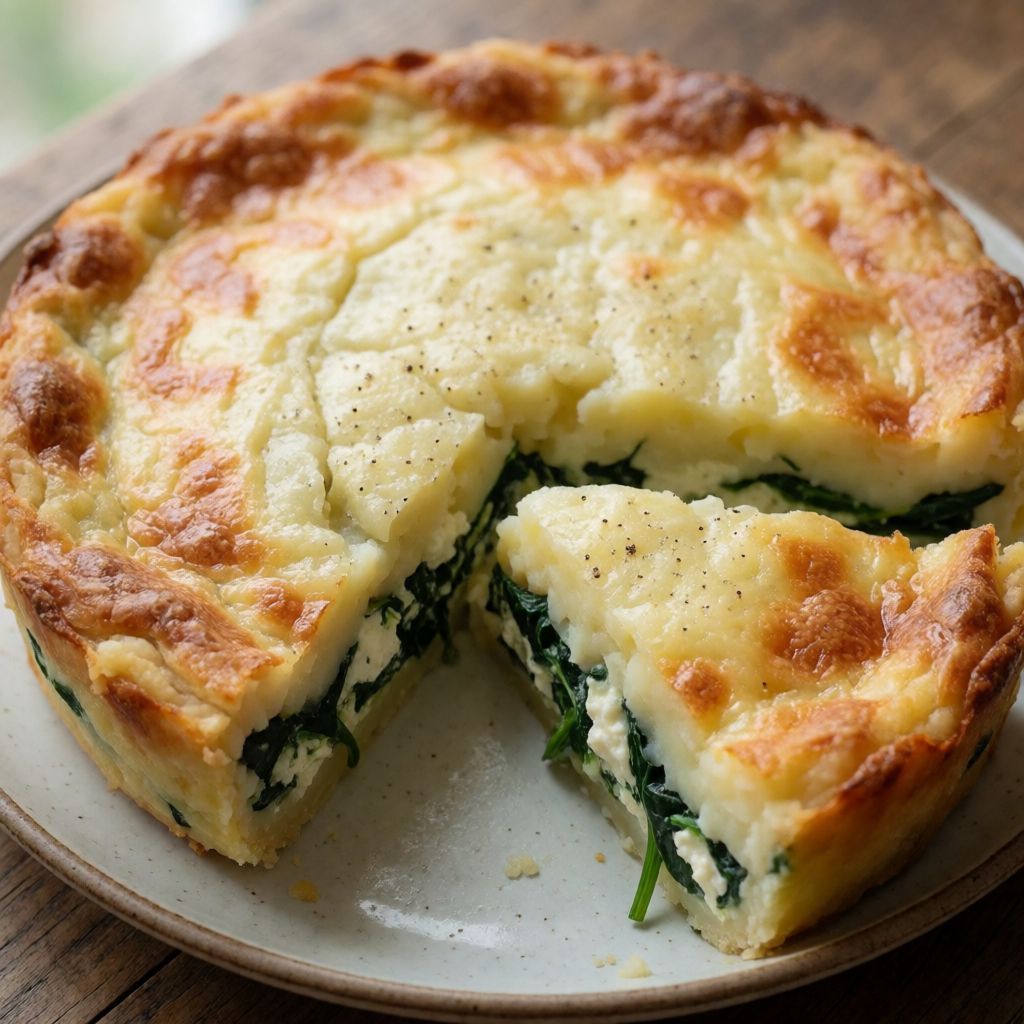
Potato and Spinach Pie Without Puff Pastry
A no-pastry potato and spinach pie layered with ricotta, Parmesan and melting cheese, finished with an egg topping.
Labels are worked out automatically from the ingredients and can be wrong. Check the packaging if it matters to you.
Ingredients
- 700 g cooked potatoes
- 100 g Parmesan
- salt to taste
- black pepper to taste
- 400 g spinach or chard
- 250 g ricotta
- nutmeg to taste
- mozzarella to taste
- breadcrumbs to taste, dried
- eggs
- vegetable oil for frying



Steps
Boil the potatoes in lightly salted water until tender.
30 minPeel the hot potatoes and mash them with a potato masher or fork.
Add the Parmesan, salt and black pepper and mix well.
Line a 22 cm springform tin with baking paper and sprinkle breadcrumbs over the base.
Spread the potato mixture in the tin in an even layer, forming a rim around the edges.
Sauté the chard or spinach leaves in a pan with a little oil.
Squeeze the chard well and blend it with the ricotta.
Add a pinch of nutmeg, salt and black pepper to taste.
Spread the filling over the potato base and level it evenly.
Scatter pieces of mozzarella on top.
Beat the eggs and pour them over the surface of the pie.
Sprinkle breadcrumbs over the top.
Bake in a preheated fan oven at 180°C.
20 min
What was changed
mozzarella was swapped for a melting cheese that is easy to find in UK shops.
This is a pie that has no pastry doing the work — the potato itself is the crust. Mash it, bind it with Parmesan, and press it into a tin: that's your shell, no rolling pin, no butter cut into flour, no chilling dough for an hour. It's really a gratin wearing a pie's clothes, and that's not a compromise — it's the whole trick. People reach for shortcrust out of habit, as if a pie needs pastry to be a pie. No — a pie needs a structure that holds a filling and holds its shape when you cut it. Mash does both, if you get the moisture right.
What decides whether it works is how wet the potato is. Boil it properly — the fork should go in without resistance, no bounce-back — then peel it while it's still hot. Hot potato releases steam as you mash it; cold potato just sits there wet and sulky, and a wet base means a soggy bottom later, the same enemy every British quiche-maker already knows from blind-baking. The Parmesan isn't seasoning here so much as glue — its proteins firm up as it cools, giving the base enough backbone to hold a wall. That's also why you build a rim with your fingers rather than relying on a tin side: the tin gives you a shape, the rim gives you a dam, so the ricotta filling doesn't flood over the edge during baking.
Start with the potato itself — not a waxy salad potato, which stays firm and lumpy and will fight the masher, but a floury type. In a UK kitchen that's Maris Piper or King Edward, the same potatoes you'd want for roasting Sunday lunch, because the thing that makes them collapse into roast-potato fluff is the same thing that makes them collapse into a smooth mash: more starch, less structural cell-wall rigidity. Boil them whole in their skins if you can — skin-on potatoes take on less water through the cut surface, so you avoid a sodden mash before you've even started. Peel while hot: the skin slips rather than clings, and you lose less potato to the peeler.
Parmesan here does double duty — salt and savour, yes, but mainly the job of setting. If you haven't got Parmesan, any hard, dry grating cheese with a similar bite works — a mature Cheddar grates drier than you'd expect and does a similar structural job, though it won't give you the same nutty depth. Pre-grated Parmesan in a tub, the powdery kind, is the one substitution to avoid — it's often cut with anti-caking starch and won't melt and bind the way a block, grated fresh, will.
Spinach or chard — the recipe gives you the choice because they behave almost identically once cooked: both collapse to a fraction of their raw volume and both need that hard squeeze. Chard has a slightly firmer stem and a more mineral, less sweet flavour than spinach; either is fine, but don't skip the sauté-then-squeeze step thinking frozen spinach saves time — frozen spinach actually holds more water post-thaw than fresh-cooked, so if you use it, squeeze harder and longer, twice if you have to.
Ricotta is the filling's body, not its flavour — it's mild on purpose, built to carry nutmeg and pepper rather than compete with them. If ricotta isn't to hand, cottage cheese blitzed smooth, or a mild curd cheese drained in a sieve for ten minutes, gets you close enough; just drain whatever you use, because ricotta itself is already somewhat watery and any substitute wetter than that will undo the squeezing work you did on the spinach.
Mozzarella's only job is to melt and pull — it's the stretch, not the taste. Use the ball type packed in liquid rather than the dry block sold pre-shredded for pizza; the pre-shredded kind is coated to stop it clumping in the bag, and that coating stops it melting properly too.
Nutmeg is traditional with spinach and ricotta for a real reason, not a mystical one — it's a flavour that cooking's chemistry makes sense of: a little warmth and bitterness that cuts the flatness of cooked greens and dairy, the same logic as nutmeg in a béchamel. A pinch is genuinely a pinch — oversalt forgives itself, over-nutmeg turns medicinal.
Breadcrumbs on the base aren't there for crunch, though you'll get a little — their real job is absorption, a layer that intercepts any last moisture trying to migrate from potato into tin, so your tin's bottom doesn't go soggy and stick to the paper. Dried breadcrumbs work better than fresh here precisely because they're thirstier.
The tin itself matters more than the oven. A springform with a loose base is what lets you unclip the pie's sides and lift it clean rather than wrestling it out and tearing the crust — if you haven't got one, a cake tin lined generously with baking paper, with enough overhang to lift by, does the same job by a different route. And give it patience once it's out of the oven: a few minutes to firm up on the counter before you cut, the same rule as any baked custard or quiche, because the egg is still finishing its set in the residual heat and a too-early cut just lets everything run.