
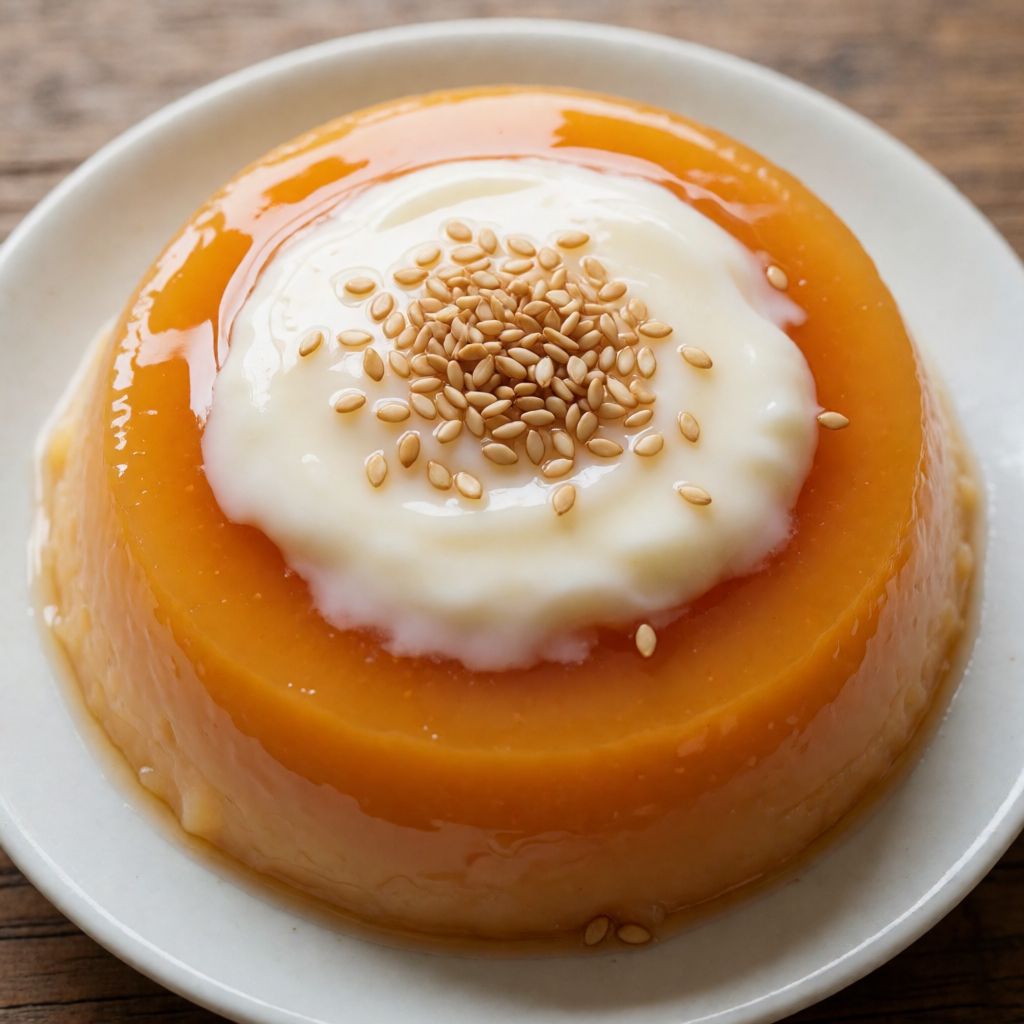
 AI photo
Apricot Pudding
A smooth apricot pudding sweetened with acacia honey and set with agar-agar, served with a sesame crunch.
Labels are worked out automatically from the ingredients and can be wrong. Check the packaging if it matters to you.
Ingredients
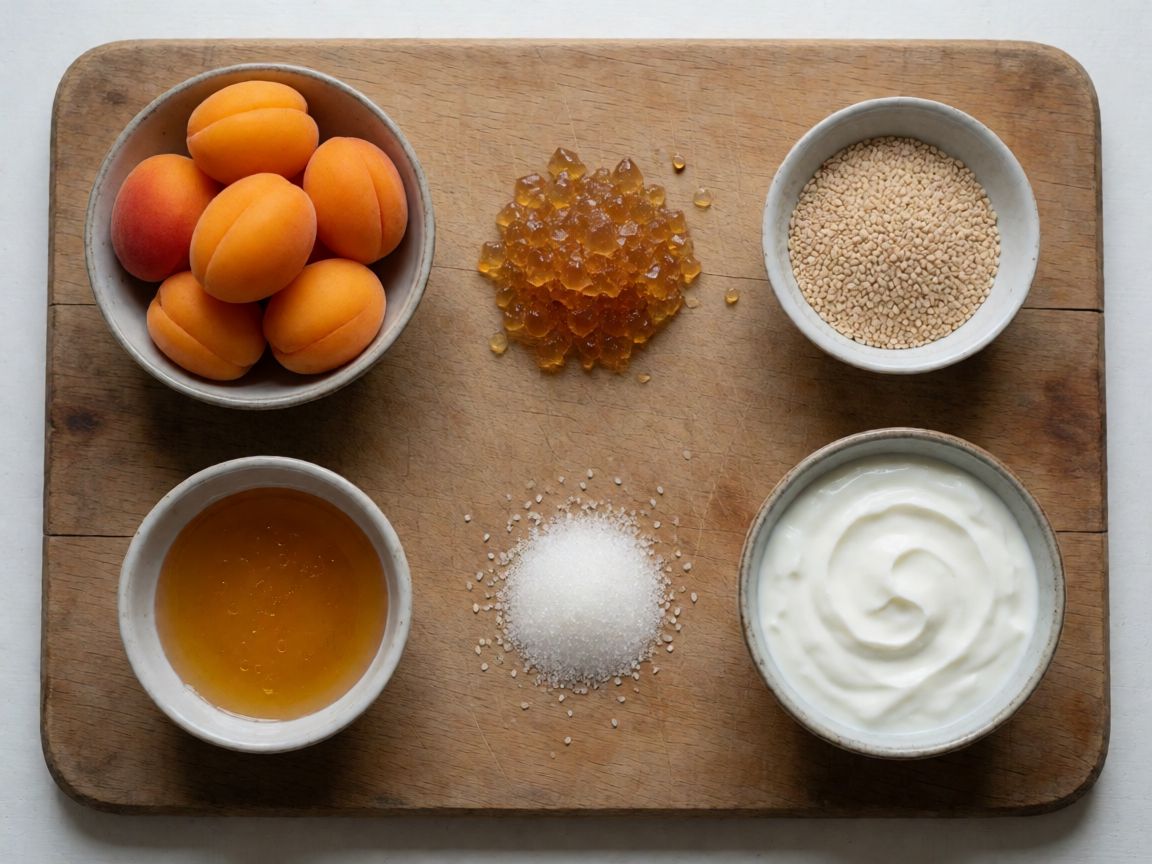
- 500 g Apricots
- 1 tsp Agar-agar
- 3 tbsp acacia honey
- 50 g Sesame seeds
- 100 g Caster sugar
- 100 g Greek yogurt
- pinch Salt a pinch







Steps
Wash the apricots, remove the stones and cut into small pieces. Put them in a saucepan with the acacia honey and a pinch of salt, and cook for a few minutes.
Add the agar-agar and cook for a further 10 minutes.
10 minTransfer the mixture to a bowl and blitz with a stick blender until smooth and even.
Pour the purée into pudding moulds and leave to cool at room temperature.
Once cooled, chill the puddings in the fridge for at least 2 hours to set.
120 minToast the sesame seeds in a frying pan for 2-3 minutes, stirring constantly, until golden and starting to pop.
3 minIn a small saucepan, mix water with the caster sugar and caramelise over a low heat.
Mix the caramel with the toasted sesame seeds and spread the mixture onto a sheet of baking paper.
Cover with another sheet of baking paper and roll out with a rolling pin to a thickness of about 4 mm.
Leave to cool completely at room temperature until firm.
Serve the puddings on individual dessert plates, decorated with yogurt and the sesame brittle.
This is a set apricot pudding — no eggs, no gelatine, no oven. The whole dish stands or falls on one thing: how you handle the agar-agar, because that's what turns soft, sloppy fruit purée into something you can turn out of a mould and cut with a spoon that holds its shape.
Agar-agar isn't gelatine with a different name. Gelatine sets in the fridge and melts again on a warm plate — that's why a gelatine pudding "sweats" if you leave it out too long. Agar sets at room temperature, around body heat already, and once it's set it stays set even if you leave it on the table during Sunday lunch. That's the whole reason this recipe can tell you to cool the puddings at room temperature first and only then chill them — the fridge here isn't doing the setting work, it's just doing the final firming and chilling for taste. Some people skip the room-temperature stage and go straight to the fridge, thinking cold sets things faster — no, because a sudden drop in temperature on a still-warm purée can make the surface firm while the inside stays loose, and you get a pudding with a skin and a puddle underneath.
Apricots: ripe ones, soft enough to give under light pressure — the whole point of cooking them down is to break fruit cells open and release pectin and water, and underripe apricots fight you on this, staying grainy and sour no matter how long you cook them. If British apricots look sad and tight in the shop (they usually do — this fruit doesn't love our climate or our supermarkets' supply chains), use tinned apricots in juice, drained, or even dried apricots soaked back to softness in warm water first. Peaches or nectarines work on the same logic: soft stone fruit with enough acidity to cut the honey.
Agar-agar: a seaweed-derived setting agent, sold as powder or flakes, and the two are not interchangeable gram for gram — flakes need roughly double the quantity and longer cooking to dissolve fully. One teaspoon of powder here is doing real structural work, so don't eyeball it down "because it's healthier" — too little and the pudding never leaves liquid behind, it just slumps. If you genuinely can't find agar (it sits by the gelatine or in the baking aisle of a bigger supermarket, sometimes under "vegetarian setting agent"), gelatine leaves will set the purée, but you lose the room-temperature stability and the texture turns softer, more mousse-like than sliceable.
Acacia honey: chosen here for what it doesn't do — it's one of the mildest, least floral honeys, so it sweetens without arguing with the apricot. Any honey with a light, not-too-perfumed character will do; a heavy-handed heather or manuka honey will fight the fruit for attention. If you'd rather not use honey at all, caster sugar works, though you lose a little of the rounded flavour honey brings and gain nothing in return except convenience.
Sesame seeds: raw, untoasted, white or a mix of white and black for colour. Toasting them yourself rather than buying pre-toasted seeds matters because sesame oil turns rancid fast once its outer coat is cracked by heat, and pre-toasted seeds sitting on a shelf for months have usually gone past their best — you'll taste it as a flat, slightly stale note instead of nuttiness. Watch the pan, not the clock: the seeds go from pale to gold and start to crackle and jump, and that's your signal, not a stopwatch.
Caster sugar for the brittle rather than granulated: finer crystals dissolve faster and more evenly in the water, which matters because uneven dissolving is exactly what gives you a caramel with hard, gritty sugar crystals through it instead of a smooth, glassy sheet. Keep the heat low and resist stirring once it starts to colour — stirring at that point knocks sugar crystals back into the syrup and can seize the whole pan into a grainy mess, which is the real reason caramel recipes tell you to leave it alone.
Greek yogurt at the end isn't decoration for its own sake — it's acid and fat cutting through a pudding that's all sweetness otherwise (honey, sugar, ripe fruit, caramel). Full-fat, thick, unsweetened is what you want; a thin yogurt will just run off the plate instead of sitting as a proper spoonful against the pudding.
As for moulds — small ramekins, teacups, even a muffin tin lined with cling film will do; you don't need proper dariole moulds. To turn the pudding out cleanly, dip the base briefly in warm water to loosen the edge rather than forcing it — agar sets firm enough that a sharp tap or knife around the rim usually does the job without tearing it.
And give the whole thing time. The fruit needs time to break down before the agar goes in, the pudding needs time at room temperature before the fridge, the fridge needs its two hours properly, and the caramel needs time to cool flat and hard before you try to break it into shards. Rushing any one of these doesn't save you minutes — it loses you the pudding.