
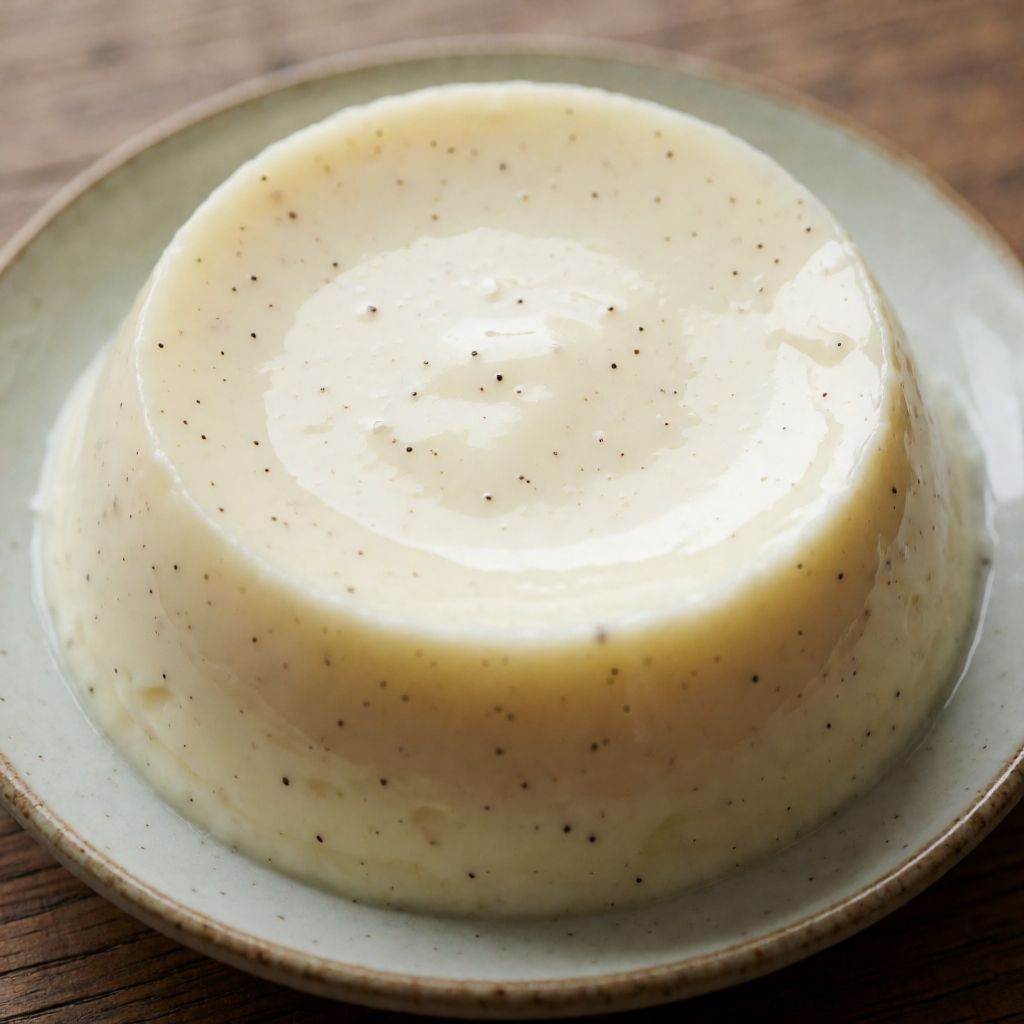
 AI photo
Vanilla Pudding
A silky vanilla pudding set with gelatine, flavoured with a real vanilla pod and chilled until firm.
Labels are worked out automatically from the ingredients and can be wrong. Check the packaging if it matters to you.
Ingredients
- 350 ml Milk
- 250 ml Double cream
- 150 g Caster sugar
- 9 g Gelatine leaves
- 4 pcs Egg yolks
- 1 pcs Vanilla pod




Steps
Put the gelatine leaves in a bowl, cover with cold water and leave to soak for 15 minutes.
15 minSplit the vanilla pod lengthways and scrape out the seeds with the tip of a knife.
Pour the milk and cream into a saucepan, add the vanilla seeds and bring to the boil.
Put the egg yolks in a bowl, add the sugar and whisk until the mixture turns pale.
Remove the milk and cream mixture from the heat and strain it through a fine sieve.
Squeeze out the gelatine and stir it into the hot milk and cream mixture with a whisk.
Stir the whisked egg yolks and sugar into the milk and cream mixture.
Pour the custard into a mould or individual serving glasses.
Leave the pudding to cool at room temperature, then place it in the fridge for 4 hours.
240 minDip the mould in hot water for a few seconds to turn out the pudding.
"Vanilla Pudding" is a misleading name if you grew up with British puddings — this isn't Christmas pudding, no suet, no steaming for hours under a damp cloth. This is a crème that sets cold, held together by gelatine, carrying the weight of cream and egg yolk. Think of it as a close cousin to panna cotta, and to the old blancmange your nan might have turned out of a copper mould — same family, same trick: sweetened cream held in shape by a protein that unwinds in heat and knits back together in cold.
What decides whether it works isn't flavour — vanilla and sugar rarely let you down — it's heat, at two separate moments. First, when you pour the milk and cream over the vanilla seeds and bring it to the boil: that's the moment the fat in the cream pulls the aromatic oils out of the vanilla, because vanilla's flavour lives in fat, not in water. A vanilla pod simmered in plain water gives you very little; in cream, it gives you everything it has.
Second moment: when that just-boiled liquid goes into the whisked yolks. There's no return trip to the stove here, no gentle cooking to nappe stage the way you'd make a proper crème anglaise. The heat of the liquid itself has to do the job — enough volume, hot enough, to carry the yolks past the point raw egg worries you, without scrambling them. That only works if you whisk as you pour, steadily, not in one dump. Stop whisking and you get little cooked flecks through 600ml of custard, and no sieve brings that back.
Milk and cream together, not one or the other: milk carries the vanilla's lighter, brighter notes, cream carries the fat that holds them and gives the set its body. Double cream in the UK sits around 48% fat — go lower and you get a thinner, wearier set that needs a touch more gelatine to compensate; go without cream altogether and you've made a milk jelly, not this. If double cream isn't in, whipping cream will do, you'll just get a softer wobble, nothing to lose sleep over.
Caster sugar is chosen for its grain, not its purity — fine crystals dissolve into whisked yolks fast, before you've tired your arm. Granulated works if you whisk longer and don't mind the extra minute. Leave muscovado or demerara out of this one; their molasses note fights the vanilla rather than supporting it, and that's reason enough, not tradition for tradition's sake.
Gelatine leaves, the kind sold in most UK shops, are almost always platinum strength — that's why the recipe can say "9g" and trust it to set roughly 600ml of liquid to a soft, spoonable firmness. If you only have powdered gelatine, match it roughly gram for gram and still bloom it, in a splash of cold water, before it goes anywhere near heat — the mechanism doesn't change: gelatine that goes into hot liquid dry clumps and never fully opens up, leaving grainy spots that no amount of straining the custard earlier will save you from.
Egg yolks here are doing a job most people assume eggs always do — thickening — but they're not the main thickener in this dish, the gelatine is. The yolks are there for colour, for the particular silkiness only fat-and-protein-in-suspension gives, and because a custard without yolk tastes thin even when it's perfectly set. That's also why there's no long stovetop cooking of the base: you're not building a set from egg coagulation, so you don't need the 80-odd degrees that would demand. Some say any custard with raw-looking egg yolk in it is unsafe to eat cold — no, because the point of pouring the liquid in boiling and whisking hard is exactly to carry the yolks through that heat in one pass; if you're nervous about it, bring the milk and cream to a proper rolling boil, not just a shiver, before it meets the yolks.
The vanilla pod itself: choose one that's plump and a little oily to the touch, not dry and brittle — a dry pod has given up most of what it had to give before it ever got near your pan. If you've none, a teaspoon or two of good vanilla extract, added once the milk is off the heat, does the job honestly; it won't give you the black flecks, but it gives you the flavour, which is the point.
For the mould: this is where a dariole mould or a jelly tin earns its keep in the back of a cupboard, but ramekins, teacups, even small glass bowls all work — anything with a slightly flared shape releases more willingly than straight sides. The hot-water dip at the end isn't ceremony: it melts a whisper-thin layer of set gelatine right where it touches the mould, so the pudding lets go under its own weight when you turn it out, rather than tearing. Running a knife round the edge first, which people do out of habit, usually just scars the surface — heat does the releasing, the knife only cuts it. And don't shortchange the chilling: four hours is a floor, not a target. A single large mould has further for the cold to travel to its centre than four small glasses do, and gelatine that hasn't finished setting all the way through will look fine on top and sulk in the middle when you turn it out.