
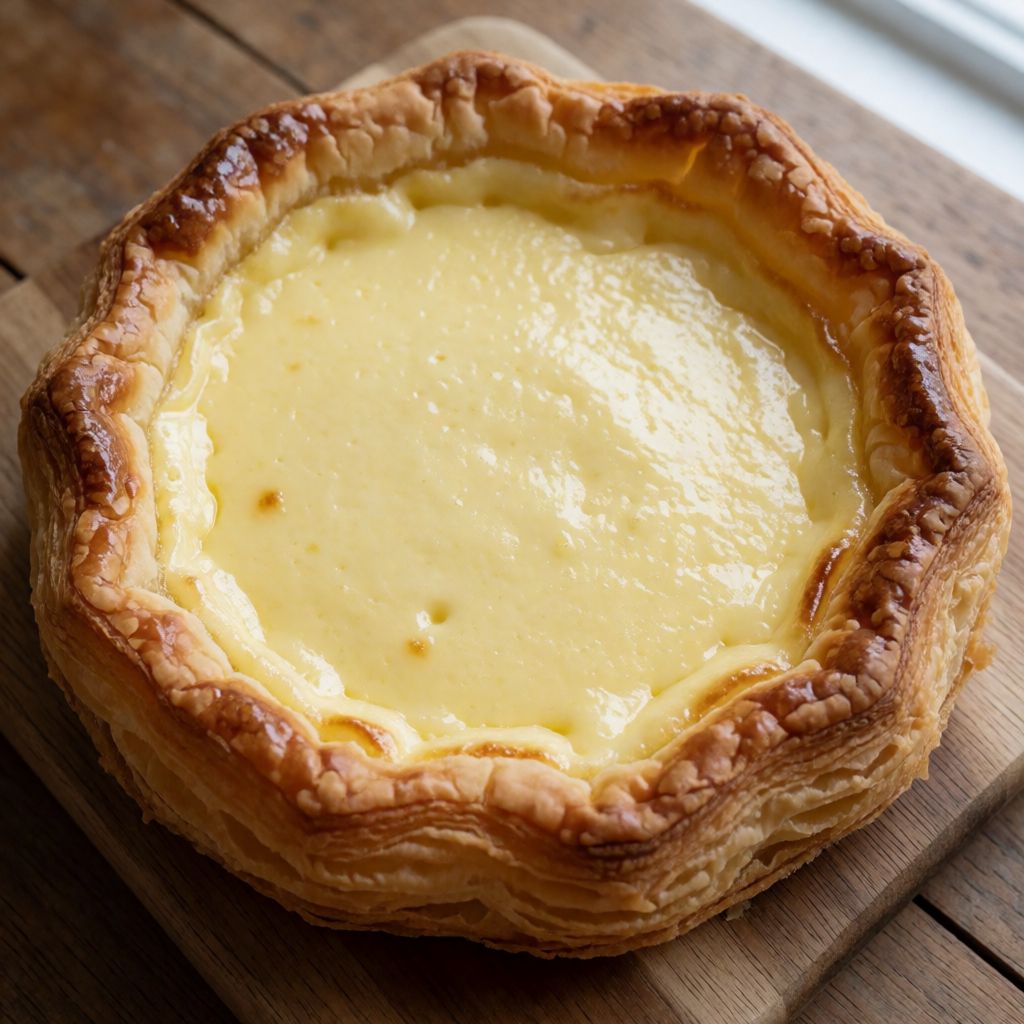
 AI photo
Puff Pastry Custard Tart
A classic puff pastry tart filled with smooth vanilla custard and finished with a pastry lattice on top.
Labels are worked out automatically from the ingredients and can be wrong. Check the packaging if it matters to you.
Ingredients
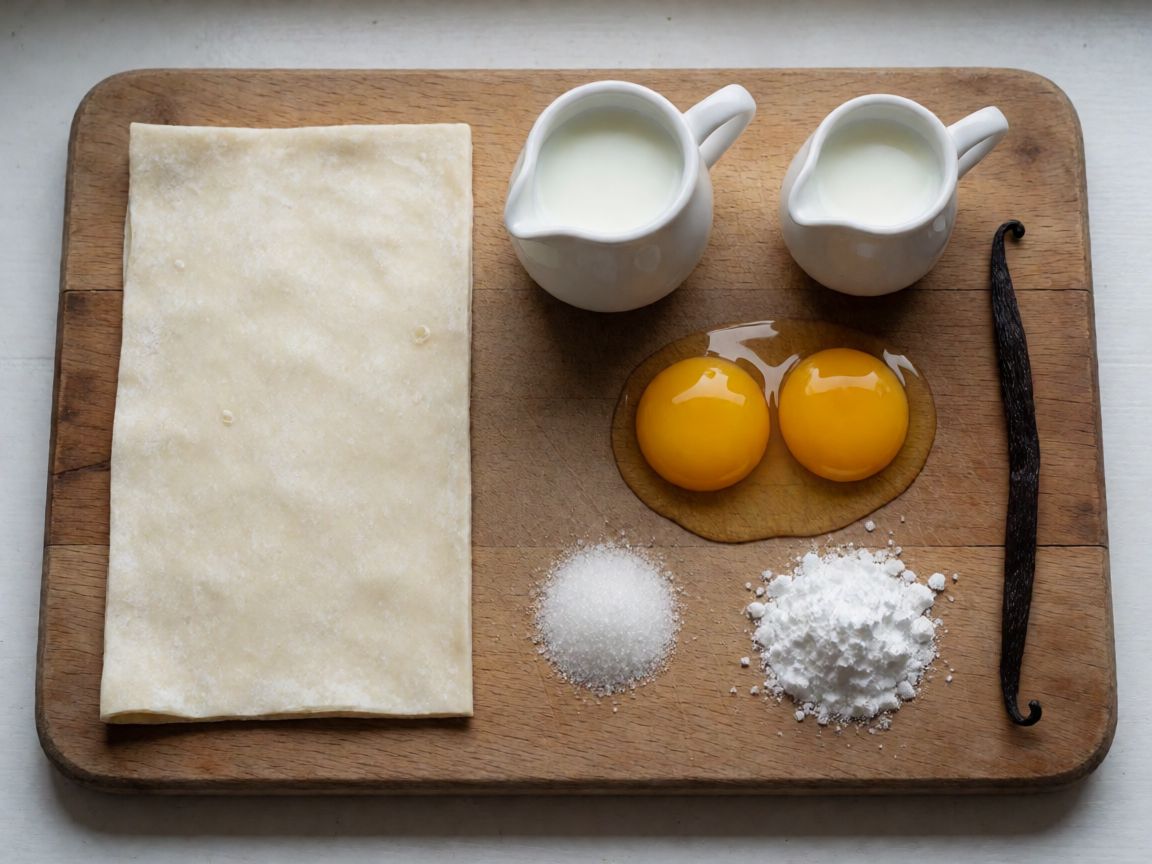
- 1 pcs Puff pastry
- Milk for brushing
- 250 ml Milk
- 2 pcs Egg yolks
- 50 g Caster sugar
- 30 g Potato starch
- 1/2 pcs Vanilla pod




Steps
Prepare the custard: pour the milk into a saucepan, add the vanilla pod and bring to the boil.
Whisk the egg yolks with the sugar and potato starch until smooth.
Pour the egg mixture into the hot milk, stirring over low heat until the custard thickens.
Let the custard cool.
Roll out the puff pastry and trim it to fit a 22 cm tart tin, keeping the trimmings.
Line the tin with the pastry on baking paper, prick it with a fork and pour in the custard.
Cut the trimmings into strips and arrange them in a lattice on top.
Fold the edges of the pastry inwards and brush with milk.
Bake in the oven at 180°C for about 25 minutes, covering with paper if needed.
25 min
What you're making here is a cross between a French flan pâtissier and a British jam tart: a thin, wobbly custard baked right inside a puff pastry shell, with the trimmings turned into a lattice on top instead of being thrown away. That lattice isn't decoration for its own sake — it's steam management. A full sheet of raw pastry laid over wet custard would trap steam underneath, rise unevenly, and crack the custard crust as it lifts. Strips let the steam escape between them, so the top stays flat enough to brown instead of blistering.
What decides whether this tart works is a conflict of temperatures that the recipe is quietly solving for you. Puff pastry wants heat fast and hard — the water in its butter layers needs to flash into steam before the butter melts and runs out, otherwise you get a pale, greasy base instead of flaky layers. Custard wants the opposite: gentle, patient heat, because egg yolks set at a much lower temperature than pastry needs to puff, and if they get there too fast they curdle and weep water. 180°C is the compromise point — hot enough to lift the pastry, cool enough that the custard sets to a tremble rather than scrambled eggs. Some say puff pastry only behaves properly at a roaring 220°C — no, not with a wet filling sitting on it, that temperature would set the crust days before the centre decides what it's doing, and you'd be covering it with paper from minute five.
Puff pastry, for a kitchen without a kazan or a pastry brake, means the shop-bought block or ready-rolled sheet, and that's not a compromise — even most French pâtissiers buy it rather than laminate it themselves for a tart this size. What you're looking for is pastry that's still cold and firm when you unroll it; if it's gone soft and greasy at room temperature, the butter has already started separating from the dough and no amount of oven heat will give you distinct layers. Keep the trimmings, as the recipe says — that's not thrift for its own sake, it's structural: those strips are your steam vents and your lattice in one.
Milk, boiled with the vanilla pod, is doing a specific job: heat opens the pod's seeds and oils and lets them move into the liquid, which cold milk simply won't pull out of a pod on its own. If you don't have a pod, use an extract or paste with a real vanilla smell, not a vanillin one that smells like a candle shop — the test is simple, smell it before it ever goes near the pan.
Egg yolks only, no whites, because whites would set the custard rubbery and cloud it; yolks alone give you the colour and the silkiness, at the cost of needing something else to thicken the body, which is where the starch comes in. Potato starch (or cornflour, by the same logic — any starch that cooks to a clear, glassy gel rather than a cloudy paste) thickens without the raw, pasty taste flour leaves if it's undercooked, and it sets firmer on cooling, which matters here because this custard has to hold its shape once sliced, not slump like a crème anglaise.
Caster sugar dissolves into the yolks almost on contact because the grains are small; granulated will get there too, it just asks for more whisking before you add it to the milk, otherwise you're fishing out undissolved grit later.
The whole custard stage — whisking, pouring hot milk slowly onto yolks, stirring low and steady until it thickens — is where patience is the actual ingredient. Rush the heat and the yolks coagulate before the starch has gelatinised evenly, and you get custard with little curdled threads running through it instead of one smooth set. Milk for brushing the folded edge, instead of egg wash, gives a softer, more matte finish — less shine, less deep brown, which suits a tart that's meant to look like pastry and custard, not a glazed pie. If you want more colour on the rim, egg wash works too; just know you're trading matte for shine, not fixing a fault.