
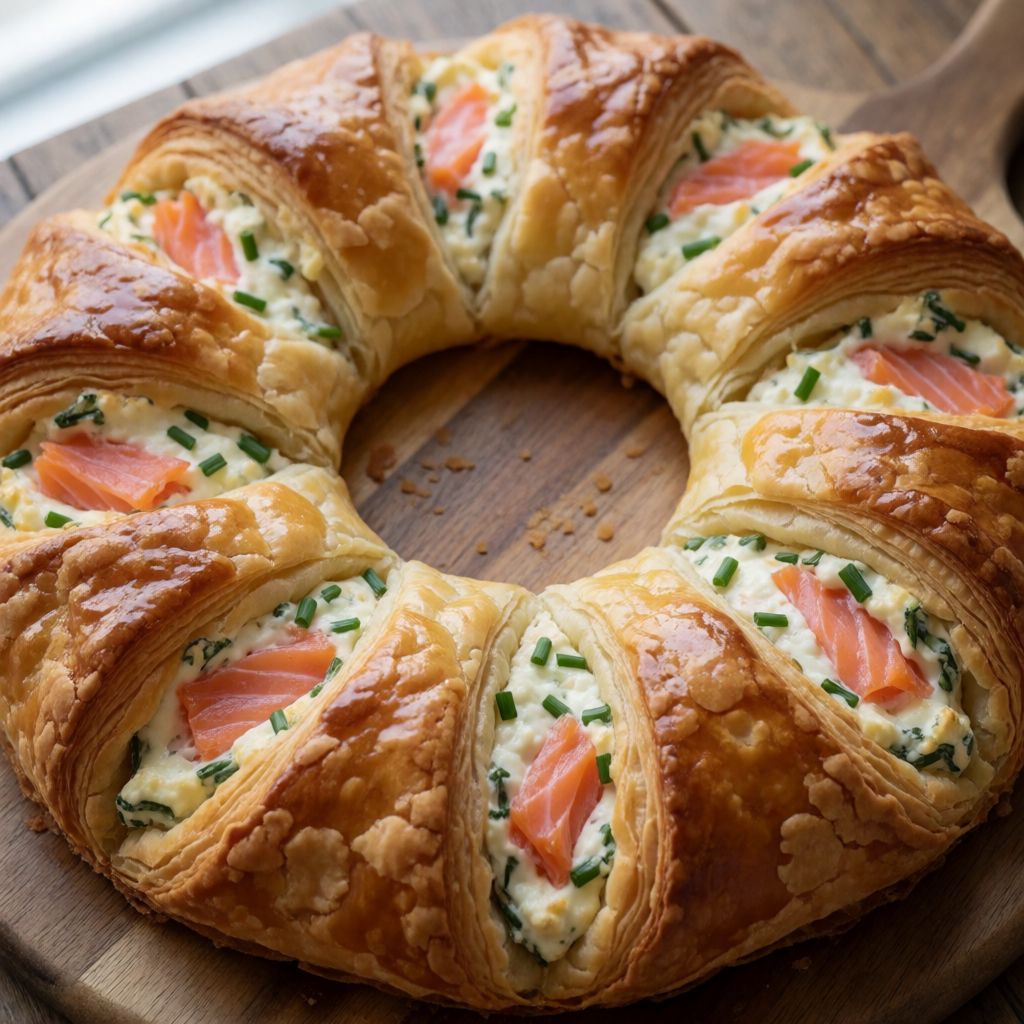
 AI photo
Puff Pastry Wreath with Salmon
A festive puff pastry wreath filled with a creamy ricotta, chive and smoked salmon mousse, topped with sesame and poppy seeds.
Labels are worked out automatically from the ingredients and can be wrong. Check the packaging if it matters to you.
Ingredients
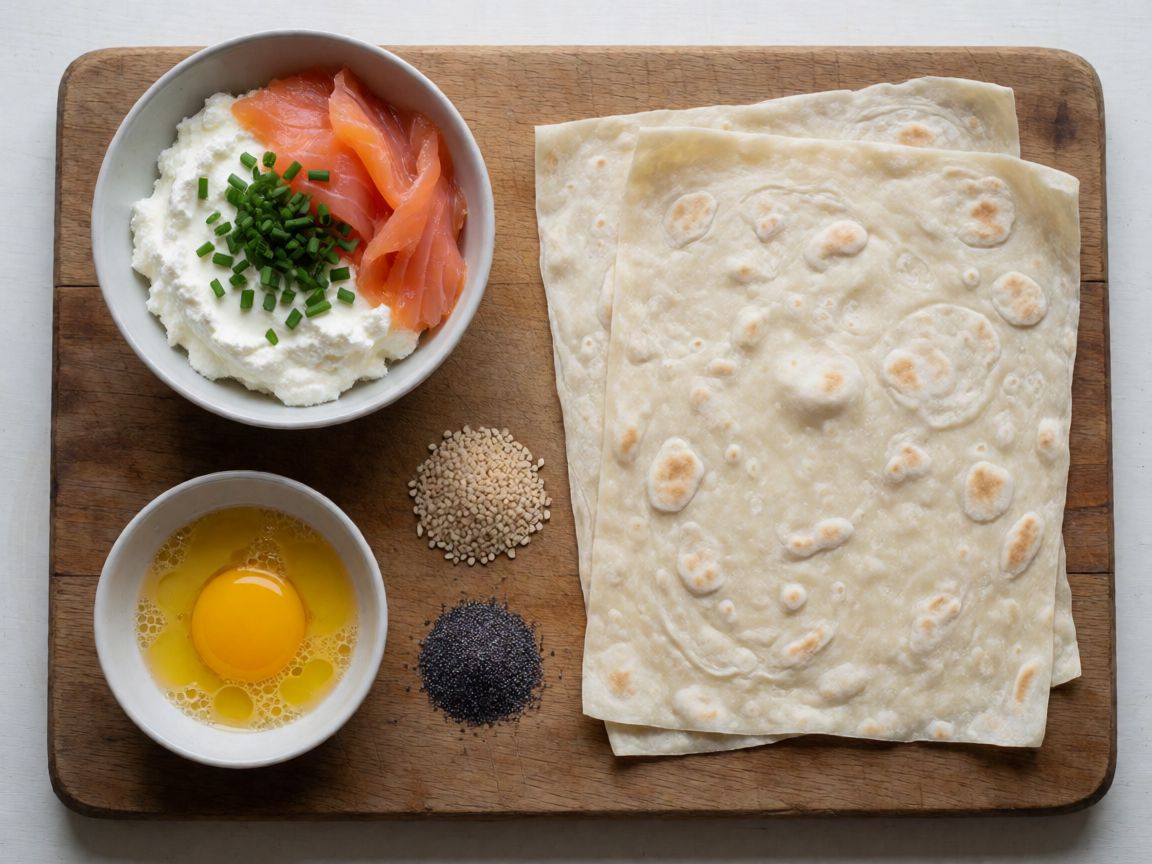
- 2 pcs Puff pastry ready-rolled sheets
- 200 g Ricotta
- 200 g Smoked salmon
- 1 bunch Chives
- 1 pinch Salt
- 1 pinch Black pepper
- 1 pcs Egg yolk lightly beaten
- 1 tbsp Sesame seeds
- 1 tbsp Poppy seeds









Steps
In a blender, combine the ricotta, chives, smoked salmon, salt and pepper, and blend until smooth and creamy.
Lay one sheet of puff pastry on a baking tray and spread the filling evenly, leaving a 1cm border around the edge.
Cover with the second sheet of pastry, place a bowl in the centre and make the first 4 cuts around it.
Divide each of the four sections with three more cuts, to make 16 sectors in total.
Take two sectors at a time, twist them together twice and join the ends.
Remove the bowl, divide the central part into 8 sections and fold them outward.
Brush the surface with egg yolk, sprinkle with sesame and poppy seeds, and bake in the oven at 200°C.
28 min
What you're building here isn't a pie, it's a wheel — two sheets of puff pastry sandwiched round a wet filling, then cut and twisted into spokes so the oven can get at every layer at once. That's the whole trick: a double-layered disc baked flat would puff thick in the middle and barely lift at the rim, because the centre sits on filling and the edge doesn't. Cutting it into sixteen strips and twisting them exposes bare pastry everywhere, so steam escapes evenly and every spoke rises the same amount. The wreath shape isn't decoration for its own sake — it's how you solve an uneven-heat problem without a kazan, just a flat tray and a domestic oven.
What decides whether it works is the filling, and almost nothing else. It has to be thick enough to hold its shape when the top sheet goes down and the cuts go through it, and dry enough that it doesn't ooze into those cuts and glue the twists shut. Ricotta that's been sitting in its own whey, or salmon that's been minced too wet, will leak the moment you press the bowl rim into the dough to mark the centre — and a leaking filling means a wreath that won't separate into clean spokes, just a soggy, fused mess. That 1cm untouched border round the edge is the seal: it's where the two sheets are pressed together bare, with no filling between them, so the whole thing holds its edge instead of blowing apart in the heat.
Ricotta is doing one job here: binding and softening the salmon without fighting its flavour. The criterion for a substitute is simple — any soft, mild, unsalted curd cheese that won't weep liquid once blended. Drained cottage cheese works, pushed through a sieve so it loses the grain. A full-fat cream cheese works too, though it brings more fat and a slightly heavier mouthful. What won't work is anything salted or tangy enough to compete with smoked fish — feta, for instance, turns the filling into a fight between two strong flavours instead of one smooth one.
Smoked salmon is the whole point of the filling, but it's also the most forgiving ingredient in the list, because it's going into a blender, not staying whole. The only real requirement is that it's firm enough to mince cleanly rather than turn to paste on its own — offcuts sold cheap at the fish counter are exactly right for this, since you're pureeing them anyway and paying full price for pristine slices would be wasted here. If you've no smoked salmon, any other smoked or cured fish with a comparable oiliness — smoked trout, smoked mackerel with the skin and any dark flesh trimmed off — will carry the same job, though the flavour shifts from delicate to more assertive, mackerel especially.
Chives are there for a clean, grassy bite that doesn't turn raw and sharp the way a chopped onion would. If you've none, the green part only of a spring onion, sliced very fine, does the same work — the white part is too aggressive raw and will sit in the filling like little hot coals. Dill is the other obvious stand-in with salmon, and it's not wrong, just a different dish; chives keep the filling quiet, dill makes it loud.
Puff pastry from a packet is worth defending, not apologising for. Proper puff is built from folding butter through dough dozens of times until you've got hundreds of separate layers — a job that takes real time and a cool room, which is exactly why it became an industrial product long before it became a home one: a factory can hold a consistent cold temperature all day, your kitchen counter can't. Buying two ready-rolled sheets isn't cutting a corner, it's buying back the one ingredient home baking struggles to supply reliably — cold, steady hands-off time.
The egg yolk goes on thin, with a brush, right before the seeds — not before, or the seeds won't stick, and not with a heavy hand, or it pools in the cuts and burns there before the dough underneath has even coloured. Sesame and poppy together give you two different textures and two different colours against the gold, which matters more here than flavour, since neither seed brings much taste at the quantities used — this is a dish eaten with the eyes as much as the fork, three or four to a wreath if you're calling it a light main, more as a starter alongside the kind of spread you'd put out after a Sunday roast, with tea poured for whoever's still standing by the time it's cool enough to cut.