
 AI photo
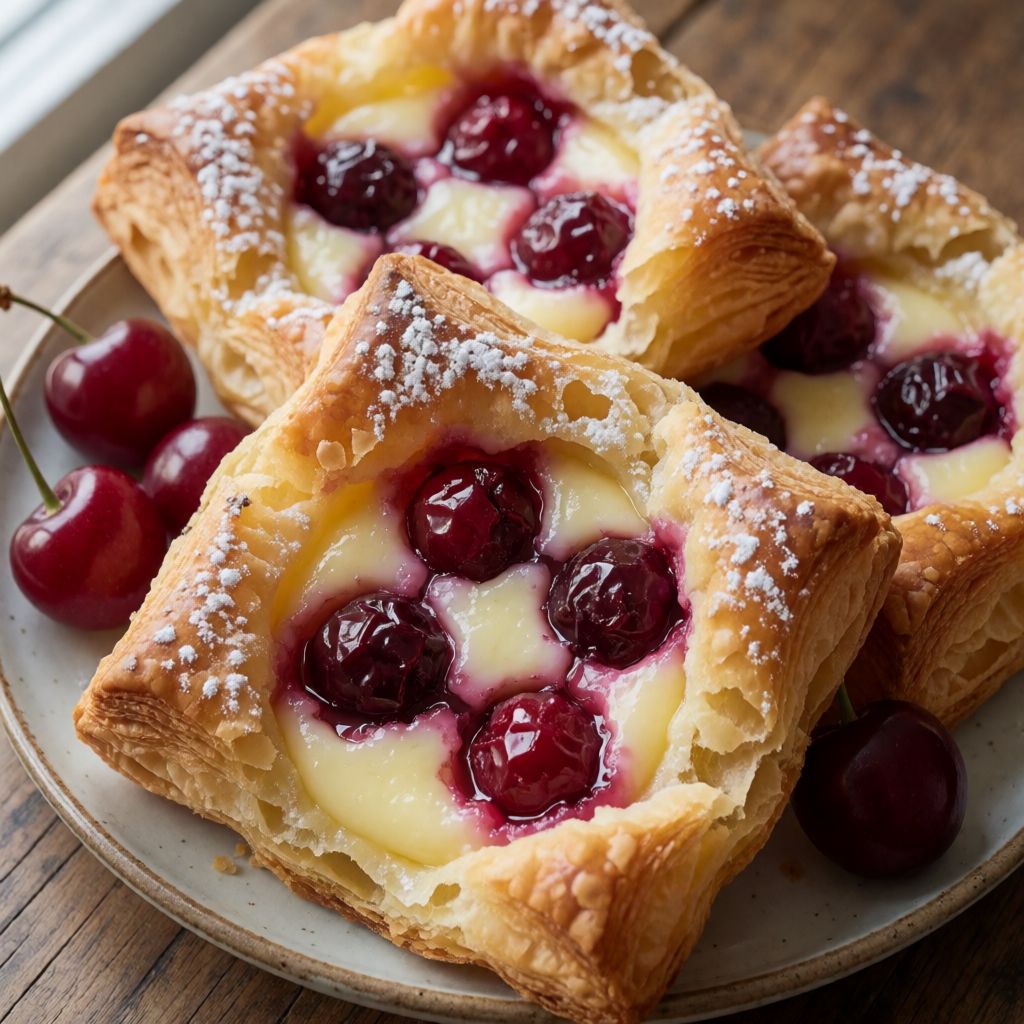
Cherry and Custard Puff Pastries
Flaky puff pastry parcels filled with a smooth lemon custard and topped with glazed cherries.
Labels are worked out automatically from the ingredients and can be wrong. Check the packaging if it matters to you.
Ingredients
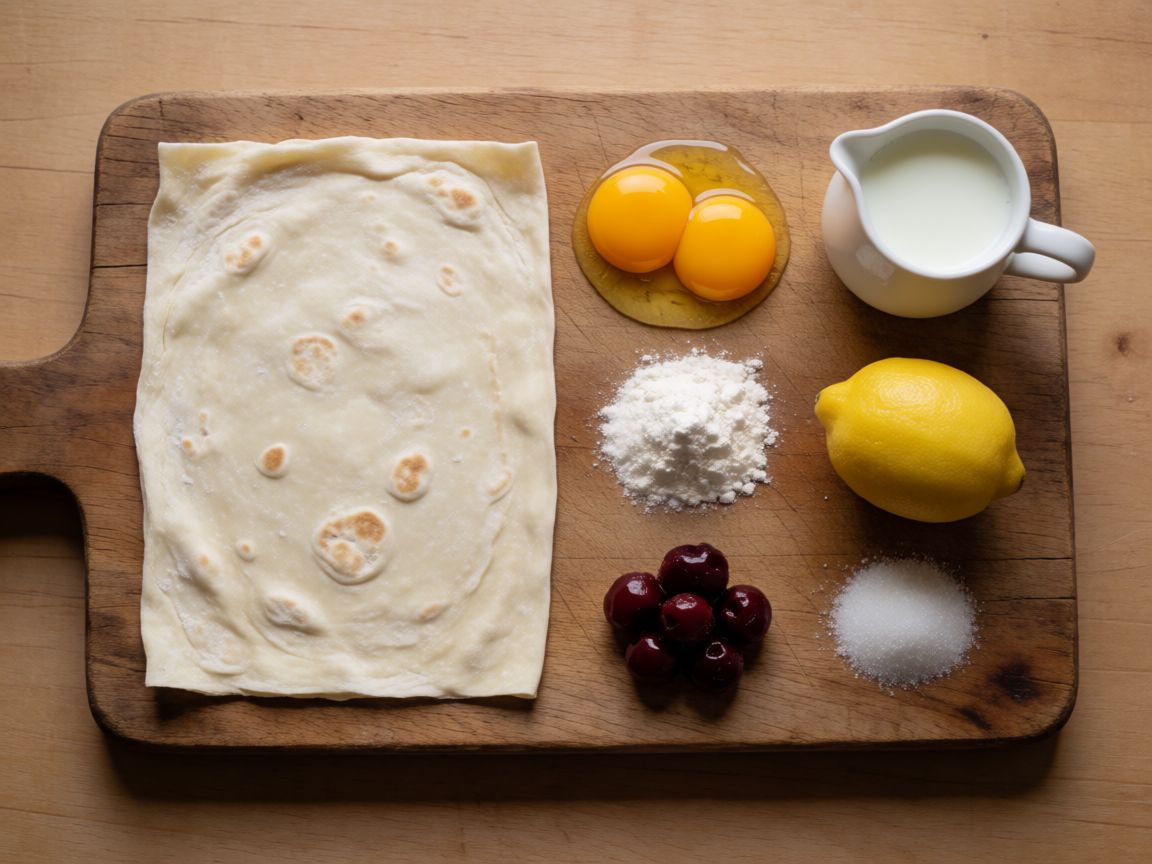
- 1 pcs Puff pastry
- 2 pcs Egg yolk
- 1 tbsp Sugar
- 1 tbsp Flour
- 200 ml Milk
- 1 pcs Lemon for zest
- 150 g Cherries
- 70 g Sugar
- 1 tbsp Lemon juice






Steps
Cut the sheet of puff pastry into six squares, fold each in half, snip two slits along the folded edges, then unfold and cross the outer strips over one another.
Lay the pastries on a baking tray, prick them with a fork and brush with beaten egg yolk.
Bake at 180°C fan until golden.
18 minWhisk the egg yolk with the sugar, stir in the flour, then gradually whisk in the milk.
Pour the mixture into a saucepan, add the lemon zest and cook gently, stirring, until thickened.
Leave the custard to cool.
Halve the cherries and cook them with the sugar and lemon juice.
5 minSpoon the custard into the centre of each pastry and finish with the cherry glaze.
What you are building here is not a filled pastry in the usual sense — it is a little puff-pastry basket that has to make its own walls by rising, and then you drop a cool custard and hot-cooked cherries into the hollow it leaves. The whole dish stands or falls on two things: whether the pastry actually rises into a frame instead of a flat biscuit, and whether you have the patience to let the custard go cold before it meets that frame.
The cross-over cut at the start is not decoration. Puff pastry rises because steam, trapped between dozens of thin butter layers, pushes them apart like a concertina. If you bake a plain square, it puffs up any old way, lopsided, and you get no well to put anything in. Snip the folded edges and cross the outer strips, and you have built yourself a low wall on four sides — the steam still pushes everything up, but now it pushes up around a space you have already decided the shape of. Some say puff pastry just "does its own thing" in the oven and shaping is pointless. No — because without that frame your custard has nowhere to sit and runs straight off the tray.
Puff pastry you buy, you don't make at ten o'clock on a weeknight — nobody sane does, not even in a proper kitchen with a kazan-sized worktop. Any all-butter ready-rolled sheet from the chiller cabinet does the job; the only thing to check is "butter", not vegetable fat blend, because butter is what melts into those gaps and leaves room for steam. Six squares from one sheet gives you two pastries a head for three people — a dessert, not a cake, so that is plenty.
Two egg yolks go two different ways, and that split matters. One brushed on top is there purely so the surface browns and shines — egg yolk browns faster and glossier than the pastry alone, nothing more mystical than that, so don't fuss over a perfectly even coat, a quick once-over with a pastry brush is enough. The other goes into the custard, where the yolk's fat is what gives body and richness without the rubbery edge egg white brings; you don't want whites in a custard, they set too firm and too fast.
The tablespoon of flour in the custard is not there to taste of anything — it raises the temperature at which the egg protein would otherwise seize and curdle, so you can cook the mixture properly thick instead of nervously half-setting it off the heat too soon. Whisk the sugar into the yolk before anything else touches it: sugar grains dissolving straight into yolk coat the protein and are part of what stops it going grainy later, not just sweetness arriving early. Milk goes in gradually afterwards so you are warming the yolk mixture up in stages rather than shocking it — pour it all in cold at once and you risk pockets that scramble before the rest has caught up.
Lemon zest in the custard is there for the oil in the skin, not the juice — zest an unwaxed lemon if you can get one, since wax sits on the surface and doesn't want to let the oil out into warm milk. The same lemon's juice, saved for the cherries, does a different job entirely: cherries have almost no acidity of their own once sugared, and without it the glaze tastes like sweetness and nothing else. If cherries aren't in season, frozen ones work, but drain them properly first — they shed far more water than fresh fruit, and that water will turn your quick glaze into a thin puddle instead of a syrup that clings.
Some people treat custard and British tinned custard as the same word meaning the same thing — no, because what you're making here holds its own shape enough to sit on a pastry without soaking through it, where jug custard would vanish straight into the crumb. That's also why it has to be properly cold before it meets the pastry — not just cool to the touch, properly chilled through, so it behaves like a soft paste rather than a sauce. Rush that step and the whole point of building the pastry frame in step one is wasted, because the walls go soft from the inside before anyone gets a fork in.