
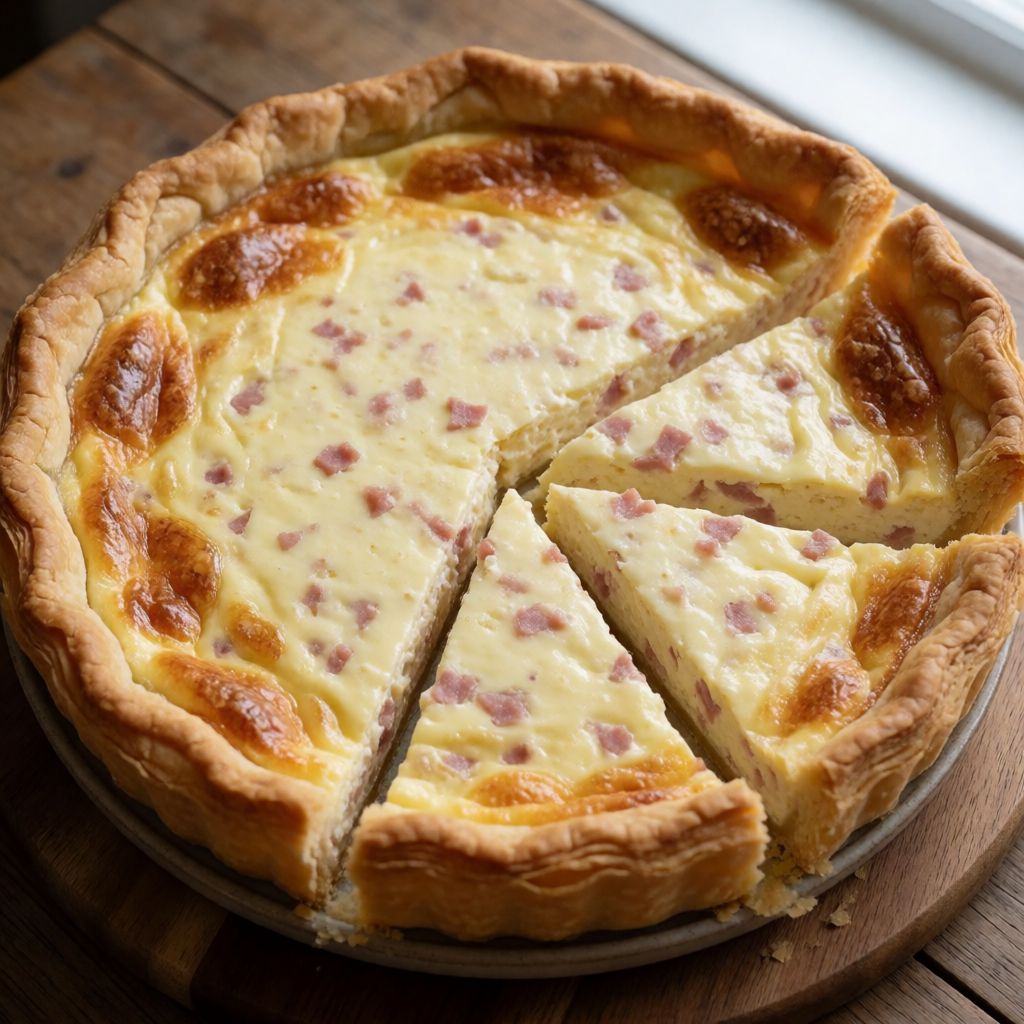
 AI photo
Quiche, My Way
A simple savoury quiche with ricotta, ham and cheese, great for using up leftovers.
Labels are worked out automatically from the ingredients and can be wrong. Check the packaging if it matters to you.
Ingredients
- 1 pcs Puff pastry sheet or shortcrust pastry
- 200 g Ricotta
- 100 g Ham
- 4 pcs Eggs
- Salt to taste
- Black pepper to taste
- Leftover cheese, diced e.g. fontina, tomme or emmental, to taste





Steps
Beat the eggs in a bowl, add the ricotta, the diced cheese and the ham cut into strips. Mix well and season with salt and pepper.
Line a tin with baking paper, lay in the pastry, prick the base with a fork and shape the edges.
Fill the tin with the filling.
Bake at 180°C for 28 minutes.
28 minServe hot or warm.
What was changed
Leftover cheese, diced was swapped in because cottage cheese cannot be cut into cubes like a firm cheese.
Quiche is not really a recipe, it's a method: beat eggs, loosen them with something soft and milky, bind in whatever's left in the fridge, pour it over pastry, and bake until the custard holds a shape instead of running. What decides whether it works has nothing to do with France and everything to do with protein and water.
Eggs are the glue. Four eggs to 200g of ricotta is roughly the ratio that sets firm but still trembles - too much wet dairy and you get egg soup under a crust, too little and you get rubber. At 180°C the egg proteins unfold and link up slowly enough that the whole tin heats through evenly, before the surface overcooks and starts weeping. That watery pool you sometimes find under a slice isn't bad luck - it's custard cooked too hot too fast, squeezed dry of its own liquid. You want the centre to wobble like a set jelly when you nudge the tin, not slosh, not stand like a brick. 28 minutes is where that usually happens in an ordinary oven - check the wobble, don't just trust the timer.
Some say quiche needs the pastry blind-baked first - no, not this one. Blind-baking exists for deep, slow-cooked custard tarts where raw dough would turn to paste long before a thick filling sets. Here the layer is thin, the bake is quick, and the pastry sits right under it - there's enough direct heat coming up through the tin to crisp the base before the custard has time to soak in.
Ricotta, not cream, is doing a specific job. It's a curd cheese, already mostly set, with less free water than double cream or crème fraîche - so it dilutes the eggs just enough to keep the custard soft, without adding so much liquid that the bake turns watery. If you've no ricotta, use any drained soft fresh cheese with little loose whey - cottage cheese pressed through a sieve, fromage blanc, even full-fat quark. Avoid mascarpone on its own; it's richer than this dish needs and will sit heavy instead of setting light.
The cheese you dice in is genuinely "leftover" - that's not false modesty in the ingredient list, it's the whole point of the dish. The criterion is simple: you want a cheese that melts without flooding the custard with extra water or fat. Semi-hard, aged a little - fontina, tomme, emmental, a knob of cheddar going dry at the edges - all behave. A very fresh, high-moisture cheese like mozzarella will dump water into the mix as it melts and you'll be back to that weeping-custard problem, just caused by cheese instead of heat.
Ham cut into strips is just cooked, salted meat for backbone and saltiness - and if Sunday's roast left you with a bit of gammon going spare, that's exactly what belongs here instead of buying ham specially. Bacon, leftover chicken, even a few anchovies if you want something saltier and sharper, all do the same structural job: something savoury the egg can hold in suspension. Taste the mixture before you add extra salt - cured meat and aged cheese have usually already salted it for you, and oversalting is the easiest way to ruin a dish this simple.
Puff pastry versus shortcrust is a real choice, not a formality. Puff gives you a flaky, slightly crisp edge that contrasts with the soft custard and bakes fast enough to match the 28 minutes without extra attention. Shortcrust is the older, more traditional base - sturdier, a bit more work to roll, and it wants its base pricked just as carefully, maybe given a couple of extra minutes if it still looks pale at the edges when the custard's set. Either is correct; they're just two different textures sitting under the same egg mixture.
In an ordinary kitchen, don't go looking for a proper loose-bottomed tart tin if you haven't one. Baking paper lining any oven dish of a similar size does the job - it stops sticking and lets you lift the whole thing out to serve. One real limit of a home oven worth knowing: heat from below is often weaker than heat from above, which is exactly where a soggy base comes from. If your oven runs that way, sit the tin on a baking tray that's already hot from a few minutes in the oven - it gives the pastry a head start on crisping from underneath, fighting the oven's own weak spot rather than the recipe's.
Quiche as a dish has peasant economics behind it, not mystery: eggs and dairy were what a farm always had, and a tart base was a way to stretch a little meat and cheese into a filling meal without much of either. There's no magic ratio handed down from Lorraine - just egg as a cheap, reliable setting agent for whatever else was in the larder. Treat this version the same way: it rewards using what's actually left over, and it rewards patience with the oven door shut, letting the custard set on its own time rather than rushing it with more heat.