
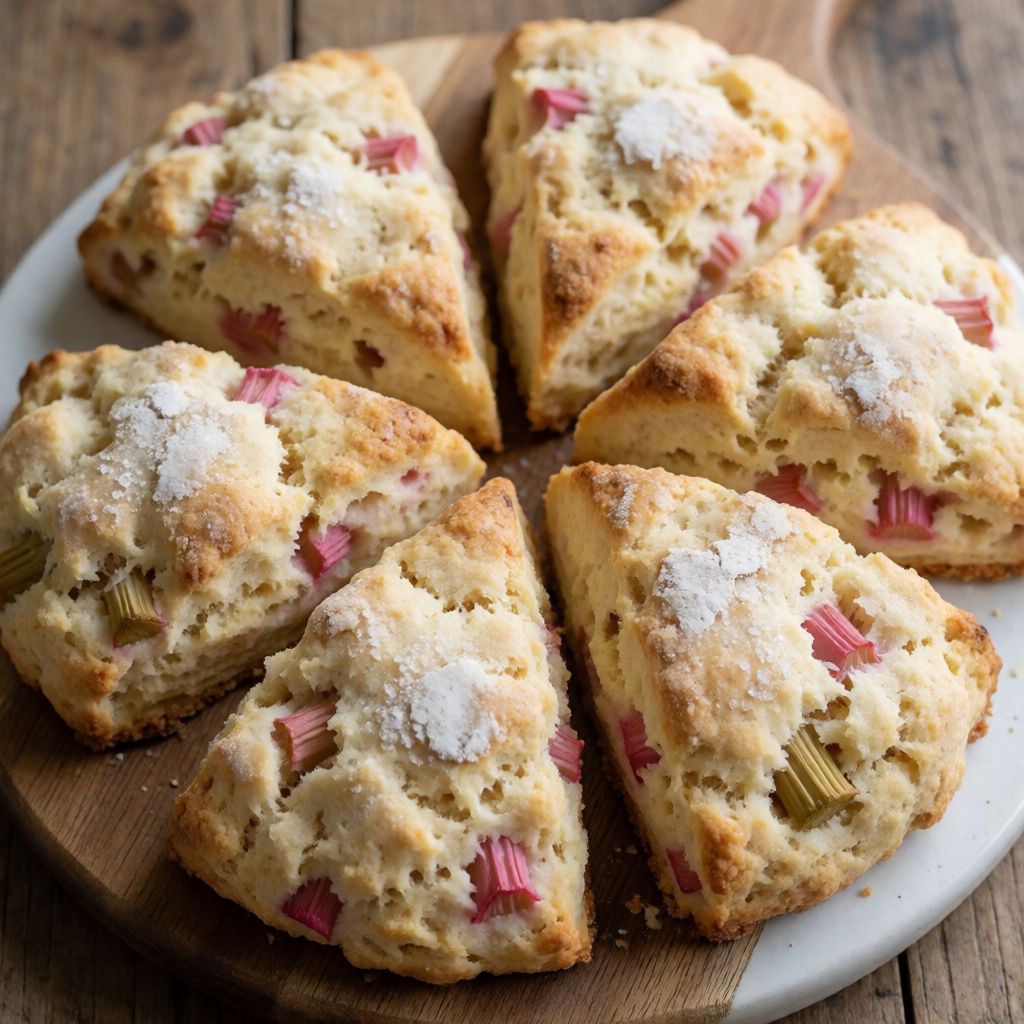
 AI photo
Rhubarb Scones
Soft, buttery scones studded with diced rhubarb, brushed with egg for a golden finish.
Labels are worked out automatically from the ingredients and can be wrong. Check the packaging if it matters to you.
Ingredients
- 180 g Plain flour
- 30 g Caster sugar
- 0.5 tsp Salt
- 1 tsp Baking powder
- 70 g Butter cold
- 100 ml Buttermilk
- 4 tbsp Whipping cream
- 75 g Rhubarb diced into small cubes
- 1 pcs Egg beaten









Steps
Mix all the dry ingredients in a bowl. Rub the cold butter into the mixture with your hands until pea-sized lumps remain, then add the rhubarb and stir.
5 minQuickly pour in the buttermilk and bring the dough together with the whipping cream. The dough should be only just combined – do not knead it.
2 minTurn the dough out onto a floured surface and press into a 1.5 cm thick square. Cut out rounds with a 6 cm cutter.
Place the scones on a baking tray lined with baking paper. Brush the tops evenly with beaten egg.
1 minBake in a preheated fan oven at 180°C for 16–18 minutes, until lightly golden.
17 minLet the scones cool for a few minutes on a wire rack and serve warm, fresh from the oven.
3 min
What was changed
The oven temperature was rounded to the nearest display step: .
A scone is not bread. It's a fast dough — flour, fat, and a leavening agent that works through chemistry, not yeast and time. What decides whether it rises into layers or collapses into a biscuit the size of a hockey puck is one thing: the butter, and how little you handle it after it goes in.
Cold butter rubbed into flour until the pieces are pea-sized — not finer — stays solid long enough to hit the oven still in lumps. In the heat, each lump melts and the water inside it turns to steam, pushing the dough apart from the inside. That's your lift, not the baking powder alone. Baking powder gives gas; the butter gives the structure that gas pushes into. Rub the butter down to fine crumbs and you lose that structure — you get a dense, sandy scone instead of a flaky one.
The rhubarb goes in after the butter is already rubbed in, cut into small dice, not grated or stewed down. Small pieces stay where you put them and don't bleed their water into the flour before baking starts — rhubarb is mostly water and tartness, and too much liquid too early turns your dough gummy. Its sourness is doing a real job too: cutting through the butter the way lemon cuts through fat on fish.
Some say scones need a good knead, the way bread dough does, "to build structure." No — the opposite. Bread wants gluten: long chains that trap gas and give chew. A scone wants the gluten left half-asleep. Knead it and you wake it up, and you get something that chews like a bap, not a scone. "Just combined" means stop the second there's no loose flour left. That's it, no further.
Buttermilk isn't here for flavour alone. It's acidic, and that acid reacts with the alkaline part of your baking powder to release extra gas, and it also loosens the gluten strands that are forming, keeping the crumb tender rather than springy. If you've none in the fridge, the criterion is simple: any soured dairy with real acidity. A squeeze of lemon juice stirred into ordinary milk and left five minutes will curdle and do the same job, a thinned-down plain yoghurt works too. Plain milk on its own won't — you'll get rise from the baking powder but not the tenderness.
The whipping cream comes in right at the end, to finish bringing the dough together without adding plain water, which would do nothing but build gluten. Cream brings fat as well as moisture, so you get cohesion without toughness. Any cream with enough fat to enrich rather than dilute will do — double cream works, just a little richer; single cream is thinner and does less work, but it won't ruin anything.
The egg wash on top is pure surface chemistry: protein and sugar browning in the heat, giving colour and a bit of shine. It is not a leavening agent and doesn't make the scone rise higher — some kitchens treat egg wash as a magic rising trick, but by the time it's brushed on, the rise is already decided by the butter and the baking powder underneath. All egg wash changes is what you see, not what you feel when you bite.
When you cut the rounds, push the cutter straight down and lift straight up — no twisting. Twisting smears the cut edge shut, sealing the layers you built by rubbing in the butter, so the dough can't separate upward cleanly in the oven; you get a scone that spreads sideways into a flat disc instead of rising into a dome with a split waist. No 6cm cutter in the house — a small glass or a cup of the right rim will do the same job.
A fan oven moves hot air around the tray, which is why 180°C fan reads lower on the dial than an equivalent conventional setting but cooks just as fast, often faster, and more evenly. That speed matters: you need the oven hot enough, quickly enough, to turn the butter's water to steam before the butter simply melts and runs out as grease. A cool or slow-to-heat oven gives you flat, oily scones, not flaky ones — that's the defect traced back, not just "they didn't rise." Every domestic oven lies a little about its own temperature, so go by colour on top, not purely by the clock — the written minutes are a floor, not a verdict.
Cool them on a wire rack, not on a plate. A flat surface traps the steam escaping from underneath, and that trapped steam turns the base soggy — the same reason you don't stack bread straight from the oven. Give them those few minutes; cutting into a scone the instant it leaves the oven tears the crumb instead of slicing it, because it hasn't finished setting. Eight scones from this batch, warm, split, with butter or jam — and if you want to go the full cream-tea route with clotted cream on top, that's borrowing from a different argument entirely about which goes on first, jam or cream, and not one this recipe needs to settle for you.