
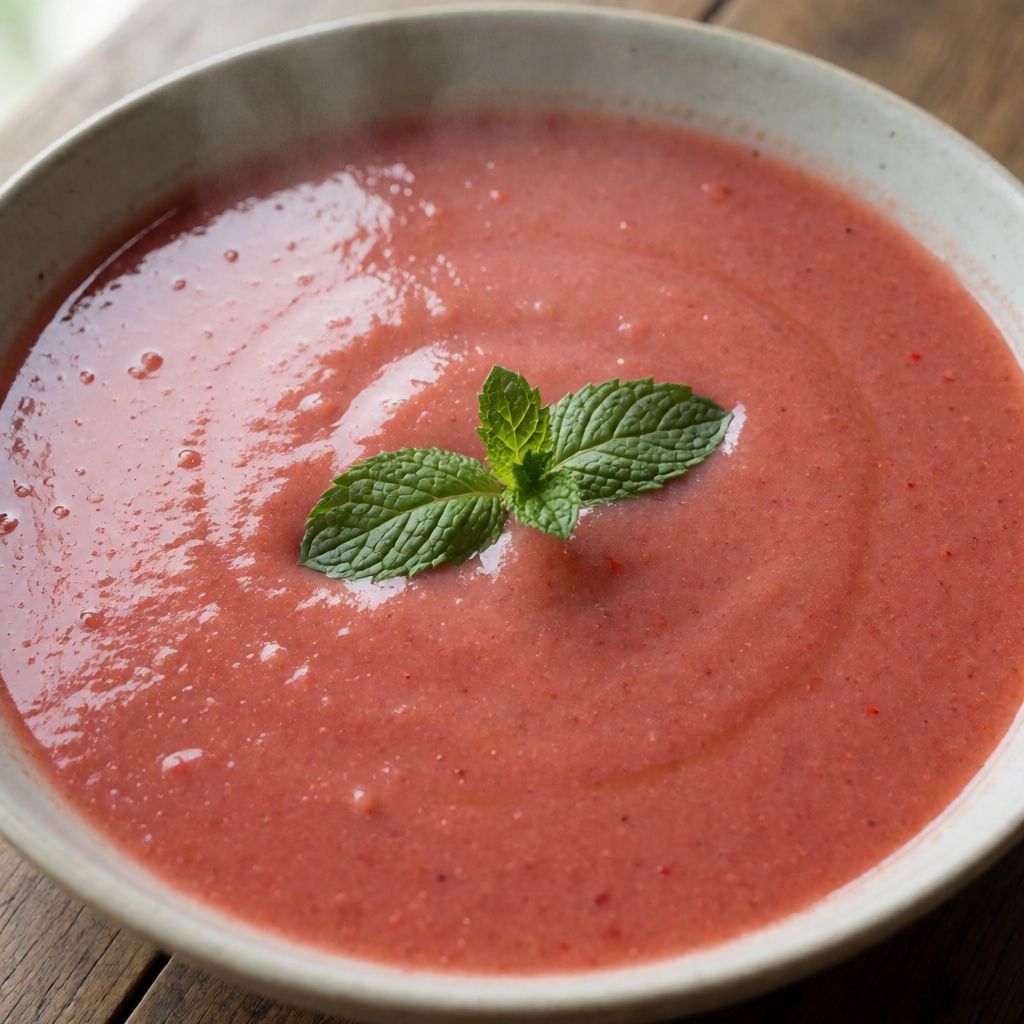
 AI photo
Rhubarb and Strawberry Soup
A cold, lightly sweet fruit soup made with rhubarb and strawberries, finished with mint and a scoop of vanilla ice cream.
Labels are worked out automatically from the ingredients and can be wrong. Check the packaging if it matters to you.
Ingredients
- 250 g Rhubarb diced
- 300 g Strawberries diced
- 0.5 pcs Vanilla pod
- 150 g Sugar
- 600 ml Water
- 1 bunch Mint leaves
- 100 g Strawberries fresh
- 1 bunch Mint leaves
- 0.4 l Vanilla ice cream







Steps
Put the rhubarb and strawberries in a saucepan.
Cut the vanilla pod lengthways and scrape out the seeds.
Mix the vanilla seeds with the sugar so they are evenly distributed.
Add the vanilla sugar, water and mint leaves to the pan with the strawberries and rhubarb.
Bring to the boil and let simmer, covered, for 15 minutes.
15 minLet the soup cool slightly in the pan.
Strain the soup to separate the cooked berries, rhubarb and mint leaves.
Press out all the juice with the back of a tablespoon and put the pink soup in the freezer until it becomes icy.
The soup can also be chilled in the fridge for up to 3 days, then put in the freezer to become icy before serving.
Serve the rhubarb soup in deep bowls with fresh strawberries, mint leaves and a scoop of vanilla ice cream.
This isn't a soup in the sense of something that fills you up — it's a cold fruit infusion, closer to a drink you eat with a spoon. Rhubarb and strawberries are boiled hard enough to fall apart, then thrown away. What you keep is the pink liquid they bled into the water. The whole dish is a decision to value the juice over the fruit, which sounds wasteful until you remember what rhubarb actually is: sour, stringy, and nobody's idea of a pleasant mouthful once it's gone soft and grey from boiling. Straining solves a problem, not a preference.
What decides whether it works is the balance between tartness and sugar, and that balance is set by the rhubarb itself, not by a recipe number. Early-season rhubarb — thin, pink, forced under cover — is milder. The thick, deep-red stalks from midsummer are sharper and need every gram of that sugar, sometimes more. Taste the liquid before you freeze it. This is the one place in the recipe where you're allowed, even expected, to disagree with the measurements on the page.
The second thing that decides it is temperature contrast. This is served icy-cold, almost at the point of forming crystals, with a scoop of vanilla ice cream melting into it at the table. If the soup is merely "fridge cold" rather than properly chilled toward freezing, it tastes flat and the ice cream turns it into lukewarm pink milk in under a minute. Patience with the freezer step is not optional — it's the difference between a dessert and a disappointment.
Rhubarb needs almost no introduction to a British kitchen — it grows in back gardens here with the same quiet persistence as mint, which is why both appear in this recipe without anyone needing to buy anything exotic. Pick stalks that feel firm and snap rather than bend; a stalk that bends like rubber has gone past its best and will give you stringy fibres even after boiling. Trim away any leaf entirely — rhubarb leaves contain enough oxalic acid to make you properly ill, and that's not folklore, that's the reason your grandmother told you to cut them off.
Strawberries do double duty here: some go into the pot to be boiled and discarded for their juice, and some stay raw on top at the end, cut in half or quartered, for texture and a burst of actual strawberry flavour that boiling destroys. Don't use the same handful for both — buy a punnet of whatever's ripest and softest for the cooking, and keep back firmer, better-looking berries for the garnish, since those will be seen and bitten rather than squeezed through a spoon.
The vanilla pod is there for its seeds, not its pod — scraping and mixing them into the sugar spreads the tiny black flecks evenly through the liquid instead of leaving them clumped in one spot. If you don't have a pod, a teaspoon of good vanilla extract stirred in at the same stage does the job almost as well; vanilla sugar from a jar is a reasonable stand-in too, though it's milder and you may want a touch more. The test for "any vanilla" is simple: it should smell warm and sweet on its own, not just alcoholic.
Water is the medium, not a filler — 600 ml for 550 g of fruit is enough to extract the colour and flavour without drowning it, and because you strain everything out afterward, there's no danger of a watery result; what you're left with is concentrated by the straining itself, since the solids have given up their juice into a smaller final volume.
Mint appears twice for two different jobs: boiled into the soup for a background coolness that marries with the fruit, and added fresh at serving for a sharp hit of aroma the boiled leaves lose entirely. Standard garden mint is fine for both — you don't need anything delicate like chocolate mint here, since it's going to be strained out anyway on the first round.
On a domestic hob, "bring to the boil and simmer, covered" just means: lid on, heat until bubbles roll steadily, then turn it down until they're gentle rather than violent — rhubarb breaks down fully within the time given regardless of exact flame strength, so judge it by the fruit collapsing into mush, not by a clock. Pressing the solids with the back of a spoon afterward isn't optional squeezing for extra effect — it's where a good third of your flavour and colour lives, trapped in fibre that looks spent but isn't.
Freezing "until icy" rather than fully solid is the texture you're after — a loose, slushy cold, not a block you need to hack at. If your freezer runs hard and you overshoot into a solid brick, let it sit at room temperature for ten minutes and break it up with a fork before serving; that's a fix, not a failure.