
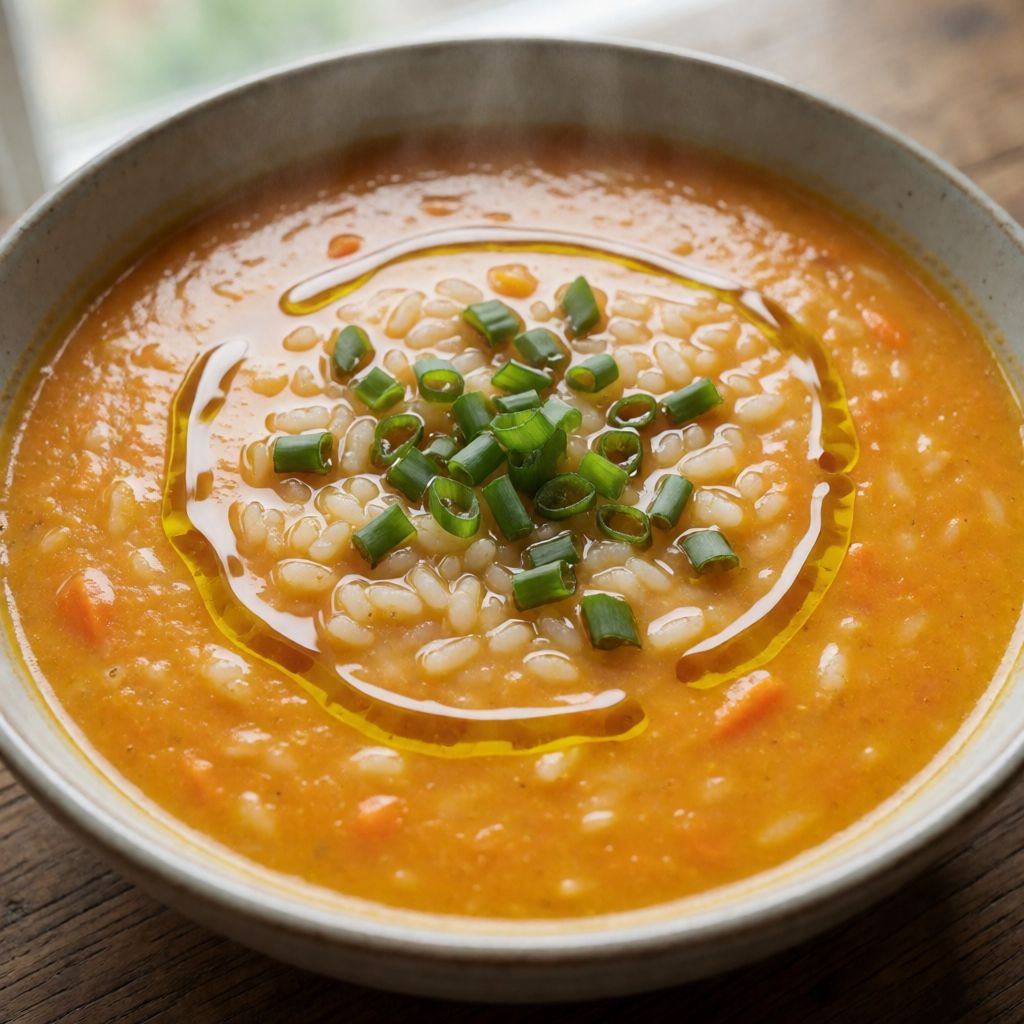
 AI photo
Rich Carrot and Rice Soup
A comforting soup of carrots and rice, finished with lemon and olive-oil dressed rice.
Ingredients
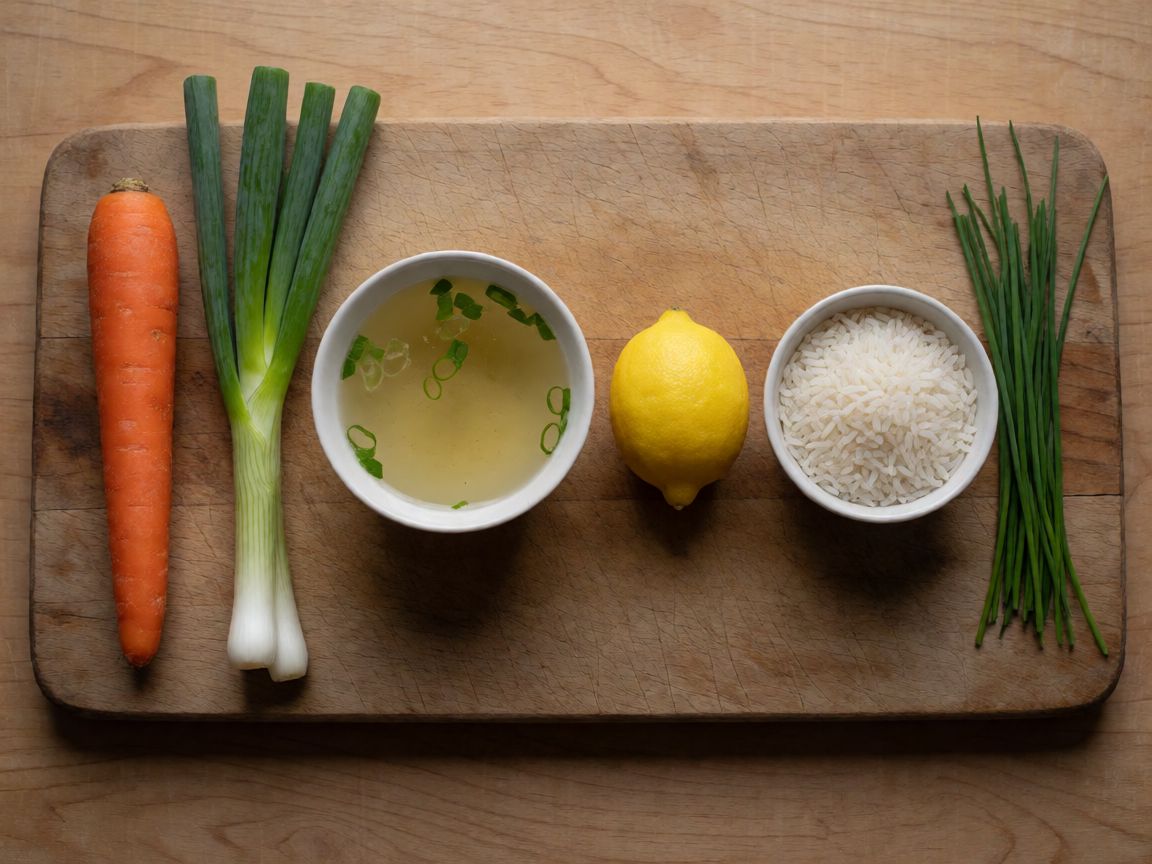
- 800 g Carrots
- 2 pcs Spring onions
- 1 l Vegetable stock
- 1 pcs Lemon
- 150 g Rice
- Olive oil to taste
- Chives to taste
- Black pepper to taste
- Salt to taste









Steps
Chop the carrots and spring onions and cook in the vegetable stock for about 20 minutes.
20 minSeparately, cook the rice in salted water.
Add the grated lemon zest and the juice of half the lemon to the vegetables and stock.
Dress the cooked rice with olive oil and chives snipped with scissors, and add wedges of the other lemon half.
Blend the stock and vegetables until smooth.
Serve in individual bowls, placing the dressed rice in the centre of each portion, and season with black pepper.
This is not really a soup with rice floating in it — it's a carrot purée with a small rice side, kept apart so one doesn't drown the other. 800g of carrot to a litre of stock is a heavy ratio, and once you blend it, the carrot's own starch and pectin give the body — no cream, no flour hiding in there. The thickness you taste is the vegetable itself, broken all the way down, nothing else doing the work.
What decides whether it works is how far you let the carrot go before the blender ever touches it. The test isn't a stopwatch, it's a fork: push it into a chunk and it should give under its own weight, not under force. Carrot that still resists blends to a grit that looks smooth in the jug and feels like sand on the tongue — so treat the recipe's "about 20 minutes" as a floor, not a target, and keep checking.
Lemon zest and juice go in late, almost as a decision separate from the cooking, and that's deliberate. Boil citrus and the zest's aromatic oil turns bitter, the juice's sharpness goes flat — heat is exactly what lemon doesn't want. So it joins the pot right before blending and gets maybe a minute's warmth, no more.
Rice cooked separately, dressed in oil and chives, sits in the middle of the bowl rather than swimming in the purée. Some cooks are tempted to tip rice straight into the pot, thinking it'll thicken the soup the way it does in a broth — no, because here it would cloud a purée that's already thickened by the carrot, and it would go gluey long before the carrot is soft enough to blend. Keeping it apart is the whole point of "cook separately" in the method.
Start with the carrots — 800g, which in real terms is six or seven medium ones, enough for four with rice alongside. Buy them with colour holding right to the core; snap one in half, and if the middle is pale and almost woody, that carrot is past its sugar peak and into fibre, and no amount of simmering will make it blend silk-smooth, only less obviously stringy. If your carrots are tired, swap some of the weight for parsnip — the criterion is a starchy, sweet root, not specifically carrot, and parsnip breaks down the same way under heat.
Spring onion — two of them, white and green both — is there for the base note, not the main flavour. It goes in raw and chopped, straight into the stock with the carrot, no separate frying step, because twenty-odd minutes of gentle simmering does to a raw onion what a quick fry in butter does: takes the sharpness out slowly instead of quickly. If all you've got is a regular onion, use it, but use less — about half the volume, because a cooked onion holds a stronger bite once the water's gone than a spring onion ever does.
The stock decides a lot before you've even touched the carrots. A cube brings its own salt along with it, so taste before adding any more — the easiest way to over-salt a vegetable purée is to salt an already-salted cube. Homemade stock from saved trimmings has almost none, so season it properly. Either way, the lemon's timing is mechanical, not sentimental: zest keeps its aromatic oil in tiny glands just under the skin, and that oil is volatile — simmer it and it cooks off or turns bitter, much like burnt garlic. Grate only the yellow, never into the white pith, or you'll trade one bitterness for another.
Rice is cooked in its own pan of salted water and stays there — any long-grain rice that holds its shape works, basmati is fine. Avoid a risotto-style rice, because the starch that makes risotto creamy would turn this rice gluey and clumped instead of loose grains you can scatter over a bowl. Dress it while it's still hot: oil poured into warm rice coats each grain, poured onto cold rice it just sits on top and does nothing. Chives get snipped with scissors rather than chopped with a knife for the same small reason cooks always have — a blunt domestic knife bruises hollow stems, and bruised chives weep and wilt before they reach the bowl; scissors leave a clean cut.
The olive oil here works against the usual rule. Normally you want an oil with "no smell of its own" so it doesn't argue with the dish — a neutral oil for frying, say. But this oil isn't cooking anything; it's dressing rice raw, right at the end, sitting on the plate doing its own job. So here you want the opposite: something fruity or peppery with real character, because its flavour is the point, not just a carrier for heat.
The whole thing rests on one unhurried habit — letting the carrot go properly soft before the blender touches it, and keeping the lemon out of the heat until the last moment. Neither is difficult, but both are easy to rush on an ordinary hob when you're also trying to get rice on and the kettle going. Give the carrot its twenty minutes as a floor, check it with a fork rather than a clock, and you end up with a purée that has no grit in it and no bitterness — which, between them, cover almost every way this soup can actually go wrong.