
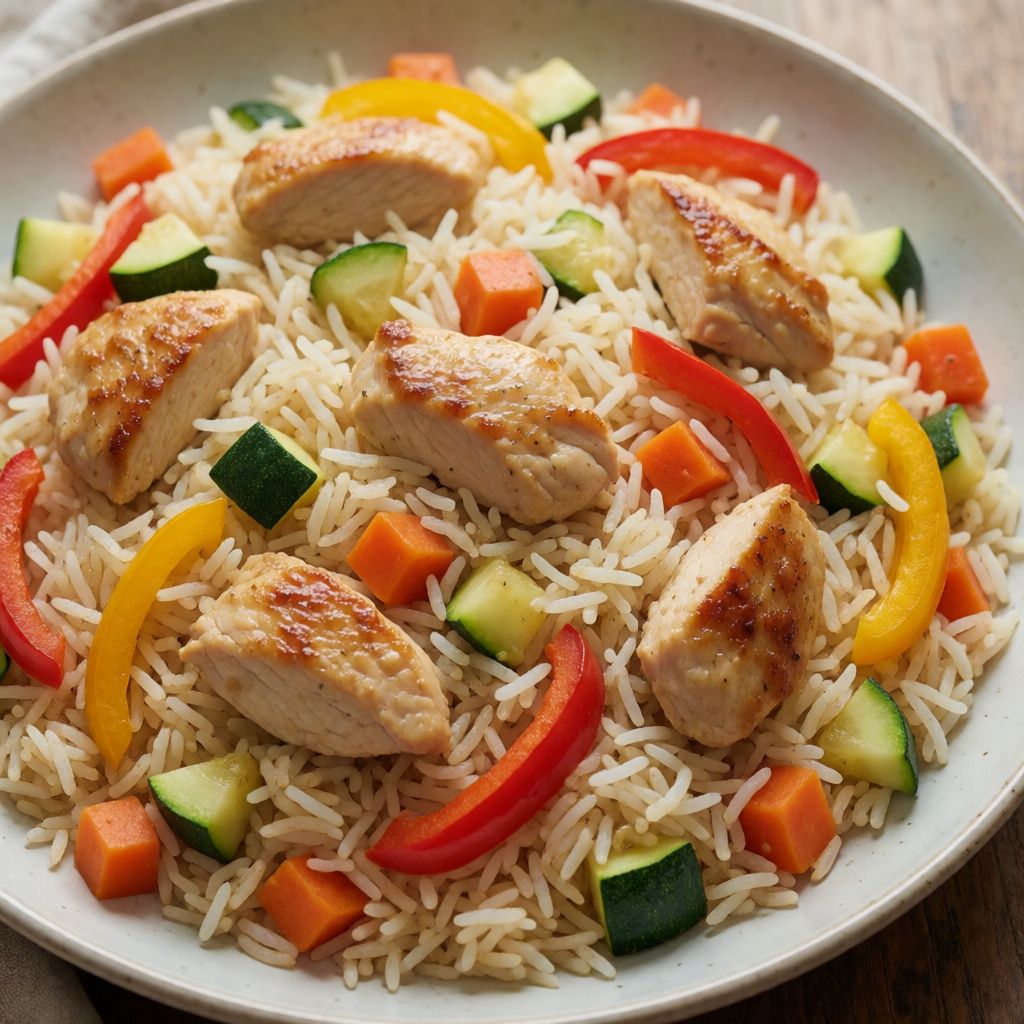
 AI photo
Basmati Rice with Chicken and Vegetables
Basmati rice with chicken, peppers, courgette, aubergine and onion in a light soy sauce.
Labels are worked out automatically from the ingredients and can be wrong. Check the packaging if it matters to you.
Ingredients
- 300 g Basmati rice
- 300 g Chicken breast
- 1/2 pcs Red pepper
- 1/2 pcs Yellow pepper
- 2 pcs Carrot
- 2 pcs Courgette
- 1 pcs Aubergine
- 1/2 pcs Red onion
- Olive oil to taste
- 3 tbsp Soy sauce








Steps
Wash and dry the vegetables, then peel them. Cut the carrots and courgettes into batons, deseed and cut the peppers, dice the aubergine, and thinly slice the onion.
Transfer the vegetables to a large wok and add the olive oil.
Cook the vegetables over high heat, stirring often, until softened.
20 minBoil the basmati rice in boiling water until done.
Cut the chicken breast into 1.5-2 cm cubes and fry in a hot pan until golden.
Drain the rice and rinse it under running water.
Add the chicken to the vegetables and let it simmer for a few minutes. Doneness: 74°C inside.
Add the cooked rice and mix well.
Pour in the soy sauce and stir-fry everything together for a few minutes so the ingredients combine.
This is not a stir-fry pretending to be a pilaf, and it's not a pilaf pretending to be a stir-fry either. It's three separate cooking processes — vegetables, rice, chicken — brought together only at the very end, in a pan that's really just a holding bay. The whole dish stands or falls on one thing: whether you can get those three things ready at roughly the same moment, because nothing here waits well for anything else.
Rice cooked separately and rinsed is the quiet genius of the recipe. Some say rinsing washes away flavour — no, it washes away surface starch, which is the stuff that turns grains into a single sticky block the moment you try to stir-fry them. A wok full of wet, starchy rice clumps around the spatula instead of moving through the vegetables; rinse it, and every grain stays its own grain, free to pick up soy sauce and vegetable juice instead of just more of itself.
The vegetables go in raw and in a pile, which looks careless but isn't. High heat and constant movement is doing a specific job: driving off the water sitting in courgette and aubergine flesh before it turns the whole pan into a simmering stew. You're not braising here — you're chasing moisture out, which is why "stirring often" matters more than any clock. The carrot bending instead of snapping is your actual finish line; twenty minutes is just where that usually happens on a domestic hob, not a rule carved in stone.
Basmati itself is chosen for a reason beyond fragrance. It's a long, thin grain with less of the starch that makes short grains like arborio or sushi rice cling together — which is exactly what you want when the rice has to get stir-fried and still separate under a spatula rather than mash into risotto. If you only have jasmine rice, use it; it behaves almost the same way. Avoid pudding rice, risotto rice, or anything labelled "sticky" — wrong tool entirely, they'll gum up the wok.
Chicken breast is doing a job that thigh meat would do differently, not worse. Breast is lean and cooks fast and dry; thigh has more fat and forgives a slightly longer stay in the pan. If you've only got thigh in the fridge, use it and don't panic about the exact timing — it's more patient with heat than breast is, which actually makes your life easier here, not harder.
The vegetable list — pepper, carrot, courgette, aubergine, red onion — isn't fixed by any rule of cuisine, it's fixed by what cooks at roughly compatible speeds and gives contrasting textures: carrot for bite, courgette and aubergine for give, pepper for a bit of sweetness that survives high heat without turning bitter. Swap within that logic — broccoli, mangetout, even cabbage — rather than by what's simply in the fridge. What doesn't belong is anything that weeps a lot of water slowly, like whole tomatoes; they'll turn your stir-fry into a sauce.
Soy sauce here is standing in for salt, and for the savoury depth that in a proper pilaf would come from stock and hours of slow cooking in a kazan. You don't have a kazan on a British hob — you have a wok or a wide frying pan and an extractor fan, and soy sauce is the honest, quick substitute for that long-simmered depth. Any dark, salty, fermented liquid condiment does a similar job — tamari if you need it gluten-free, a dash of Worcestershire in a pinch, though that changes the flavour more than people admit.
Olive oil is listed "to taste" because its job is just to stop things sticking and to carry heat evenly — it isn't meant to be tasted on its own in a dish this busy. Any neutral oil with no smell of its own works just as well; a fragrant extra virgin is actually wasted here, its flavour gets steamed off and bullied out by soy sauce and chicken fat anyway. Save the good olive oil for something that lets it speak.
Patience, finally, is the ingredient nobody puts on the list but everyone needs. Rushing the vegetable stage so the carrot's still raw in the middle, or rushing the chicken so it's pale instead of browned, doesn't save you fifteen minutes — it just means the dish tastes like separately underdone things tossed together at the end, rather than three things that each did their job properly before they ever met.