
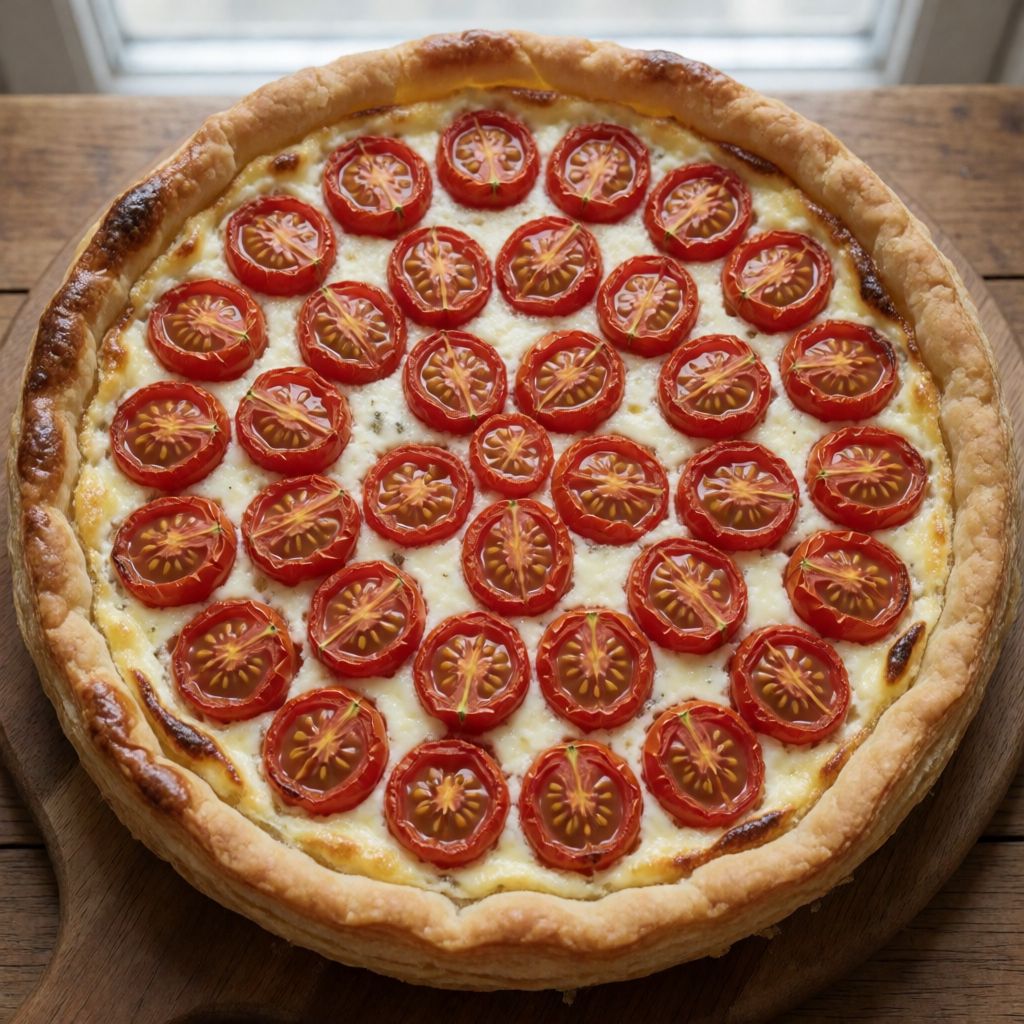
 AI photo
Ricotta and Cherry Tomato Tart
A simple savoury tart with puff pastry, creamy ricotta filling and fresh cherry tomatoes on top.
Labels are worked out automatically from the ingredients and can be wrong. Check the packaging if it matters to you.
Ingredients
- 1 pcs Puff pastry
- 2 pcs Eggs
- 300 g Ricotta
- Cherry tomatoes to taste
- 2 tbsp Parmesan
- 4 tbsp Breadcrumbs dried
- Olive oil to taste
- Basil to taste, fresh
- Oregano to taste
- Salt to taste









Steps
Unroll the pastry on its baking paper and carefully line a tart tin, pressing it firmly against the edges. Prick the pastry all over with a fork.
Mix the breadcrumbs with a few tablespoons of olive oil and spread this mixture over the base of the pastry.
Crack the eggs into a large bowl and whisk vigorously.
Add the ricotta and mix with the eggs until smooth and even.
Add the Parmesan to the filling, sprinkle generously with oregano and add chopped fresh basil.
Season with a pinch of salt, mix well and pour the filling into the tin, smoothing the surface with a spatula.
Wash the cherry tomatoes, pat dry and cut in half.
Arrange the tomato halves cut-side up on top of the tart, decorating the filling.
Lightly sprinkle with oregano.
Bake the tart in a preheated oven at 180°C (static/conventional) for 25-30 minutes, until the pastry is golden.
28 minRemove the ricotta and cherry tomato tart from the oven and serve.
This is a custard pretending to be a tart. Ricotta and eggs, whisked together, bake into something between a quiche and a cheesecake — soft, barely holding a slice, not rubbery. The pastry's only job is to stay crisp underneath that wet filling for the twenty-odd minutes it takes the custard to set, and that single job is where most people lose the tart before it even goes in.
What decides whether it works is the base. Puff pastry is built from layers of butter and dough that want to steam apart and rise. Pour a wet ricotta mix straight onto it and the steam has nowhere to go but up through the filling — you get a soggy bottom and a pastry that's climbed into the middle of your tart instead of staying flat underneath it. The breadcrumb-and-oil layer in step 2 isn't decoration; it's a barrier. The oil coats the crumbs, the crumbs soak up what moisture does get through, and together they slow the custard down long enough for the pastry underneath to crisp before it goes limp. Some say you must blind-bake puff pastry for any wet filling — no, because the breadcrumb layer does the same job faster and without a second oven stint, as long as you don't skip pricking the base with a fork, which lets trapped air and steam escape sideways instead of lifting the whole sheet into a dome.
Ricotta is the filling's whole personality. It's a whey cheese, not a curd cheese like cottage cheese, which means it's naturally drier and milder — it won't fight the eggs for water the way a wetter cheese would, and that dryness is exactly why it sets into a clean custard rather than a puddle. Buy it fresh from the deli counter if you can; the tubbed supermarket version works fine too, just drain off any liquid sitting on top before you mix, or your custard takes longer to firm and the pastry underneath pays the price. If you've genuinely no ricotta, a well-drained cottage cheese blitzed smooth, or curd cheese, gets you close — the aim is a cheese with body but no strong character, because ricotta's whole value here is staying out of the way of the egg and tomato.
Eggs are the actual setting agent — two eggs to 300g ricotta is a working ratio, not a dramatic custard like a quiche's. Whisk them properly before the ricotta goes in, not after, so you're not fighting lumps of cheese into already-thickened egg. The Parmesan does two things: salt, and a savoury backbone that ricotta on its own doesn't have. Any hard, aged grating cheese does the same job — pecorino, an aged Cheddar at a push, anything with "no smell of its own" doesn't apply here, you actually want the smell; what you're choosing on is hardness and age, so it grates fine and doesn't melt into a greasy layer.
Breadcrumbs: dried, not fresh, because fresh breadcrumbs still carry their own moisture and you're trying to build a barrier against moisture, not add more. Dried crumbs plus oil behave almost like a thin pastry of their own — the oil fries them very gently in the oven's heat before the custard above has even started to set. Use a plain, flavourless oil here rather than a heavily peppery extra virgin — anything with "no smell of its own" is the test, so a light olive oil or even a neutral vegetable oil both do the job without arguing with the oregano and basil.
Basil goes in fresh and chopped, straight into the raw mixture — it cooks through gently in the oven's heat rather than frying, which is why you use fresh rather than dried: dried basil loses its brightness fast at 180°C exposed on top, but folded into the custard it survives fine. Oregano is used twice, in the filling and dusted on top of the tomatoes — the second dusting is the one that matters for smell, since whatever you sprinkle on the exposed surface gets direct dry heat and releases its oil straight into the air you'll smell when you open the oven door.
On the oven itself: "180°C static" matters if your oven has a fan setting, because a fan oven runs noticeably hotter-feeling at the same number — drop it by about 15-20°C if you're baking on fan, or just watch the pastry edge rather than trust the dial. Twenty-five to thirty minutes is your lower bound, not your deadline. The tart is done when the pastry edge has gone from pale to properly golden and the custard, given a gentle shake, wobbles like a set jelly rather than sloshing like batter — the centre firms last, same as any custard, so don't judge doneness from the edges alone. Patience here is short — this isn't an all-day braise — but the five minutes you let it rest before cutting is still patience, and skipping it is how you end up with a slice that collapses sideways instead of lifting clean.