
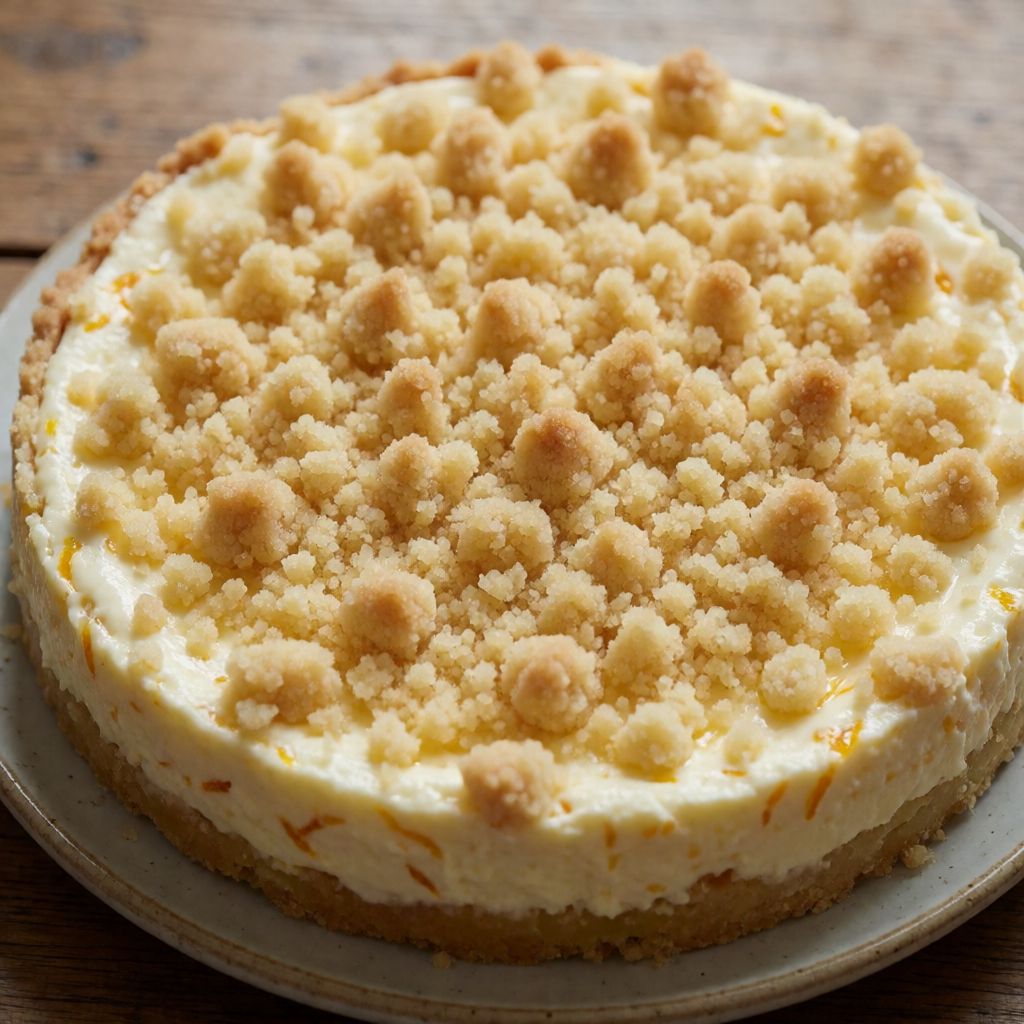
 AI photo
Ricotta and Orange Crumble Tart
A crumbly shortbread base filled with a smooth ricotta and orange cream, baked until golden.
Labels are worked out automatically from the ingredients and can be wrong. Check the packaging if it matters to you.
Ingredients
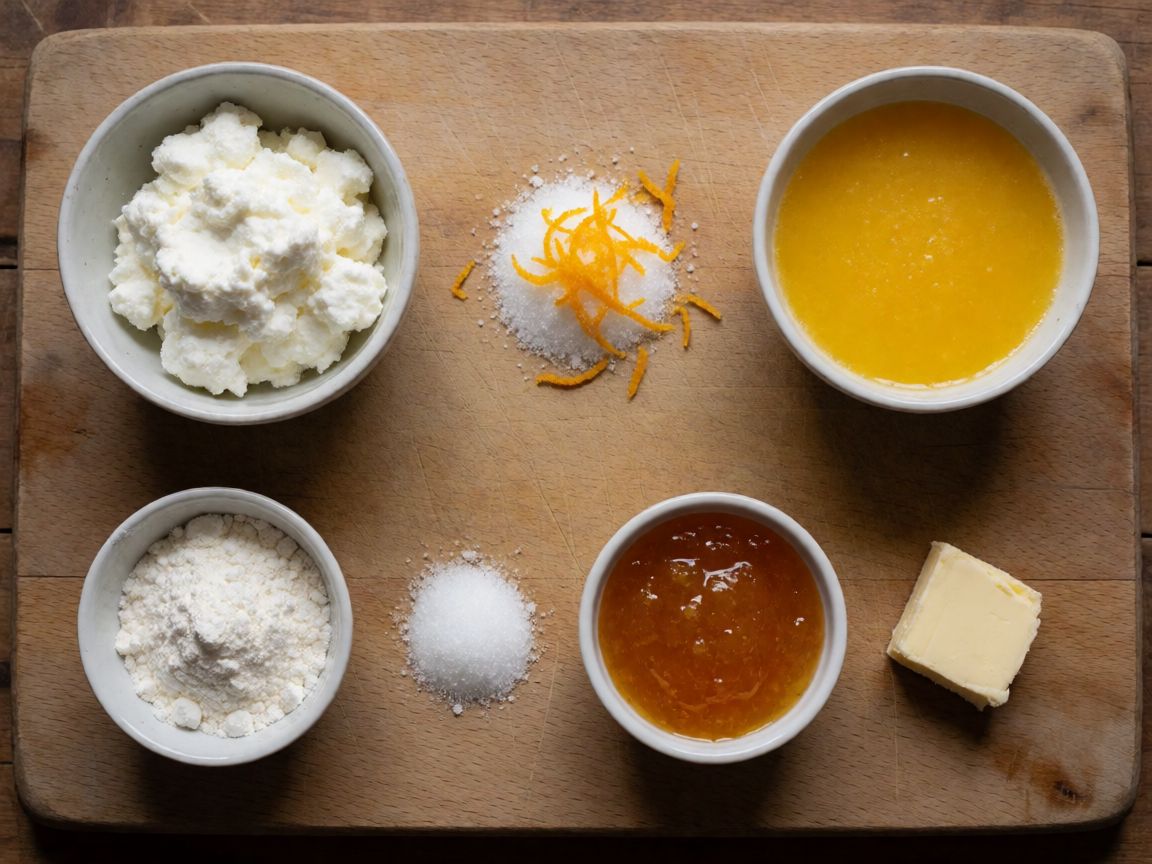
- 400 g Ricotta
- 80 g Caster sugar
- 1 pcs Orange zest
- 60 ml Orange juice
- 150 g Orange marmalade
- 300 g Plain flour
- 100 g Caster sugar
- 100 g Butter cold
- 1 pcs Egg
- 8 g Baking powder
- 50 g Amaretti biscuits crushed










Steps
Combine the flour with the sugar, then add the egg, baking powder, crushed amaretti biscuits and cold butter cut into cubes.
Rub the ingredients together with your fingers until a crumbly mixture forms.
Place the dough in the fridge for at least 30 minutes.
30 minUsing an electric mixer, beat the ricotta with the sugar until smooth.
Add the orange zest and orange juice, then stir in the orange marmalade and mix well.
Take the dough out of the fridge and press two-thirds of it into a baking tin, forming a firm base.
Spread the cream evenly over the top, then cover with the remaining crumbly dough.
Bake in a fan oven preheated to 160°C for about 35 minutes.
35 min
This is a crumble wearing a cheesecake's clothes. Underneath, it's the same crumbly, buttery dough you'd put on stewed apples — but instead of fruit, you're hiding a smooth ricotta-orange filling under it, and some of that dough also forms the base. So it's a tart that doesn't need rolling pins or blind-baking weights. The dough is rubbed by hand, not rolled, which is the whole point: you're building two textures from one mixture.
What decides whether it works is the butter and the fridge. Cold butter, cut small, rubbed in with fingertips until it disappears into crumbs — that's what gives you "crumbly," not "pasty." If the butter softens while you work it, the flour coats it in a greasy film instead of staying separate, and you get a dense, chewy lid instead of a sandy one. The 30 minutes in the fridge afterwards isn't optional resting for its own sake — it re-hardens any butter that warmed under your hands, so the crumbs hold their shape in the oven instead of melting into a slab before the structure sets. Skip that chill and the top "crumble" bakes flat and greasy, more pastry than crumble.
The filling is simple arithmetic: ricotta for body, sugar for sweetness, zest for perfume (the oils, not the juice, carry orange flavour — juice alone tastes thin), and marmalade doing double duty as both extra orange punch and a bit of set, since marmalade has pectin in it. Beat the ricotta smooth first — lumpy ricotta stays lumpy once baked, heat doesn't fix that.
On ingredients, start with the flour-sugar-butter-egg base, because that's the engine of the whole dish. Plain flour, not strong bread flour — you want a mixture that breaks apart, not one that develops gluten and goes tough. The egg is there to bind just enough of the crumbs into a cohesive base layer when you press it into the tin, while leaving the lid portion loose enough to stay crumbly. The baking powder lifts the base a touch so it's not a dense biscuit floor — you're not after puff, just enough give that it doesn't eat like a cracker. Butter: cold, straight from the fridge, cubed small — any neutral dairy butter does; margarine will work structurally but brings its own flavour and a softer melt, which blurs the sandy texture you're after.
The amaretti biscuits are not decoration. Crushed into the dough, they bring almond bitterness and a dry, sandy crumb that plain flour alone can't give you — this is the detail that makes it taste bakery-bought rather than homemade shortbread. If you can't get amaretti (not always on a UK supermarket shelf, though Italian delis and larger Tesco/Waitrose stores often stock them), the honest substitute is any dry almond-flavoured biscuit, crushed — a few digestives with a drop of almond extract gets you close, though you lose some of that bitter edge amaretti has from the apricot kernels in it.
For the filling: ricotta, full-fat, from the chiller not a tub meant for spreading — the full-fat version holds structure when baked, low-fat versions can weep. Caster sugar dissolves into the ricotta cleanly when beaten; granulated would leave grit. The orange — zest it before you juice it, obviously, but also buy an orange that isn't waxed to a shine without washing it first, since you're eating the skin's oil. Marmalade: use a thick-cut or smooth orange marmalade you'd actually put on toast — this is one of those moments where a British kitchen has the advantage, marmalade being a shelf staple here rather than a specialty item. If your marmalade is very bitter (thick Seville-style), you may find the balance tips savoury-bitter; a smoother, sweeter marmalade keeps this as a dessert rather than a breakfast echo.
On the tin and the oven: "fan oven at 160°C" matters because fan ovens run hotter-feeling than the number suggests — they move air, which strips moisture off the surface faster. That's actually useful here: it's what dries and sets the crumb topping into something crisp rather than soft. If your oven isn't fan-assisted, you're looking at roughly 180°C conventional as the rough equivalent — but don't take that as gospel, ovens vary enough that the real test is still visual: the top crumb should look matte and lightly golden, not wet-looking, and the filling should have stopped looking liquid-glossy in the centre when you nudge the tin.
Some say a cheesecake-style bake needs a water bath to stop cracking — no, because that problem belongs to dense, egg-heavy cheesecakes baking uncovered. Here the filling is shallow and capped by dough, so it's shielded from direct heat and from drying air; cracking isn't really a risk you're managing.
Patience shows up twice here, not once: once in the fridge before baking, and once after the oven, letting the tart cool before you cut it. Warm, the filling is still loose and the base hasn't fully firmed — cut too early and it collapses on the plate instead of holding a clean slice. Let it sit, have your tea while it cools, then cut.