
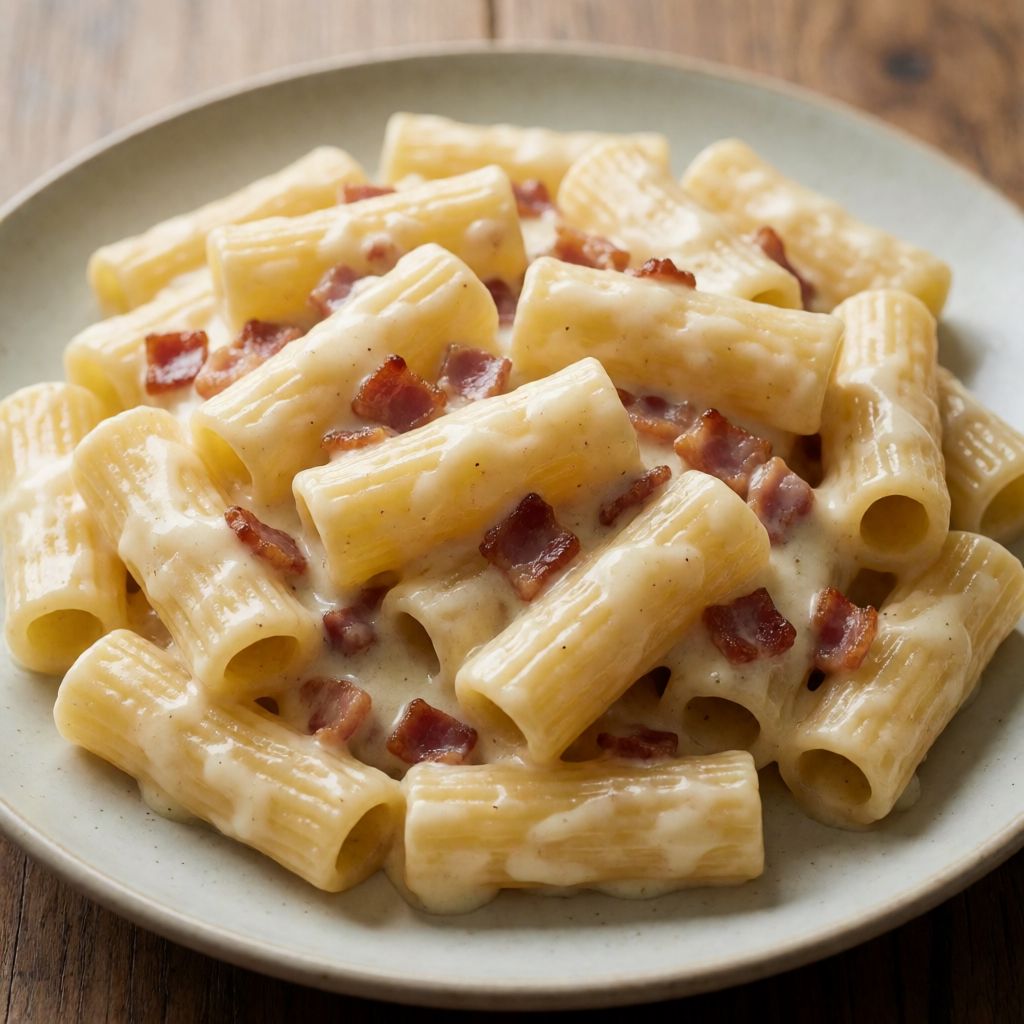
 AI photo
Rigatoni with Two Cheeses
A creamy rigatoni dish with bacon and two melted cheeses, finished with a touch of nutmeg.
Labels are worked out automatically from the ingredients and can be wrong. Check the packaging if it matters to you.
Ingredients
- 400 g Bacon
- 20 g Butter
- 100 g Emmental
- 80 g Fontina
- 200 ml Double Cream
- Salt to taste
- White Pepper to taste
- 1 tbsp Parmesan
- 1 pinch Nutmeg









Steps
Cook the rigatoni in salted boiling water until al dente.
In a deep pan, melt the butter with the cheeses, cut into cubes, over a very low heat.
Add the cream, nutmeg, white pepper and salt to taste, and stir.
Add the drained, cooked rigatoni to the pan, stir in, and add the Parmesan.
Heat through for a few minutes, stirring, and serve, sprinkling with extra Parmesan if desired.
What was changed
Toma was swapped for Fontina to suit what UK shoppers can buy.
This is not pasta carbonara's polite cousin and it isn't a classic Italian primo either — it's a stovetop cheese sauce, built the way a fondue is built, then used to dress a tube of pasta that's shaped to carry it. What decides whether it works isn't the ingredient list, it's the melt. Cheese thrown into high heat doesn't melt smoothly — it seizes. The protein network (casein, the stuff that holds cheese together) tightens and squeezes the fat out, and you end up with an oily puddle studded with rubbery curds. "Very low heat" in step two isn't caution for its own sake — it's the only speed at which the cubes soften and slump into the butter instead of spitting fat. Some say a sauce splits because the cheese was bad. No — it splits because you rushed it.
Cream comes in after the cheese has already given up its structure, and its job is emulsion, not dilution. Double cream carries enough fat that its own fat globules buffer the heat the casein is exposed to, so the sauce stays glossy instead of breaking into oil and grain. This is also why thinning it with milk, or using single cream, is a gamble — less fat means less protection, and the same heat that was gentle for double cream can still split a thinner one.
Bacon: the single biggest line by weight, so treat it as the backbone, not garnish. In a UK kitchen you've got streaky (fattier, crisps fast, good for rendering its own fat) or back bacon (meatier, less fat to render, closer to ham). Streaky suits this better because the dish wants rendered fat as a flavour carrier, the way the butter and cheese fat already do. Cure and smoke exist for a practical reason going back centuries — salt and smoke kept pork edible before refrigeration — the flavour we now chase is a side effect of preservation, not magic. Cook it dry, in its own fat, in a separate pan; the wide pan from your hob is plenty, you don't need a kazan for this, just don't crowd the strips or they'll steam instead of crisping.
Emmental and Fontina are doing two different jobs, not one job twice. Emmental has a firmer, lower-moisture structure — it gives the sauce body and that faint nutty tang, but on its own, over heat that's too fast, it turns stringy and tough rather than silky. Fontina is softer, higher in fat and moisture, and melts loose and creamy, covering for Emmental's stiffness. The criterion for substitution is simple: any cheese with enough fat and moisture to turn fluid rather than rubbery under gentle heat. Gruyère or a young Gouda will stand in for either. What won't work is pre-grated bagged cheese or very low-fat cheddar — the anti-caking starch dusted on bagged cheese, and the lack of fat in low-fat cheese, both stop a clean melt and leave you with grit instead of sauce.
Butter at the start isn't just fat to cook in — its milk solids help bridge the cheese fat and the cream that's coming, which is why a neutral oil is a worse swap here than it would be elsewhere; oil has no proteins to help hold an emulsion together. Use unsalted if you have it, so the salt in step three is a decision, not an accident layered on top of salty cheese and bacon.
Nutmeg is there to cut the richness, not to announce itself — grate it fresh if you can, because pre-ground nutmeg loses its aromatic oils sitting in a jar for months, and a pinch of flat, old nutmeg does nothing. White pepper versus black is mostly about the plate, not the mouth — white pepper won't leave dark flecks in a pale sauce, and it's a touch milder since the outer husk (where black pepper's sharper, more raw heat lives) is removed before grinding. If you've only got black, use it finely ground; the dish won't suffer, it'll just look a little more freckled.
Parmesan here is seasoning, not a third melting cheese — it goes in after the rigatoni, right at the end, so it dissolves into salt and savour rather than being asked to melt smoothly like the Emmental and Fontina were. That's also why there's extra for the table: it's a finishing adjustment, the kind you make to your own plate, not a structural ingredient the sauce depends on.
And patience, as always, is the one ingredient missing from every list. The whole mechanism here — melt without seizing, cream that emulsifies instead of splits, bacon rendered instead of boiled in its own steam — depends on you giving the pan time to do each thing slowly, in order, rather than throwing everything in to save five minutes. This is a four-person Sunday-ish dish, rich enough that a simple green salad alongside does more good than another sauce would.