
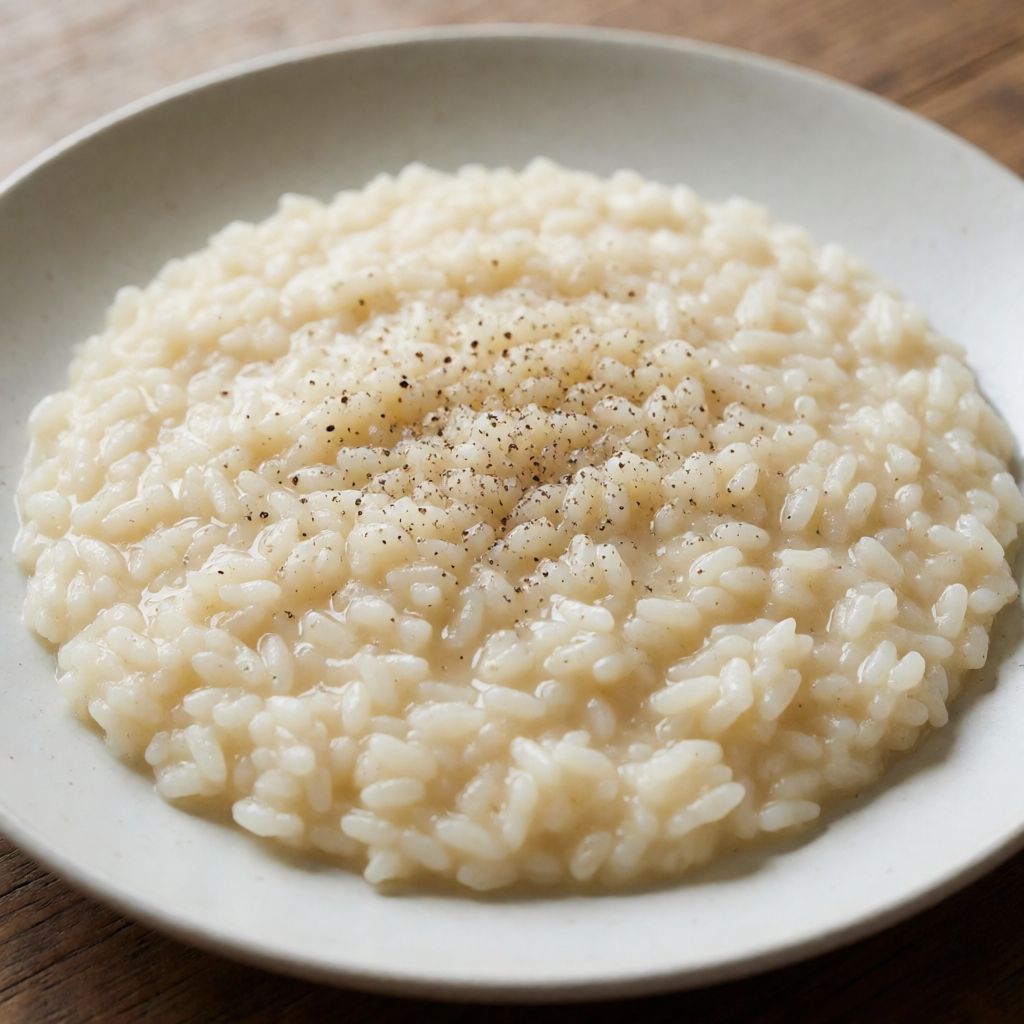
 AI photo
Champagne Risotto
A creamy Italian risotto made with champagne, butter and Parmesan.
Labels are worked out automatically from the ingredients and can be wrong. Check the packaging if it matters to you.
Ingredients
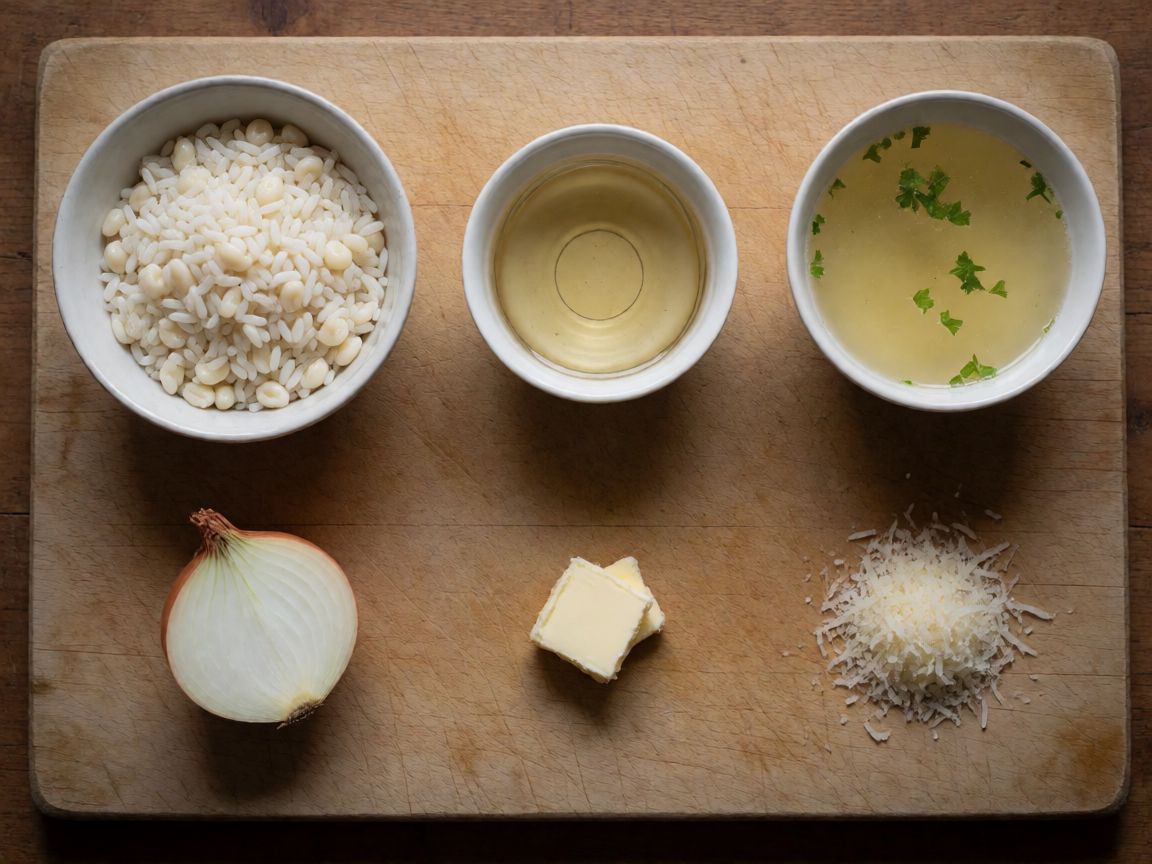
- 160 g Rice carnaroli or vialone nano
- 100 ml Champagne
- Vegetable Stock to taste
- 1/2 pcs Onion
- Salt to taste
- Black Pepper to taste
- 50 g Butter
- 60 g Parmesan








Steps
Prepare the vegetable stock, strain it and keep it hot.
In a pan, gently fry the finely chopped onion in a knob of butter over low heat.
Increase the heat, add the rice and toast it dry for a few minutes, stirring constantly.
Pour in two-thirds of the champagne and let it evaporate.
Lower the heat and add the hot vegetable stock a ladleful at a time, continuing to cook the rice until done.
Pour in the remaining champagne, season with salt and black pepper, and stir.
Remove from the heat, add the butter and Parmesan, and stir until creamy.
Serve immediately.
This is risotto in bianco with champagne stirred in instead of the usual dry white — same mechanism, louder name. What decides whether it works has nothing to do with the bubbles. It's whether you've managed the starch on the outside of each grain without cooking the inside to mush. That's the whole trick, and champagne risotto lives or dies on it exactly like the plain version does.
The tell is the wave. Tip the pan: if the risotto holds its shape like a dune, you've gone too far with the stock or not far enough with the stirring, and it will set like glue on the plate in the two minutes it takes to walk it to the table. If it runs like a slow tide and settles back, you're there. That's the only clock that matters — the rest is a lower bound, not a target.
Some say risotto needs cream to be creamy. No — the creaminess is starch, released by stirring, bound by cold butter and cheese fat at the very end, off the heat. Add cream and you get a rich soup with rice in it, not risotto. The whole point of toasting the rice dry before any liquid touches it is to seal that starch so it comes off slowly, ladle by ladle, instead of dumping itself into the pan in one go and turning everything to porridge.
Rice first, because this is the one ingredient with no real substitute, only a hierarchy. You want a short, fat grain with a chalky white heart — carnaroli or vialone nano both hold that structure: a firm, starchy outside that releases slowly and a core that keeps some bite after twenty-odd minutes in liquid. Arborio will do if that's what the shop has, but it collapses faster, so you watch it, you don't trust the clock. Long-grain rice has none of this — it's built to stay separate, which is precisely wrong for a dish whose whole point is grains that cling to each other.
The onion goes in on low heat because you want it to soften and sweeten, not brown. Browning here is a defect, not a flavour: it turns bitter edges into the base of the dish and you taste them in every spoonful after. Low and slow, in butter, until it's gone translucent — that's the cue, not a number of minutes.
Toasting the rice dry, before any liquid, is the step people skip because it looks like nothing is happening. It's doing the most important thing in the recipe: searing the outer layer of each grain so the starch comes off in a controlled trickle later, instead of flooding out all at once and gluing the pot. Skip it and you get a risotto that's either soupy or sticky, with no path between the two.
Champagne — or any dry sparkling or still white wine with no sugar in it — goes in to deglaze and to give acid. The acid does real work: it cuts through the starch just enough to stop the rice from clumping in that first minute of contact. Use something sweet and you'll fight sugar caramelising at the base of the pan instead of cooking rice. Two-thirds in early to burn off the alcohol, the last third at the end for scent, since by then the heat is off and the alcohol has nowhere to go but into the air you smell, not the pan.
Stock is not an afterthought. If you've ever made gravy from the bones and trimmings of a Sunday roast, you already know the economics here — risotto's stock comes from the same instinct, using up vegetable ends rather than throwing them out, and it has to come to the pan hot. Cold stock dropped into hot rice shocks the starch and stalls the cooking, so you end up adding more liquid than the rice needs just to get the temperature back up, and that's how risotto turns to soup.
Butter and Parmesan arrive only once the pan is off the heat — this last binding is called mantecatura and it's an emulsion, not a melt. Cold butter, not soft, shocks the starchy liquid into a sauce that coats rather than pools. Use a Parmesan that's properly aged, with that nutty sharp edge, because a mild or pre-grated one won't carry enough salt or glutamate to hold the dish together. If you've neither, any firm, well-aged hard cheese with a clean sharpness will stand in — a bland processed one will not, no matter how much you add. And give the stirring itself the time it wants: this isn't a dish you rescue by turning the heat up. Patience is the one ingredient with no substitute at all.