
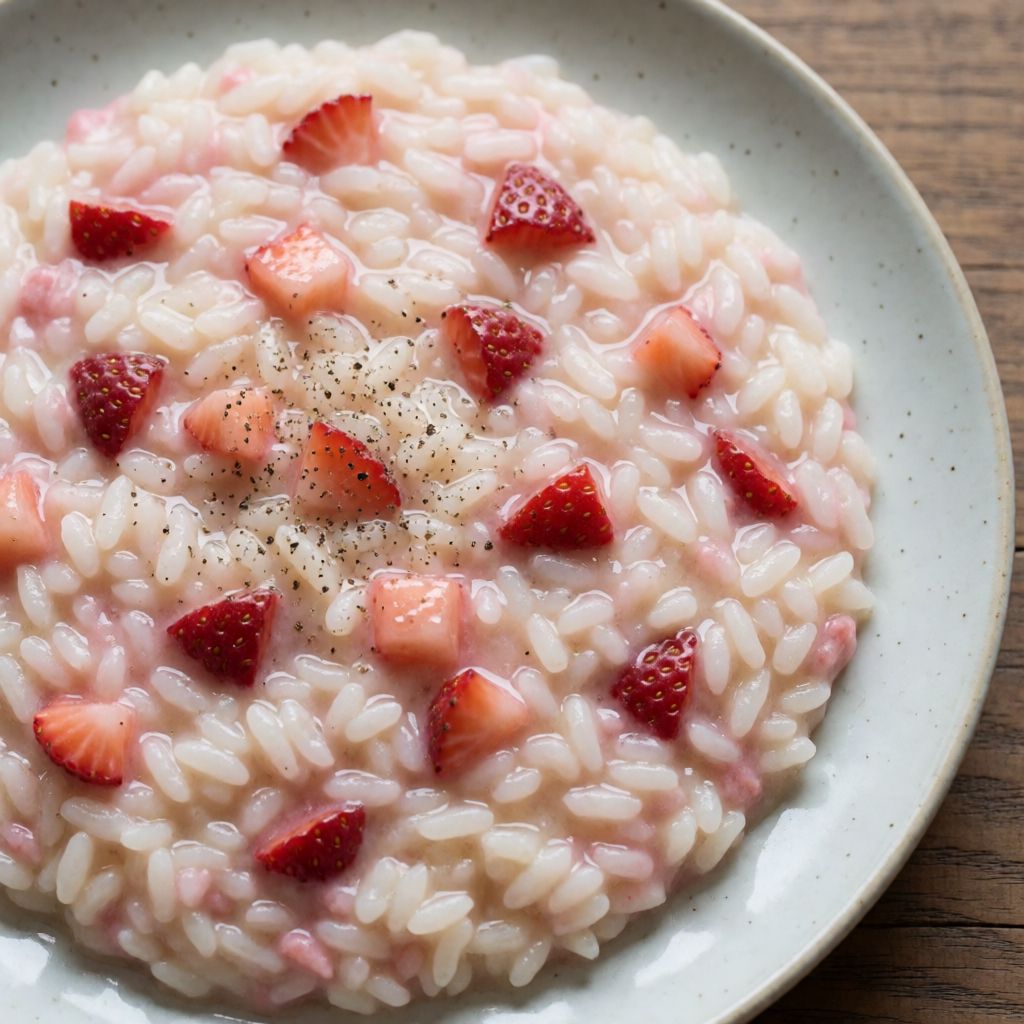
 AI photo
Romantic Strawberry and Champagne Risotto
A creamy risotto with sweet strawberries and champagne, perfect for a romantic dinner for two.
Labels are worked out automatically from the ingredients and can be wrong. Check the packaging if it matters to you.
Ingredients
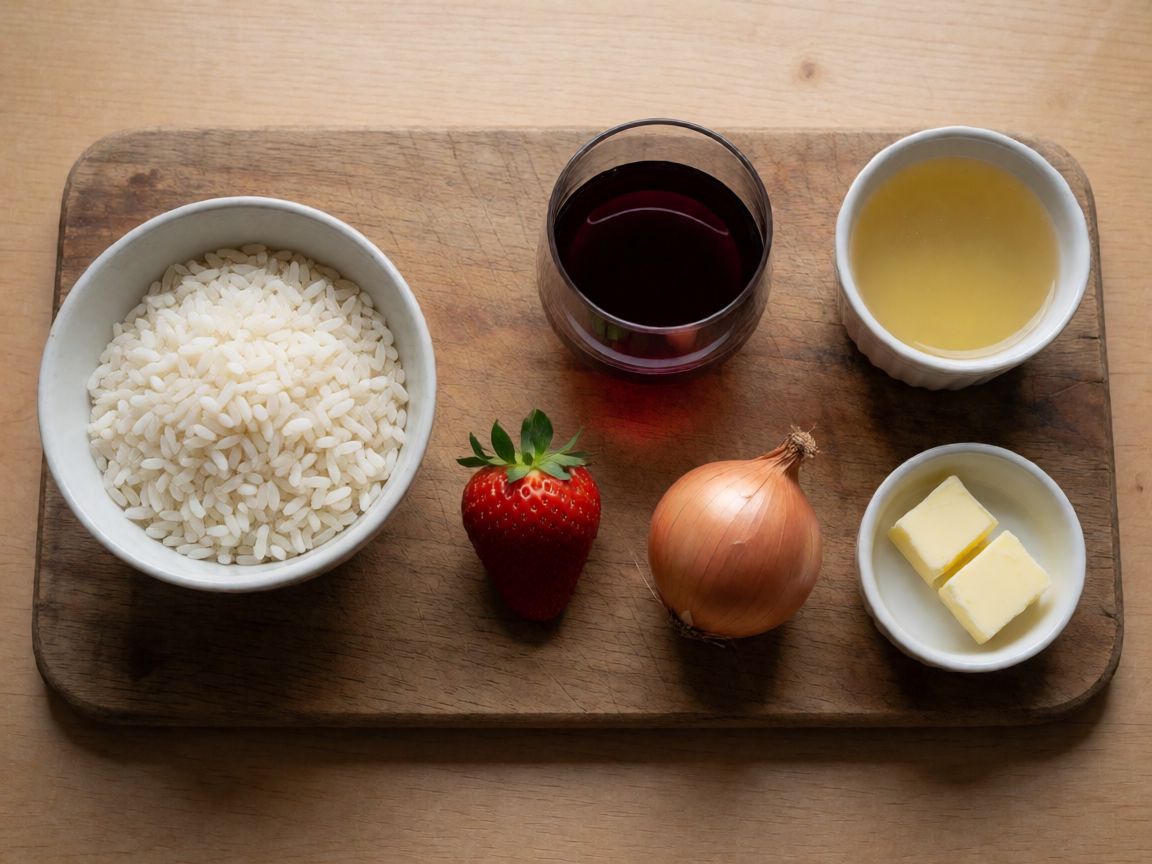
- 200 g Carnaroli rice
- 180 g Strawberries
- 250 ml Champagne or dry sparkling wine
- 0.5 pcs Onion
- Salt to taste
- Black pepper to taste
- Vegetable stock to taste
- 40 g Butter







Steps
In a saucepan, fry the finely chopped onion in butter until golden, then add the rice and toast it for a few minutes, stirring.
Pour in half the champagne and let it evaporate completely over high heat.
Add the vegetable stock and cook the rice, ladling in more stock in small amounts as it is absorbed.
Cut the strawberries into small pieces, keeping 3-4 whole for garnish.
About halfway through cooking the risotto, add the chopped strawberries along with the remaining half of the champagne.
Season with salt and pepper to taste.
Remove the pan from the heat and stir in the butter for a creamy texture.
Mix well, plate the risotto, and garnish with the whole strawberries.
This is risotto first, romance second. Underneath the champagne and the strawberries sits the same mechanism as any other risotto: a short, hard grain of rice, forced to release its starch slowly into a small amount of liquid, until the liquid itself turns creamy. The fruit and the fizz are dialect, not different grammar. What decides whether this works is not the bottle you open — it's when things go into the pan and when they come off the heat.
Some say champagne makes this dish special, elevated, a notch above an ordinary risotto. No — champagne gives you acid and a faint yeasty note from the second fermentation, nothing a good dry sparkling wine, or even a dry still white with a squeeze of lemon, doesn't also give. The bubbles are gone the second it hits a hot pan anyway. What you're buying with champagne is the smell of it on the table, not a flavour no other wine has.
The real danger point is the strawberry. Add it too early, cook it too long in all that simmering starch, and it stops being fruit and becomes jam — sweet, brown-edged, flat. That's why it goes in halfway, not at the start: enough heat to soften it and let its acid marry the rice, not enough to collapse it. The raw berries kept back for garnish aren't decoration for its own sake — they're there to remind your palate what the cooked ones tasted like before the pan got to them.
Carnaroli earns its place here for one reason: it has a dense core of amylose starch that holds its shape even as the outside starch (amylopectin) dissolves into the liquid around it. That's what gives you a grain with bite in the centre and creaminess all around it — not luck, structure. Arborio will do the same job, a little more forgiving of overcooking, a little quicker to go soft right through if you're not watching. Vialone Nano too, if you can find it — smaller grain, even more starch release, very good for a loose, almost pourable risotto. What you don't want is long-grain rice of any kind; it simply won't give up its starch the same way, and you'll end up with rice in a sauce instead of a sauce made of rice.
The onion goes in first and gently, in butter, until it turns gold — not brown, not caught at the edges. Gold means the sugars inside it have started to come forward; brown means they've burned, and burnt onion tastes bitter in a way no amount of champagne will cover later. This is also the reason the rice gets toasted straight after, a few minutes stirring in the same fat: it coats every grain in a thin layer of butter, which slows down how fast water gets into the starch once the liquid starts going in. Skip this and the rice cooks too fast on the outside before the centre's had a chance, and you get risotto that's gluey at the edges and chalky in the middle.
The champagne does two different jobs depending on when it lands. The first half goes in hot and hard, boiled off completely — that's for the alcohol burn-off and to lay down an acid backbone the rice can absorb into its starch. The second half goes in later, with the fruit, not to cook away this time but to stay fresher, brighter, closer to how it tasted straight from the bottle. That's deliberate: one half builds structure, the other half keeps the dish from tasting only of rice and butter.
Vegetable stock is the quiet workhorse and the one place home cooks most often go wrong — not in what stock they use, a shop cube or carton is entirely fine, but in serving it cold. Cold stock ladled into hot starch stops the cooking dead each time you add it, and you end up with rice that's tender outside and raw-centred no matter how long you cook it. Keep it simmering in a small pot on the next ring, and ladle it in a little at a time, letting each addition nearly disappear before the next. That slow rhythm is the actual mechanism of risotto — not the stirring itself, which just speeds up starch release by friction, but the discipline of never flooding the rice.
A kazan would hold heat evenly across its whole base; a domestic hob doesn't. Most rings run hotter in the centre, so in a wide pan at home you'll need to nudge the rice around more than a recipe written for professional equipment assumes, especially near the edges where it sits further from the flame. Use the widest pan you own for this — more surface means faster, more even evaporation when the champagne goes in, and a shallower pool of rice means you can actually see whether it's catching before it burns.
Butter is also the one ingredient worth being fussy about at the end, because its job there isn't flavour, it's emulsion — unsalted is better, since you're seasoning separately and don't want to be guessing how salty the butter already is. If you've nothing but a strongly flavoured spread, don't use it here; anything with its own loud taste fights the strawberry instead of supporting it. And patience belongs on this ingredients list too, even though it won't show up in grams: the whole dish is really just rice and time, arguing with each other until they agree.