
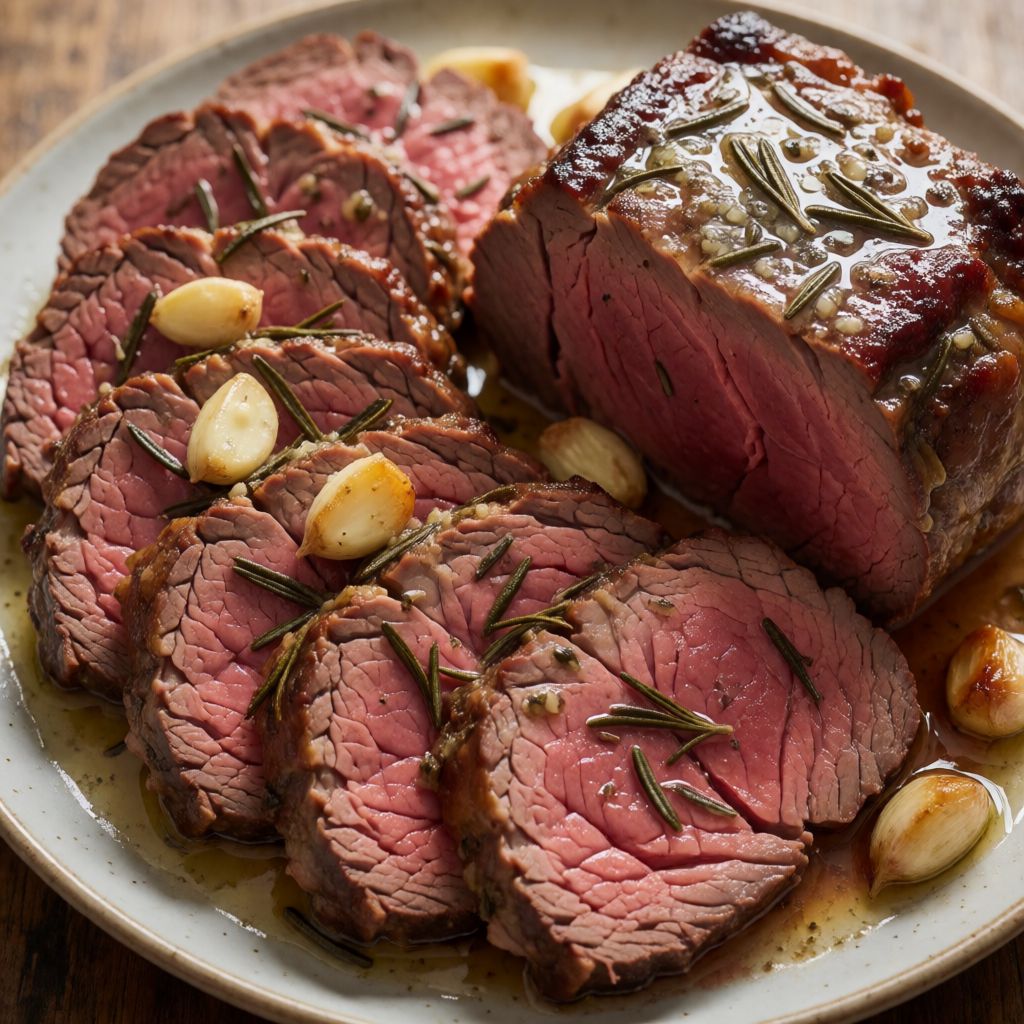
 AI photo
Roast Beef – Perfectly Cooked
A classic roast beef, rubbed with a rosemary, garlic and salt mixture, roasted to a juicy medium and rested before slicing.
Labels are worked out automatically from the ingredients and can be wrong. Check the packaging if it matters to you.
Ingredients
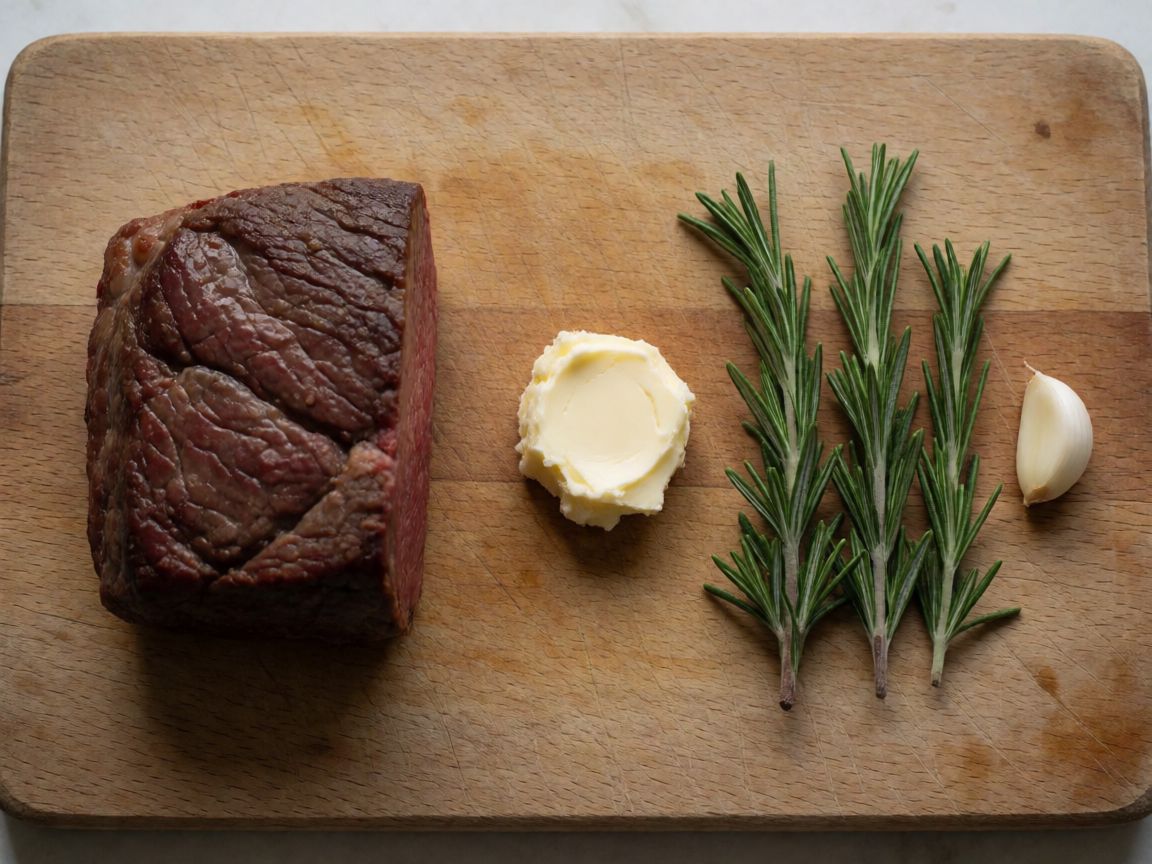






Steps
Take the meat out of the fridge and let it sit on the kitchen counter for about 1 hour.
60 minPat the meat dry with a paper towel, then heat a pan with olive oil and butter.
3 minOnce the butter stops sizzling, sear the meat on all sides until evenly golden brown.
8 minMake a herb salt: crush the rosemary, salt and garlic together in a mortar until smooth.
2 minSpread the mixture over the top of the roast beef.
1 minInsert a meat thermometer from the side into the thickest part, reaching the centre of the meat.
1 minLeave the thermometer in the meat for the whole cooking and resting time.
In the oven: place the roast beef on a rack in a preheated oven at 150°C (conventional top/bottom heat) and cook until it reaches an internal temperature of 55°C. This takes about 45 minutes to 1 hour.
52 minOn the grill: place the meat on the rack over indirect heat and cook until it reaches an internal temperature of 55°C.
Once the meat reaches an internal temperature of 55°C, remove it from the oven or grill and cover with a clean cloth — it should rest here for 20-30 minutes.
25 minCut the delicious roast beef into thin slices, ready to serve.
3 minIt's also delicious cold the next day, sliced for sandwiches.
Roast beef sounds like a loud, celebratory thing but what's actually happening is quiet and slow: a big piece of meat crossing from raw to cooked by one single number — the temperature at its very centre. Everything else — the counter, the pan, the oven, the cloth — exists to get that centre to 55°C without wrecking the outside on the way there.
Whether it works comes down to one habit people skip because it feels like wasted time: letting the joint sit out of the fridge for an hour before it goes anywhere near heat. A cold joint has a steep temperature drop from surface to core — you sear it, and by the time the heat has crawled inward the outside is already grey and tired. Warm it up first and that gradient flattens, so the core catches up to the crust instead of lagging an hour behind.
The sear itself isn't cooking the meat, it's building flavour and a seal — a crust of browned proteins (that's the Maillard reaction, not "locking in juices"; no crust on earth is watertight). Butter and oil together because butter alone burns and smokes before it browns properly, and oil alone gives you colour without the nutty taste butter brings. Some say the fat seals moisture in — no, because meat isn't a bag, it loses moisture from heat alone regardless of crust; what the sear actually does is give you taste and colour you can't get any other way.
The resting stage under a cloth, not a lid, is doing real work, not just sitting there. Pull meat off heat and the outside is hotter than the centre — the heat is still travelling inward, and the juices that got pushed toward the surface by that heat need time to redistribute before you cut. Slice straight away and they run out onto the board instead of staying in the meat. A cloth, or a couple of sheets of paper towel loosely over the top, lets the surface breathe a little as it cools rather than steaming itself soft under a sealed lid — in a normal flat kitchen a plate turned upside-down over the joint does the same job as a lid would, just don't make it airtight.
150°C in a normal fan-off, top-and-bottom oven is a deliberately gentle number. It's slow by design: the lower the oven temperature, the smaller the gap between the done edge and the raw centre by the time the middle hits 55°C, which means a more even pink from crust to core rather than a thin band of pink surrounded by grey overcooked meat. This is also why "about 45 minutes to an hour" is written as a range and a floor, not a countdown — joints vary in shape even at the same weight, and the only true clock here is the thermometer reading, not the oven timer.
The joint itself: you want a cut with enough internal fat or a fat cap to survive a long gentle cook without drying — sirloin, fillet, topside with a fat layer, rib. A very lean joint with nothing to render will come out tighter and drier at the same 55°C simply because it has no fat buffering the muscle fibre. Size matters less than shape: a thick, even cylinder cooks more predictably than a thin, tapered one, because the latter has one end racing ahead of the other toward 55°C.
Butter and olive oil are there for the sear, as above — any fat that can brown without burning does the same job; a neutral oil alone works if you're out of butter, you'll just lose a little of that nutty note. Rosemary, garlic and salt pounded together isn't decoration, it's a crude but effective way to get aromatic oils out of the rosemary and into contact with the meat's surface before it goes into the oven — crushing ruptures the leaf's cells, simply scattering whole sprigs on top barely touches the meat at all. If you don't have a mortar, a knife chopped fine and the flat of the blade pressed over it gets you most of the way there. No rosemary — thyme does the same job, it's a similar resinous herb; no fresh garlic — a little garlic powder worked into the salt, though you lose some of the sharper edge raw garlic gives.
Black pepper goes on freshly ground and ideally after cooking rather than before, because pepper's aromatic oils scorch and turn bitter under high dry heat for any length of time — a problem that matters less here given the gentle 150°C but is worth knowing as a habit for any sear.
One more thing worth saying plainly, since the method is built entirely around waiting: there's no shortcut through any of this. Not the hour on the counter, not the slow climb to 55°C, not the twenty-odd minutes resting under the cloth. Rush the resting and you'll see it on the board, not on a thermometer — in a shallow pool round the slices, which is exactly the juice that should have stayed inside.