
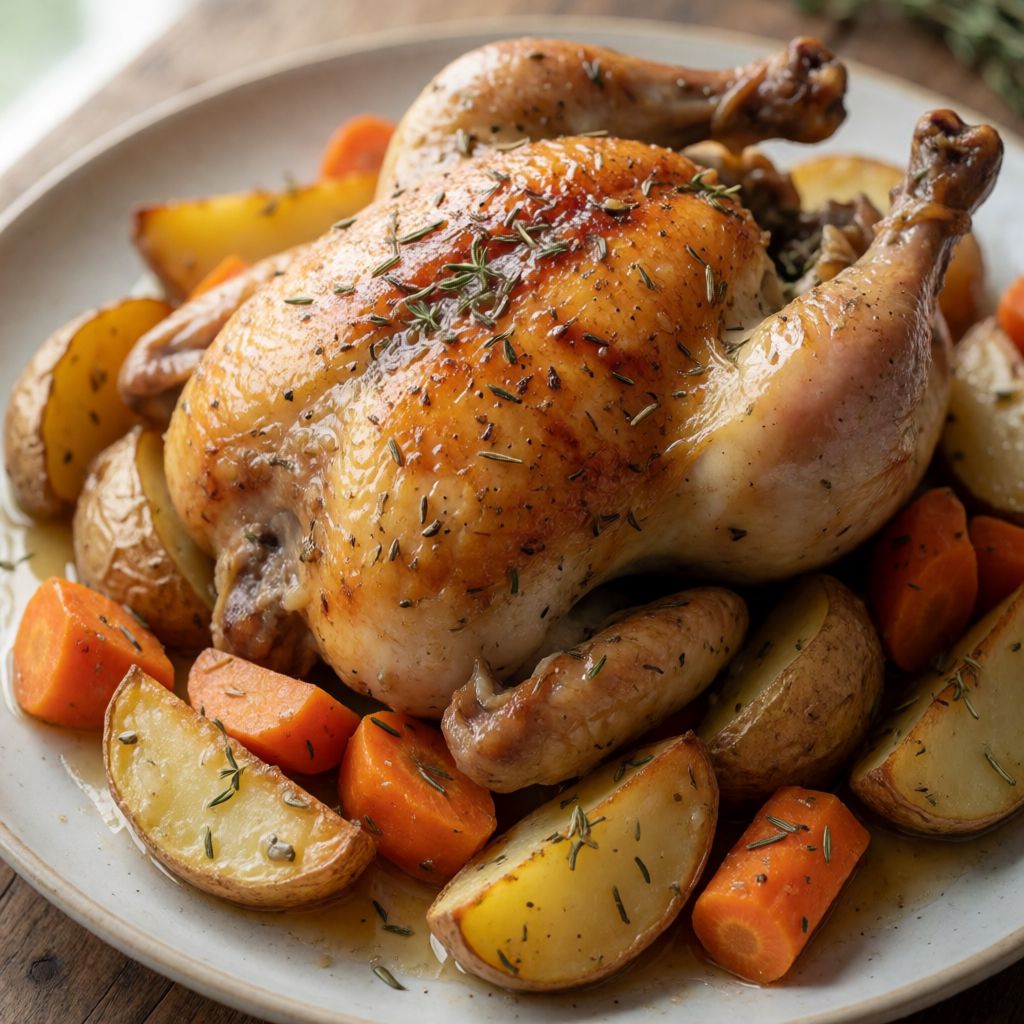
 AI photo
Baked Chicken with Potatoes and Herbs
A comforting roast chicken with potatoes, carrots and fresh herbs, all baked together in one tray.
Labels are worked out automatically from the ingredients and can be wrong. Check the packaging if it matters to you.
Ingredients
- 1 kg Whole chicken whole, thighs and breast with skin if you like
- 800 g Potatoes peeled
- 4 pcs Carrots peeled and sliced
- 1 tsp Dried thyme
- 1 tbsp Rosemary finely chopped, fresh
- 100 ml Stock
- Salt to taste
- Black pepper freshly ground
- 1 tbsp Butter for greasing the dish







Steps
Grease a heatproof baking dish with butter.
Cut the potatoes in half and place them in the dish with the carrots, stock and herbs. Mix well.
Season the chicken with salt and pepper, then place it on top in the dish.
Roast in a preheated oven at 180°C (fan) for 45 minutes, or until the potatoes are tender and the chicken is cooked through with crispy skin.
45 minSprinkle with fresh herbs before serving and serve with a salad and good bread.
What was changed
The oven temperature was rounded to 180°C to match the 10°C steps used in UK ovens.
This isn't a stew and it isn't a proper roast with separate trays — it's one dish where the bird sits on top of raw vegetables and lets its own fat and juice run down into them as it cooks. The chicken bastes the potatoes and carrots for you. That's the whole mechanism, and everything else in the method exists to protect it.
What decides whether it works is the balance between the skin going dry and tight above, and the vegetables staying moist enough below. Too much liquid in the dish and the chicken's underside steams instead of roasts, and the skin you were hoping for comes out pale and soft; too little, and the potato touching the hot metal catches and burns before the thigh is anywhere near done. A hundred millilitres of stock in a dish this size is shallow on purpose — enough to half-braise the roots, not enough to flood the bird.
Some say a whole chicken has to be turned or it won't crisp. No — turning has nothing to do with it. Crisping needs dry, moving heat reaching skin that isn't wrapped in foil or sitting in a puddle. Keep the breast and thighs facing up, exposed to the oven air the whole time, and that's where you get your crackle. The underside, pressed against stock and vegetable, will stay softer — not a mistake, just where the fat chose to go instead of pooling uselessly on a roasting tray.
Start with the chicken. A whole bird costs less per kilo than the same weight bought as breast and thigh pieces, because the butcher hasn't done your cutting for you — that price gap is the whole reason whole-chicken roasting has stayed cheap family cooking for generations, not some mystical superiority of the bird kept intact. But there's a real cooking reason too: the carcass holds the meat together and bastes it from the inside as it roasts, so a whole chicken stays juicier over 45 minutes than loose pieces would. If all you have is thighs and breast separately, skin-on, that's fine — lay them skin up, same logic applies, just watch them more closely since they're thinner and will get there sooner.
Potatoes: 800 grams peeled and halved is a lot of surface area sitting in a small amount of stock, so the variety matters more than you'd think. A waxy potato — Charlotte, a salad-type new potato, even a Desiree — holds its shape in that liquid. A floury one, Maris Piper or King Edward, the usual roasting-potato choice, will often break down at the cut edges here because it's sitting in liquid rather than dry fat; not ruined, just softer and starchier at the edges, thickening the juices a bit as it goes. Either works. Know which you're buying and don't expect King Edward to behave like Charlotte.
Carrots sliced, not left whole or in big chunks, because carrot is denser than potato and slower to soften — slicing it thinner than the potato halves is what lets both finish together instead of giving you a tender potato next to a carrot with a bite still in it.
The stock matters more than its small volume suggests. Stock already carries dissolved fat and collagen from whatever was boiled to make it, which is what gives braised vegetables actual savour instead of just salt-water flavour. The honest substitution criterion is: any liquid that already has body and savour in it — a stock cube dissolved properly, the strained liquid saved from a previous roast, even a weak gravy thinned down. Plain water isn't wrong, it just means your salt and pepper are doing all the work alone, and they rarely manage it as well as they think.
Dried thyme goes in with the liquid at the start, because dried herbs are essentially dormant until moisture and time wake them up — that's the whole justification for using dried rather than fresh here. If you've no thyme, any hardy dried herb that survives long cooking without turning bitter will do: oregano, a dried mixed-herb blend, even a bay leaf tucked in. The fresh rosemary is chopped fine for two reasons — so you're not biting whole needles at the table, and so it doesn't scorch directly against the hot dish and turn acrid. Some goes in at the start, some is held back and scattered fresh at the end, because 45 minutes of heat strips the top note off fresh herbs; what you add after roasting is what you'll actually smell when you sit down.
The butter for greasing isn't decorative — it stops the potato's cut sides, which carry sugar, from catching on the dish's hot base before the rest of the bird is anywhere near ready. Any fat with no flavour of its own does the same job: a flavourless oil, or dripping saved from a previous Sunday roast, which is in fact the older, thriftier habit this whole genre of dish descends from — one Sunday fire heating one oven, meat and vegetables together, fat saved rather than thrown out, because fuel and fat both cost something once.
Last thing, and it costs you nothing but attention: once it's out, give the bird a few minutes before you cut into it — long enough to dress the salad and slice the bread. Juice that's just been driven to the surface by heat needs a moment to settle back in, or it runs out onto the board instead of staying in the meat. That wait is as much a part of this dish as the stock is.