
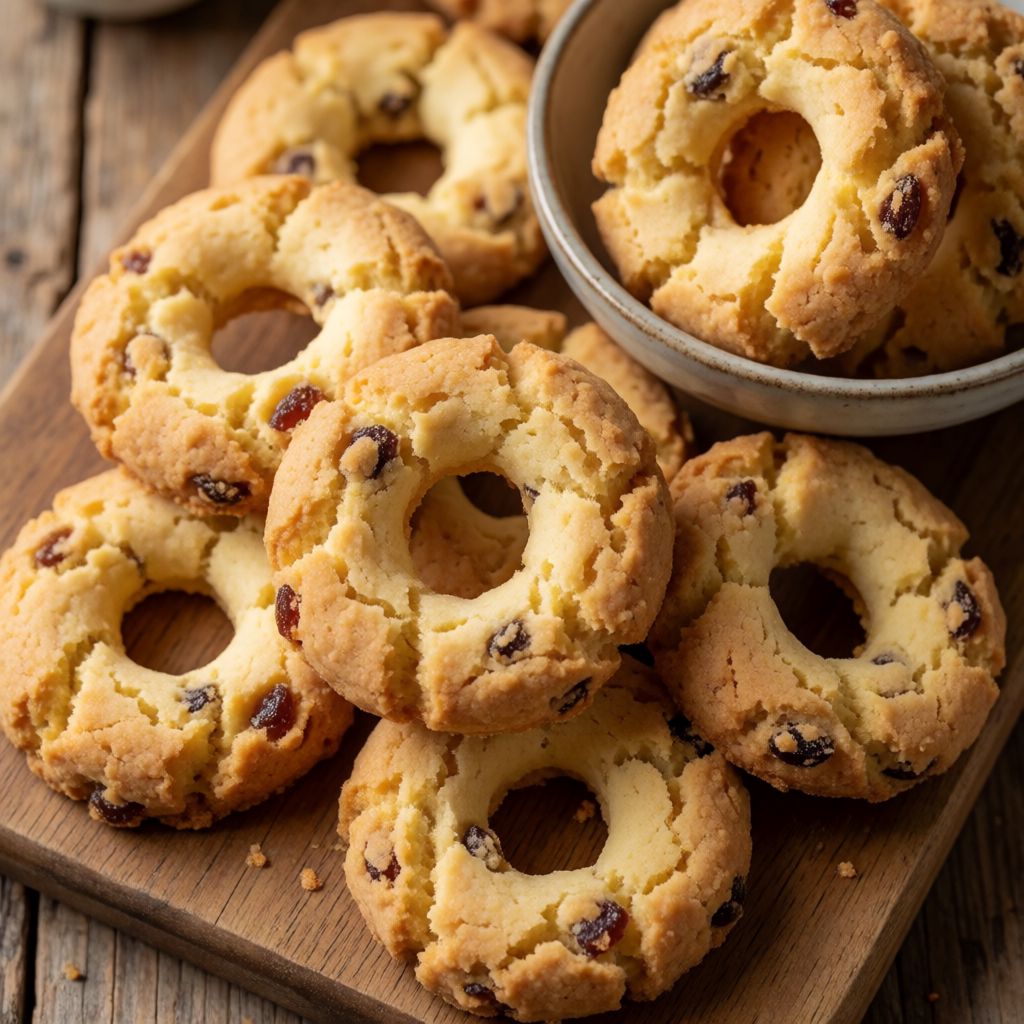
 AI photo
Neapolitan Rococò
Rococò are traditional Neapolitan spiced biscuits, baked into rings of almond-studded dough scented with orange and candied fruit.
Labels are worked out automatically from the ingredients and can be wrong. Check the packaging if it matters to you.
Ingredients
- 500 g Plain flour
- 450 g Caster sugar
- 175 ml Orange juice
- 1 pcs Orange zest
- 150 g Mixed candied fruit
- 5 g Cinnamon
- 2.5 g Baking powder
- 75 g Chopped almonds
- 175 g Almonds whole
- 1 pcs Egg








Steps
Roast the whole almonds in an oven preheated to 200°C for about 15 minutes. Remove and let cool.
15 minMound the flour, add the sugar, cinnamon and baking powder. Mix in the chopped almonds and orange zest.
Gradually pour in the orange juice and knead into a dough.
When the dough starts to take shape, add the whole almonds and candied fruit, and knead well.
Form the dough into a smooth, easy-to-shape ball.
Using a scraper, divide the dough into pieces of about 50g each.
Roll each piece by hand into a rope about 20cm long, then join the ends to form rings.
Arrange the rococò on a baking tray lined with baking paper, leaving a few centimetres between them.
Brush with beaten egg and bake at 180°C for 20-25 minutes, until the biscuits turn golden.
23 minRemove from the oven and let cool before serving or storing.
What was changed
Cinnamon and Baking powder were swapped in for ingredients not sold in UK shops, keeping the same effect in the dough.
Rococò is a Neapolitan Christmas biscuit, and it's deliberately stubborn — hard enough to crack a tooth if you bite it straight off the tray, which is the point. It's a dunking biscuit, built for a glass of something sweet or strong, not for soft eating. There's no butter, no fat at all beyond what's naturally in the almonds, which is unusual for a biscuit and tells you something: this is a dough held together by sugar and orange juice crystallising as it bakes, not by creaming anything.
What decides whether it works is the ring shape and the bake. The dough has to be dense enough to hold a ring without slumping flat in the oven — too much liquid and your rings spread into puddles; too little and they crack when you bend them into shape. You're aiming for a dough that behaves more like marzipan than cake batter: firm, slightly dry to the touch, but still pliable enough to roll into a 20cm rope without tearing.
The colour change at the end is your real signal, not the clock. "Golden" here means the surface — glazed by the egg wash — goes from pale and wet-looking to a deep amber, almost the colour of toasted hazelnut skin. The 20-25 minutes is a floor, not a target. Ovens vary, and a domestic fan oven at 180°C runs hotter at the edges of the tray than the centre, so the rococò nearest the oven wall will colour first — that's not a flaw in your technique, that's just how a home oven breathes.
Start with the almonds, because they do double duty here and the order matters. The whole ones get roasted first — 200°C until they smell toasted and the skins start to split, about 15 minutes is your floor, watch the colour of the nut itself, not just the skin — and this isn't decoration. Raw almonds inside a dense dough stay chalky and raw-tasting even after 25 minutes in the oven at 180°C; they never get hot enough for long enough. Roasting them separately first, at a temperature the dough itself will never reach, is how you get a toasted almond flavour without burning the sugar in the surrounding dough. The chopped almonds go in raw because they're smaller, more exposed to the dough's own heat, and don't need the head start.
The orange — zest and juice both — is the only genuinely wet thing in this dough, and it's doing the work butter or eggs would do in a softer biscuit: binding, flavour, a little acid to balance all that sugar. Use a real orange, zested before you juice it, not bottled juice with no skin involved — bottled juice has no oil in it, and the oil in the zest is where the actual orange smell lives, not the juice. If you're out of fresh oranges, a clementine or two will do the same job at a smaller scale; what you're substituting for is "citrus zest with real oil in the skin," not "citrus flavour," so anything waxed or flavoured won't help you.
Candied fruit is traditional because this is Christmas baking from a time before refrigeration made fresh fruit available in December — candying was how southern Italian kitchens preserved summer fruit through winter, and it ended up permanently lodged in the festive repertoire long after refrigeration made it unnecessary. If you can't get good mixed candied peel, don't reach for dried fruit as a swap — dried fruit has moisture candied fruit doesn't, and it'll soften your dough's crumb where you want it staying firm. Candied citron or orange peel, chopped small, is the closer match.
Cinnamon and baking powder are both small-quantity ingredients and that's deliberate — 5g and 2.5g respectively mean they're there to lift and perfume, not to dominate. This isn't a cake, so don't expect the baking powder to give you rise the way it would in one; in a dough this dense and sugar-heavy, it's mostly fighting to keep the biscuit from going completely leaden, not trying to puff it up.
Dividing into 50g pieces matters more than it looks like it does. Rococò rings need to be roughly uniform so they bake at the same rate on one tray — a 70g ring next to a 40g one means one's underdone while the other's gone past golden into actually hard-hard, the kind you can't eat. A kitchen scale earns its keep here far more than eyeballing it.
When you roll the ropes, you're working against a dough that wants to crack rather than stretch cleanly, because there's no gluten-softening fat in it. Roll on a lightly floured surface with steady, even pressure rather than squeezing — squeezing dries out and cracks the surface, rolling smooths it. If a rope splits as you join the ends into a ring, pinch it closed with wet fingers rather than more flour; flour on the surface at that stage just sits there raw and chalky once baked.
Patience here is less about watching the oven and more about not rushing the dough-forming stage — a dough kneaded in a hurry, with juice dumped in all at once instead of gradually, ends up patchy: wet in pockets, dry in others, and that unevenness follows you straight through to uneven baking later. Fifteen extra seconds of kneading now saves you a tray of rings that bake inconsistently later.