
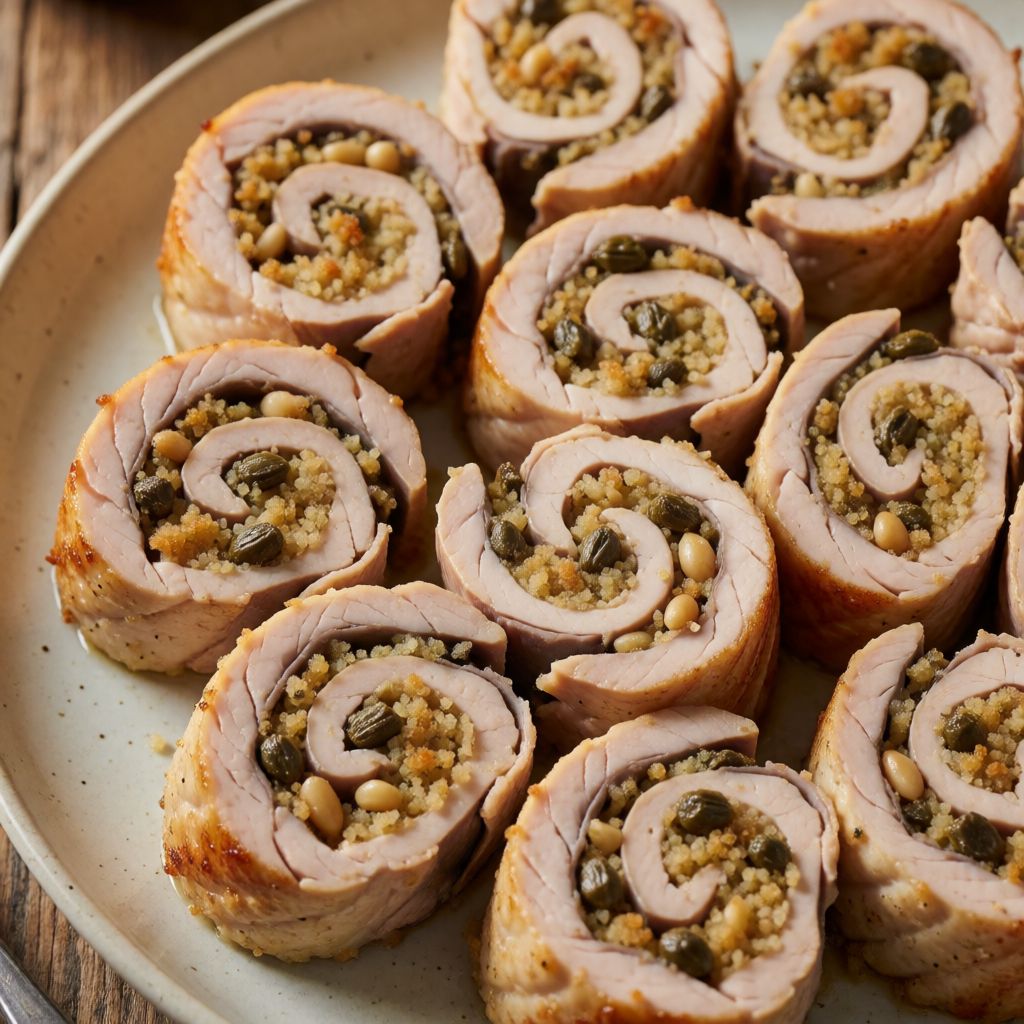
 AI photo
Swordfish Roulades
Thin slices of swordfish rolled around a savoury caper and herb stuffing, baked in a tomato sauce.
Labels are worked out automatically from the ingredients and can be wrong. Check the packaging if it matters to you.
Ingredients
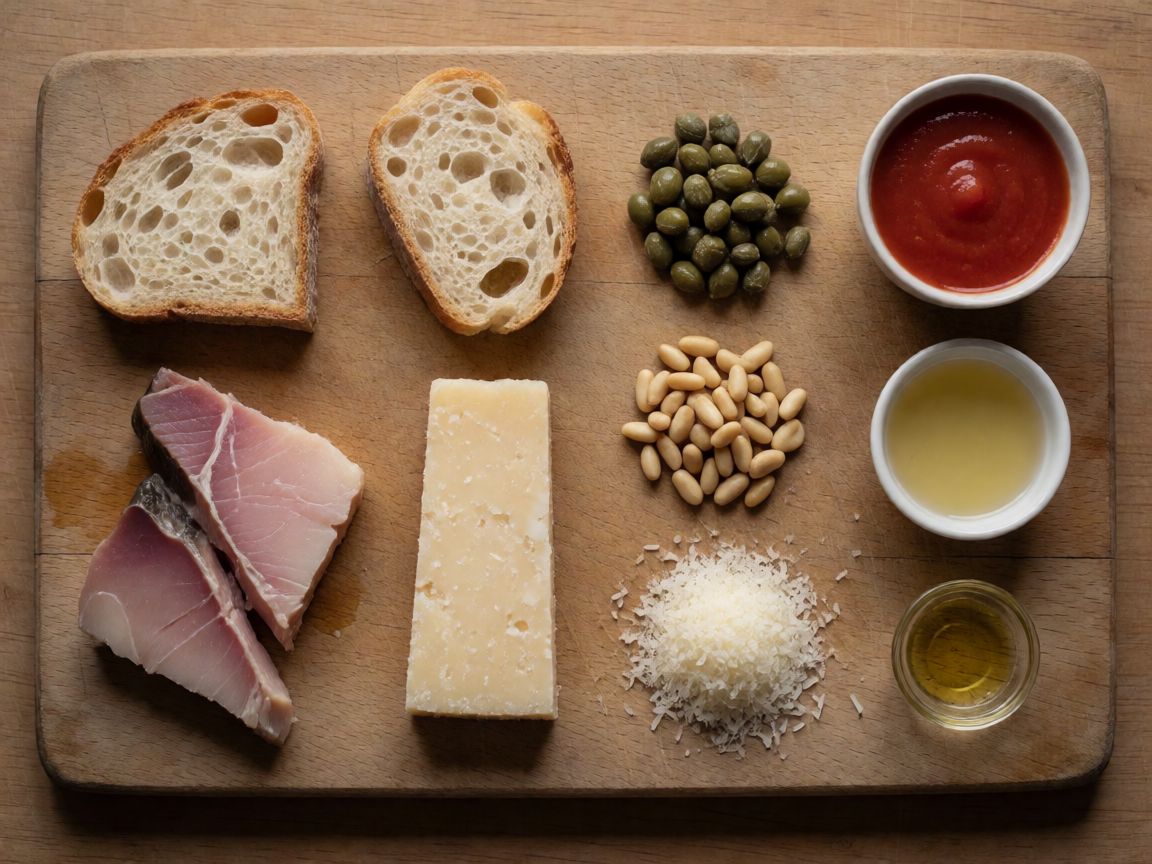
- 600 g Swordfish
- 6 pcs Toasting bread
- 1.5 tbsp Capers salted
- 1 tsp Pine nuts
- 2 tbsp Parmesan
- 0.5 tbsp Pecorino Romano
- 5 tbsp Tomato passata
- 40 g White wine vinegar
- 1 bunch Parsley
- Olive oil to taste
- 1 pcs Lemon
- Salt to taste
- Black pepper to taste












Steps
Soak the capers in cold water for at least 30 minutes, then drain in a sieve and rinse gently.
30 minCrumble the slices of toasting bread into a bowl, add the capers and parsley.
Add salt, black pepper, pine nuts, wine vinegar, lemon juice, Parmesan and Pecorino Romano, and mix well.
Rinse and pat dry the swordfish slices, remove the skin and any bones, and lay them out on a work surface.
Place half a tablespoon of the filling on each piece of fish.
Roll up the swordfish slices into roulades and place them in a baking dish greased with olive oil.
Put the tomato passata in a bowl, add oil, salt and pepper, mix, and spoon the sauce over the roulades.
Bake in an oven preheated to 180°C for about 25 minutes, until the fish is cooked through.
25 minThe roulades are ready when the thickest part reaches an internal temperature of 63°C.
This is a Sicilian trick for turning an expensive fish into a dish that feeds a crowd: involtini di pesce spada, swordfish roulades. Along the Straits of Messina, swordfish was once the daily catch, but even there it wasn't cheap enough to waste on thick steaks for everyone. So the fishermen's wives did what poor kitchens always do — they stretched it. A paper-thin slice of fish, wrapped around stale bread, capers, pine nuts and two cheeses, gives you the taste of swordfish in every bite while using a fraction of the fish. That's the real reason for the roll: not elegance, economics.
What decides whether this works is not the oven, it's the knife and the thermometer. The fish has to be sliced thin enough to roll without splitting — if your fishmonger gives you steaks, you slice them yourself, on the diagonal, against the grain, until each piece is the thickness of a slice of ham. Swordfish has almost no fat and no connecting tissue to forgive you if you overcook it; it goes from silky to chalky in the space of a few minutes. That's why the recipe gives you 63°C and not "25 minutes and done" — the time is just the point where you start checking, not the finish line.
Swordfish itself: buy it as a steak and slice it yourself rather than trust pre-cut "carpaccio" slices from the counter, which are often cut from the wrong part of the loin and tear when you try to roll them. Lean, firm, almost meat-like white flesh is the criterion — tuna loin or a thick monkfish fillet will take the same roll-and-bake treatment if swordfish isn't to be found or the price makes you wince that week.
The bread is doing the heaviest lifting in the filling, and it has to be properly stale toasting bread, not soft fresh sandwich bread. Fresh bread has too much water already in it; add vinegar, lemon and tomato juices on top and it collapses into a gum that sits heavy instead of binding lightly. Dry bread drinks up those liquids and holds its own shape — that's the whole reason stale bread was ever used in poor kitchens instead of thrown out. If your bread is too fresh, dry it in a low oven for ten minutes first; you're correcting the ingredient, not the method.
Capers here are salt-cured, not the small ones floating in vinegar brine you find in most UK supermarkets. Salt-cured capers are stronger and need that half-hour soak, because dry salt has drawn moisture out of them and packed itself into the flesh — a rinse under the tap only touches the surface, the soak actually draws the excess salt back out. If all you can get are the brined kind, skip the soak, taste the final filling before adding more salt, and expect a slightly sharper, more vinegary note throughout, since they bring their own brine along.
Pine nuts and the two cheeses are there for fat and savoury weight, since the fish itself brings almost none. Parmesan gives you nutty depth, Pecorino Romano gives you the sharp, salty edge sheep's cheese always carries over cow's — that's why only half a tablespoon of it is needed against two of Parmesan. Any aged, hard, well-salted cheese stands in for the Pecorino if you have none; a mature cheddar will do a passable job, though it won't have quite that same sheep's-milk tang. Pine nuts can be swapped for flaked almonds or even chopped walnuts — the job is crunch and mild oil, not a particular nut.
Vinegar and lemon together look redundant until you remember they're two different acids doing two different jobs: the vinegar's sharpness cuts through the fat of two cheeses sitting in a breadcrumb base, the lemon brings a brighter, more volatile top note that fades as it cooks. If you've only got one of the two, use the lemon — it's the more forgiving of the pair.
On the oven: 180°C is the number on the dial, but every domestic oven lies a little, especially the kind most British kitchens have, more used to roasting a joint on a Sunday than coaxing a delicate fish for twenty-five minutes. Trust the sauce and the thermometer over the dial — it should be gently bubbling at the edges of the dish by the time you check, and the fish itself should read 63°C at its thickest rolled point, not just look opaque on top. Patience here isn't about waiting longer, it's about checking earlier than you think you need to, because past that point there's no saving it.