
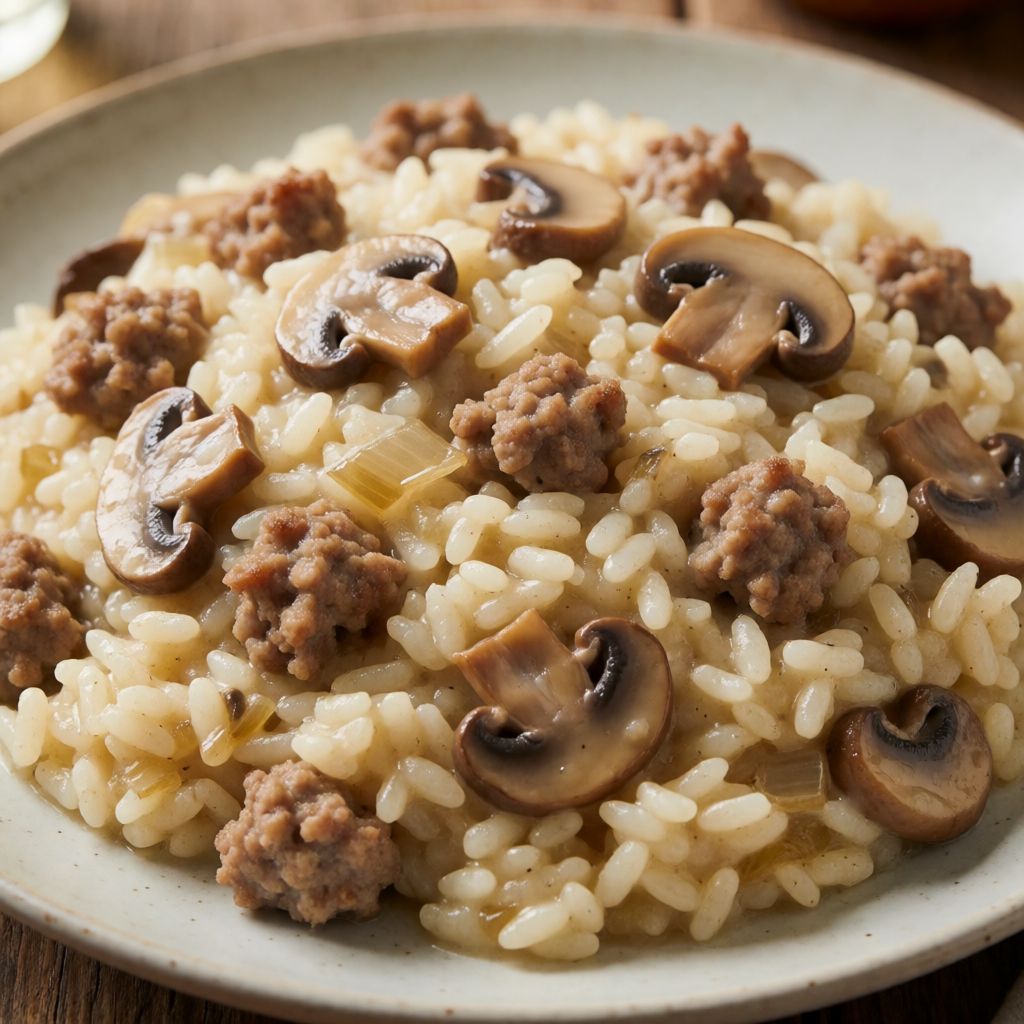
 AI photo
Sausage and Mushroom Risotto
A creamy risotto with mushrooms and sausage, finished with butter and Parmesan.
Labels are worked out automatically from the ingredients and can be wrong. Check the packaging if it matters to you.
Ingredients
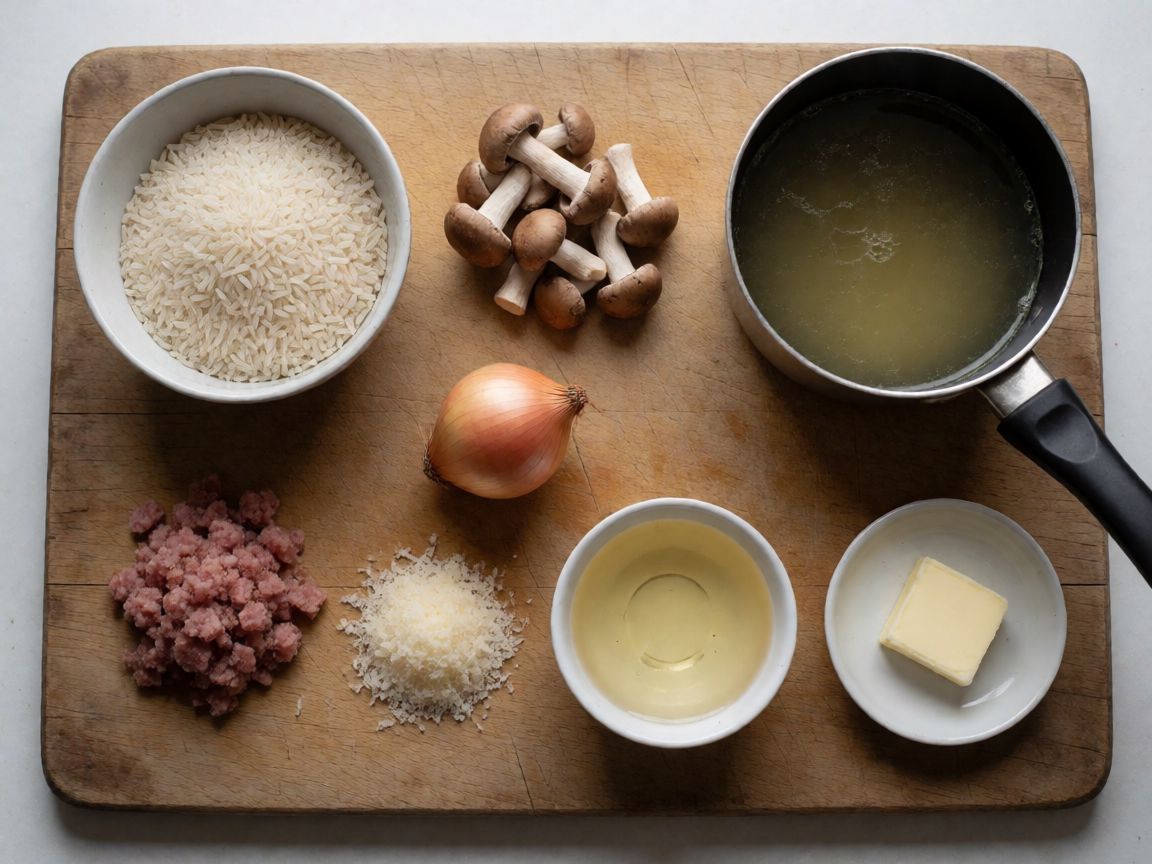
- 360 g Rice
- 280 g Mushrooms
- 1 pcs Onion
- 160 g Sausage
- 1 l Vegetable stock
- 40 g Parmesan
- 100 ml White wine
- 1 pcs Butter a slice
- Parsley to taste
- 2 tbsp Olive oil
- Salt to taste
- Black pepper to taste











Steps
Thoroughly clean the mushrooms: wipe off any soil with a damp cloth and trim away any dirty parts with a knife.
Peel the onion and slice it thinly. Put it in a non-stick pan, drizzle with olive oil and fry until golden.
Remove the casing from the sausage, crumble it and add to the onion. Fry over high heat until fully cooked through, reaching 70°C inside.
Add the rice and toast it briefly so it soaks up the flavours. Pour in the white wine and raise the heat to let the alcohol evaporate.
Add the mushrooms, pour in a few ladles of vegetable stock and stir.
Keep cooking the rice, gradually adding stock in small amounts and stirring often.
15 minCheck the rice is cooked and turn off the heat.
Add the butter and Parmesan, and mix until creamy.
Season with salt and black pepper to taste, sprinkle with parsley, plate up and serve.
Risotto is not a rice dish. It's a sauce-making technique that happens to use rice as the thing it clings to. The rice releases starch slowly as you stir and feed it liquid, and that starch is what turns broth into something thick and glossy. Get the starch release wrong — too much liquid at once, not enough stirring, the wrong rice — and you've made rice soup with mushrooms floating in it, which is a different and lesser dish.
The whole method hangs on one word: gradually. You don't dump the litre of stock in and walk away. You add a little, let the rice drink it down while you stir, add a little more. Stirring knocks the starch off the grains' surface into the liquid; that's the mechanism, not a ritual for keeping busy. Skip the stirring and the starch stays locked in the grain — you get separate, bouncy grains in watery broth, never a sauce.
Some say risotto needs constant, frantic stirring from first grain to last spoonful, arm aching, no room to breathe. No — because what matters is contact and movement often enough that nothing catches on the pan bottom, not motion every second. You can turn and check the mushrooms, you can season the sausage, you just can't forget the pot for five minutes. A domestic hob with one decent burner handles this fine; you don't need a kazan's heat retention here, you need attention.
Doneness isn't a clock. It's a grain between your teeth — it should have give, a faint resistance at the very centre, not the crunch of raw starch and not the collapse of porridge. Fifteen minutes is where to start looking, not where to stop.
Rice first. You want a short, fat, starchy grain — Arborio, Carnaroli, the names on risotto bags in any UK supermarket — because that starch coat is the entire point of the dish. Basmati or long-grain rice, bred for Sunday-roast-adjacent fluffiness and separation, will not give you this; it's built to resist exactly what you're trying to coax out of it here. If all you have is a short-grain pudding-style rice, it'll limp through, but don't expect the same cling.
The onion goes in first and slowly, because a raw-tasting onion under cooked sausage and mushroom is a flavour you can't fix later — it sits underneath everything else and sours it. Gold, not brown: brown means sugars burning, bitterness creeping in. Thin slices cook evenly without you needing to hover.
The sausage is crumbled rather than kept whole because risotto wants small, stirrable pieces that distribute through the grain, not chunks you bite into separately. 70°C inside is the number that actually matters here — that's the point pork is safely cooked, not a guess, not "until it looks done." Any coarse pork sausage with decent fat works; skip the ones packed with rusk and little meat, they render nothing and add no flavour, which defeats the reason you put sausage in a risotto in the first place.
Wine isn't decoration. Its acid cuts through the richness of butter, cheese and sausage fat — without it the dish sits heavy and flat. The alcohol has to cook off properly, which is why the heat goes up right after you add it; leave it unevaporated and you get a harsh, raw-spirit edge instead of brightness. No wine in the house — use a splash of stock with a squeeze of lemon added at the same point; you need the acid, not specifically the grape.
Mushrooms get wiped, not drowned under a running tap. Mushrooms are mostly water already, built like a sponge; soak them and they take on more water, then that water leaks out in the pan and you're steaming them instead of browning them — pale, slippery mushrooms instead of ones with any savoury depth. A damp cloth removes grit without loading them up.
Stock matters more than most people rate it, because it's not a background liquid — it's half the sauce by the end. Shop vegetable stock cubes are fine; just taste one spoonful before you commit a litre, some are salty enough that your final seasoning step becomes pointless.
Butter and Parmesan go in at the very end, off the heat, because this is where the sauce actually forms — fat and starch and the last traces of hot stock binding into that creamy finish people chase and don't always understand the cause of. Add them too early, while the pan's still roaring, and the butter just melts and runs instead of emulsifying; you lose the cling. Any hard, well-aged cheese with a decent salt content stands in for Parmesan — a strong mature Cheddar from the tea-and-biscuits cupboard will do an honest job, though it won't taste identical.
And patience — real patience, the kind that keeps you standing at the hob stirring and watching rather than setting a timer and leaving — is the one ingredient not listed on the card that the whole dish depends on.