
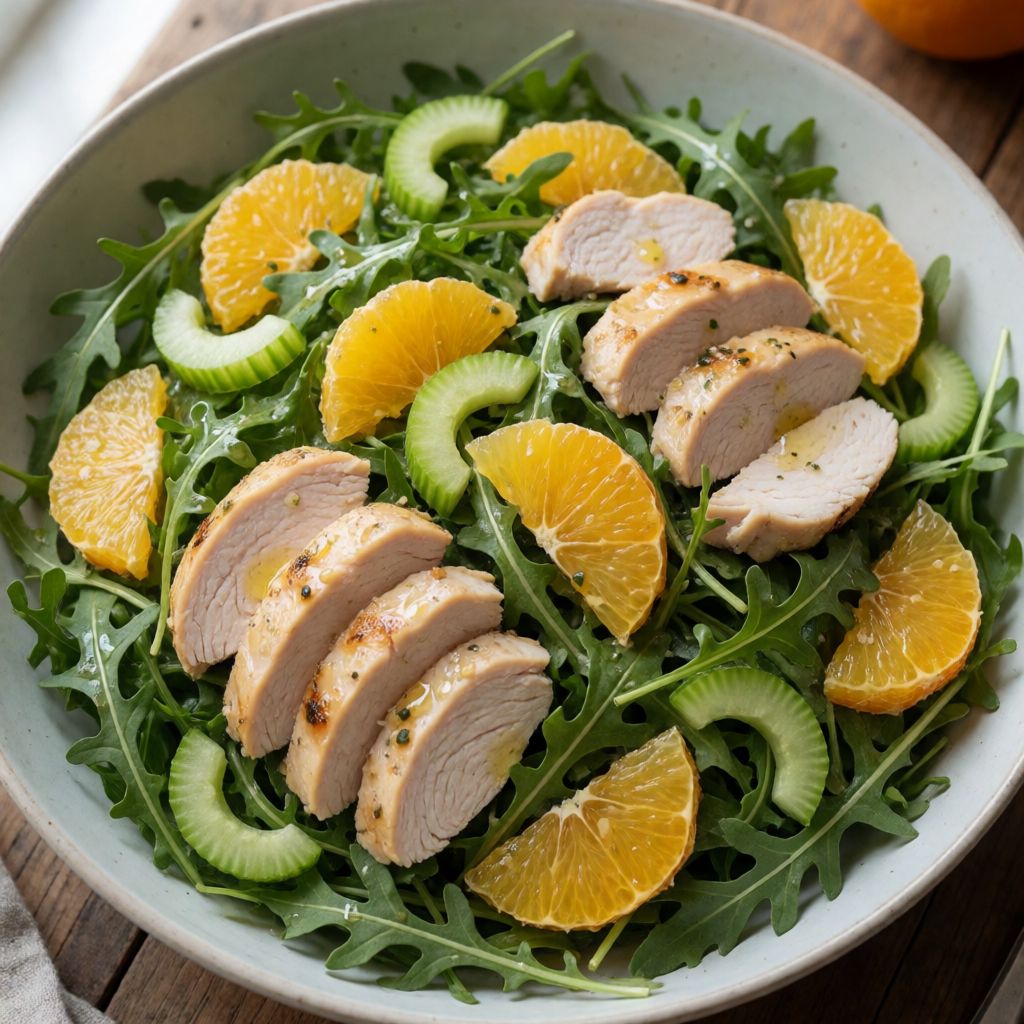
 AI photo
Chicken Breast, Orange and Rocket Salad
A fresh salad of pan-seared chicken breast, orange and peppery rocket, finished with olive oil and apple cider vinegar.
Ingredients
- 4 pcs Chicken breast
- 4 pcs Orange
- 2 pcs Celery stalks
- Rocket to taste
- Apple cider vinegar to taste
- Olive oil to taste
- Salt to taste
- Black pepper to taste






Steps
Wash the celery stalks under running water and dry them with a kitchen towel, then slice into rounds and place in a large salad bowl.
Peel the oranges, separate into segments and cut into small pieces; add to the celery and set aside.
Season the chicken breast with salt and black pepper, place on a hot griddle pan and fry for a few minutes until cooked through.
Cut the cooked chicken breast into thin strips and leave to cool.
10 minAdd the chicken to the celery and oranges, add the rocket and dress with apple cider vinegar and olive oil.
Gently mix all the ingredients together, seasoning with more salt and black pepper if needed.
Let the salad rest for at least 15–20 minutes before serving.
20 min
What was changed
Celery stalks corrected: the root vegetable listed by mistake was replaced with celery stalks, as in the original recipe.
This is not really a salad in the leafy sense — it is a plate built on contrast. Tender chicken, sweet-sharp orange, crunchy celery, bitter rocket, and a thin coat of vinegar and oil to hold the argument together. Nothing here is complicated. What decides whether it works is restraint: not overcooking the chicken, not stripping the orange of its juice while you cut it, not dressing the rocket too early.
The chicken is the part people get wrong, and it is always the same mistake — frying it until it is grey and tight because "chicken has to be well done." True, it has to be cooked through. False that this means hard as a shoe sole. A breast is lean, almost no fat to protect it, so the moment the proteins tighten past a certain point, they squeeze the water straight out onto your board. You lose juice, you lose tenderness, and no amount of dressing brings it back. The cue is not a clock, it is the breast itself: press it, it should give a little resistance, like a ripe peach, not a brick. Cut into the thickest one if you are unsure — the centre should be opaque white through, no pink thread, no give that feels raw. Then let it sit off the heat before you slice it. Same logic as resting a Sunday joint before carving — the juices that rushed to the centre under heat need a minute to walk back out evenly, otherwise they spill onto the board instead of staying in the meat.
Take the chicken breast first, because it is the one ingredient with no forgiveness built in. On a domestic hob you will not get a kazan's even, fierce heat — you have a flat griddle or a frying pan, and the breast is thick in the middle, thin at the edge. That mismatch is the real cause of patchy cooking, not the pan being "not hot enough." If your breasts are uneven in thickness, give the fat end a few taps with something heavy under cling film before it goes in — that is not fussiness, that is making sure the whole piece finishes at the same moment instead of one end burning while the other stays raw. A pan is ready when a drop of water flicked onto it skates and disappears fast, almost a hiss and gone — that is your cue, not a dial setting that means different things on every cooker.
Four chicken breasts, four oranges, two sticks of celery — feeds four. One breast and one orange per person is the whole proportion to remember, and it tells you something about the dish's logic: it is meant to be a main-course salad, not a side nibble before the real meal, which is a very un-British idea in itself — here a salad usually plays understudy to the roast, not the lead.
Oranges: you want ones with thin skin and some weight to them — heavy for their size means juicy, light means dry and pithy inside, whatever the colour of the peel says. Cut away the peel and the white pith together, following the curve of the fruit, then cut the segments free from their membrane rather than just slicing a peeled orange into rounds. Slicing with the membrane in means tough little walls in every bite and the bitter compounds sitting right in the juice that coats everything else — a small difference in technique, a real difference on the tongue. If you have no proper oranges, blood orange works, even a sharp clementine if you use two or three — the point is sweet citrus with enough acid to cut through the chicken, not sugar alone.
Celery brings water and crunch, nothing more romantic than that, which is exactly its job — a textural counterweight so the whole plate is not soft chicken and soft orange. Wash it properly; the grooves on the inside of each rib collect grit, and nobody wants that between their teeth pretending to be seasoning. No celery in the house, use fennel, thinly sliced — different flavour, same crunch-and-moisture role, and it even echoes the citrus with its own sweetness.
Rocket is there for bitterness and pepper, deliberately — the whole plate would be flat and sweet without it. Watercress or baby spinach leaves can stand in, though spinach brings less bite and you may want an extra pinch of pepper to compensate. Apple cider vinegar and olive oil are not fixed by law — vinegar just needs to be acidic without tasting of anything loud, so a light white wine vinegar or even lemon juice works, and lemon has the advantage of echoing the orange rather than competing with it. Oil should have no smell of its own so it carries flavour instead of adding one — any neutral oil does this, olive oil included if it is a mild one, not the heavy, peppery kind meant for dipping bread. Salt and pepper go on twice, once on the raw chicken, once at the end, because the chicken needs seasoning before it ever sees the pan — seasoning the outside of a cooked piece only ever sits on the surface, it never gets near the middle.
Patience here is not a virtue for its own sake, it is doing actual work: resting the chicken keeps its juice where it belongs, resting the salad lets vinegar soften celery and orange instead of just sitting on top of them. Skip both and you get a technically identical list of ingredients on a plate that tastes less like itself.