
 AI photo
Savoury Pancake Parcels with Smoked Salmon
Thin savoury pancakes tied into little parcels, filled with smoked salmon and soft cheese, then baked with butter and Parmesan.
Labels are worked out automatically from the ingredients and can be wrong. Check the packaging if it matters to you.
Ingredients
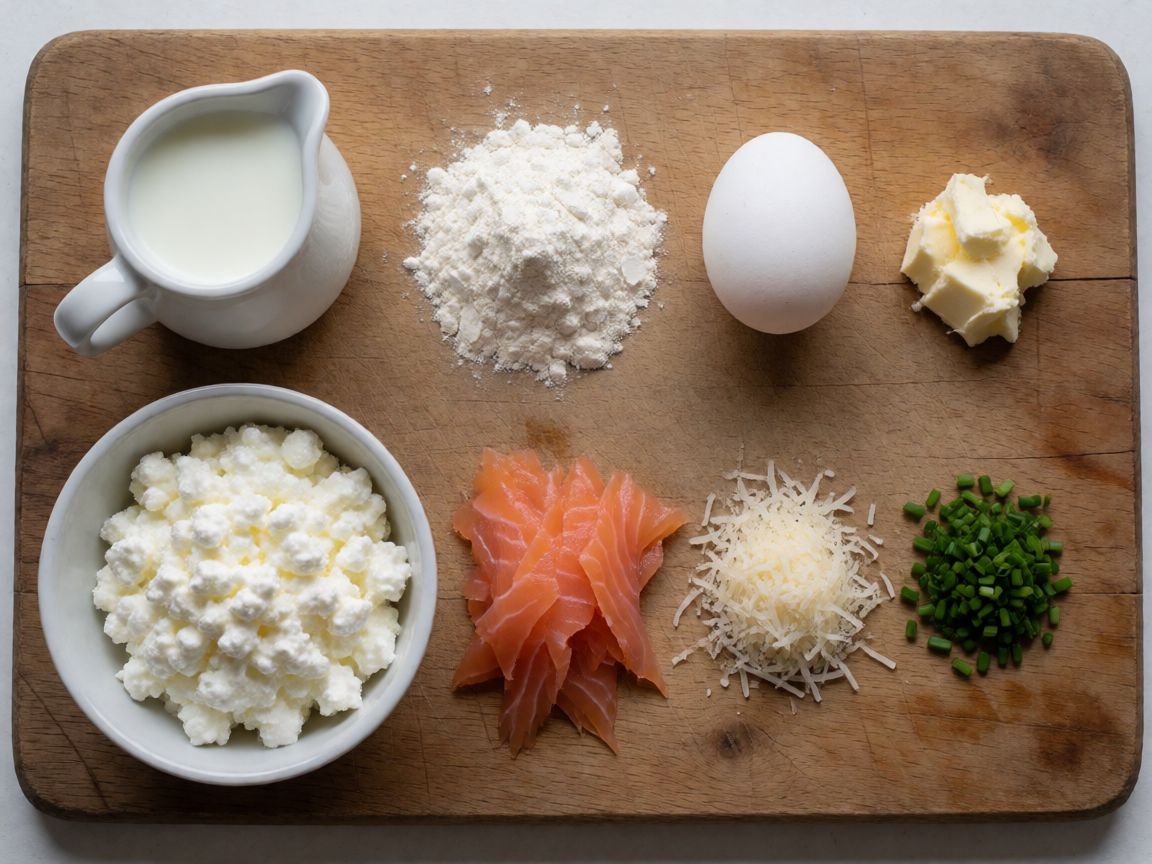
- 250 ml Milk
- 125 g Plain flour
- 1 pcs Eggs
- 15 g Butter
- Salt to taste
- 200 g Smoked salmon
- 150 g Cottage cheese
- 30 g Parmesan
- 1 tbsp Chives









Steps
In a large bowl, beat the egg, add the milk and whisk together, then stir in the warm melted butter.
Add the sifted flour to get a smooth, lump-free batter.
Cover with cling film and let the batter rest in the fridge.
30 minHeat a small frying pan, about 18-20 cm across, lightly greased with butter.
Pour in half a ladle of batter and fry the pancakes on both sides for a few seconds each.
Chop the smoked salmon and put it in a large bowl with the cottage cheese, mixing well.
Add the chopped chives and the Parmesan.
Fill each pancake with a tablespoon of the filling.
Fold the edges towards the centre to form a little parcel, and tie with chive stems.
Place the parcels in a buttered baking dish, top with butter and grated Parmesan.
Bake at 200°C for 8-10 minutes, switching on the grill for the last minute.
10 minServe hot.
This is a crepe, not a pancake in the British sense — no bicarb, no fluff, just egg and milk and flour making a batter thin enough to pour. Fold it round smoked salmon and cottage cheese, tie it with a chive like a little parcel, and the whole thing is really a vehicle: a flexible wrapper that will hold its shape in the oven for just long enough to warm through and go glossy on top. What decides whether it works is restraint in two places — how thin you fry the crepe, and how briefly you bake it. Overdo either and you get rubber.
The batter wants to rest. That's not tradition for its own sake — it's chemistry doing quiet work while you do something else. Flour proteins need time to hydrate fully, and the gluten that formed when you whisked needs time to relax again. Skip the rest and you fry a batter that's still elastic and sulky, one that shrinks back in the pan and tears when you try to fold it round the filling. Thirty minutes in the fridge isn't a ritual, it's the minimum time for starch and protein to stop fighting you.
Some say a crepe needs a special pan. No — it needs a pan that holds heat evenly and a surface you can read. An 18-20cm frying pan is simply the right size for your hand and your ladle; go bigger and the batter runs thin and tears before it sets, go smaller and you're left with thick clumsy discs that won't fold without cracking.
Flour: 125g plain, nothing self-raising — you are not making something that needs to rise, you're making a flexible sheet, and raising agents would just put bubbles in a wrapper that needs to stay smooth and tearless. Sift it in gradually, whisking, because the real enemy here isn't flour itself but lumps — a sudden tip of flour into wet egg and milk clumps instantly, and no amount of later whisking fully dissolves a lump that's already started to seal itself in flour's own starch. Add it in stages and you avoid the problem rather than fighting it afterwards.
Milk: 250ml, and it wants to be the main liquid because milk's proteins and fat give the crepe a tenderness water alone can't. Any milk with reasonable fat content works; skimmed will fry paler and slightly tougher because there's less fat to keep the gluten strands short and separate.
Butter, melted and worked in warm: 15g in the batter, more for frying, more again on top before baking. The reason it goes in warm rather than cold is simple — cold butter seizes into little solid flecks the moment it hits colder milk, and you'd fry a crepe with fat unevenly distributed, patchy brown spots where the butter burnt locally instead of greasing evenly. Any neutral-tasting oil can stand in for the butter you fry with — groundnut, a light vegetable oil — but butter in the batter and on top is doing a flavour job too, so don't swap that one without noticing you've lost something.
Egg: one, there to bind the batter and give it the stretch a crepe needs to fold without splitting — egg proteins form a thin elastic net through the batter as it cooks. Without egg you'd get something closer to a blini, thicker and less willing to be folded into a parcel.
Smoked salmon, 200g: buy it in slices, not trimmings, if you want clean chopping and no surprise bones. Cold-smoked is the usual choice here — it stays silky rather than firm, so when you fold it into the cottage cheese it distributes rather than sitting as separate chewy chunks. If you genuinely can't get smoked salmon, any cold-smoked fish with a similar oiliness — trout is the honest substitute, not tuna, which is too lean and won't carry the smoke flavour the same way.
Cottage cheese, 150g, and Parmesan, 30g plus more for the top: the cottage cheese is the quiet workhorse, giving the filling moisture and a mild dairy backdrop that lets the salmon's smoke and salt lead without shouting. Parmesan is there twice for two different jobs — inside, it adds a savoury depth and a bit of salt; on top, it's doing something else entirely, melting under a brief grill into the beginnings of a crust. That's the only reason the oven features at all: 200°C for eight to ten minutes isn't cooking the filling, which is already essentially ready to eat — it's just warming everything through and giving the top a last minute under the grill to blister and brown the cheese. Watch it, don't time it blindly: you want gold going toward amber at the edges, not the flat uniform brown of something left a minute too long. An oven's grill varies more between flats than between recipes, so the last minute is the one you stand and watch through the door, not the one you set a timer for and walk away.
Chives, a tablespoon chopped through the filling and a few whole stems for tying: besides the oniony lift they give the filling, the whole stems used as string are doing actual structural work — holding the fold shut while it bakes, so the filling doesn't push its way out the side. If your chives are too brittle to tie without snapping, a quick dip in hot water for a few seconds softens them enough to bend, the way you'd soften a leek leaf for the same job.