
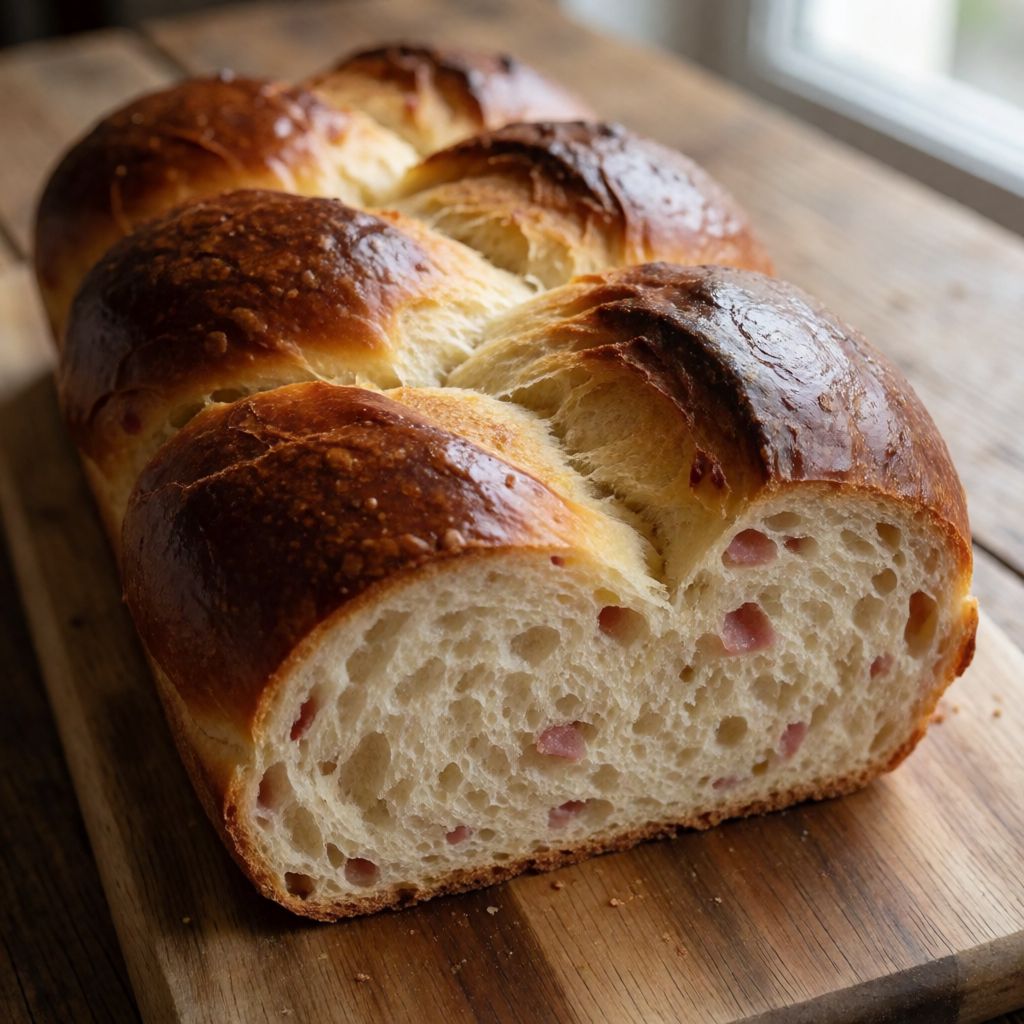
 AI photo
San Petronio Bread
A soft Italian-style rolled bread filled with ham and Parmesan, baked into a ring.
Labels are worked out automatically from the ingredients and can be wrong. Check the packaging if it matters to you.
Ingredients
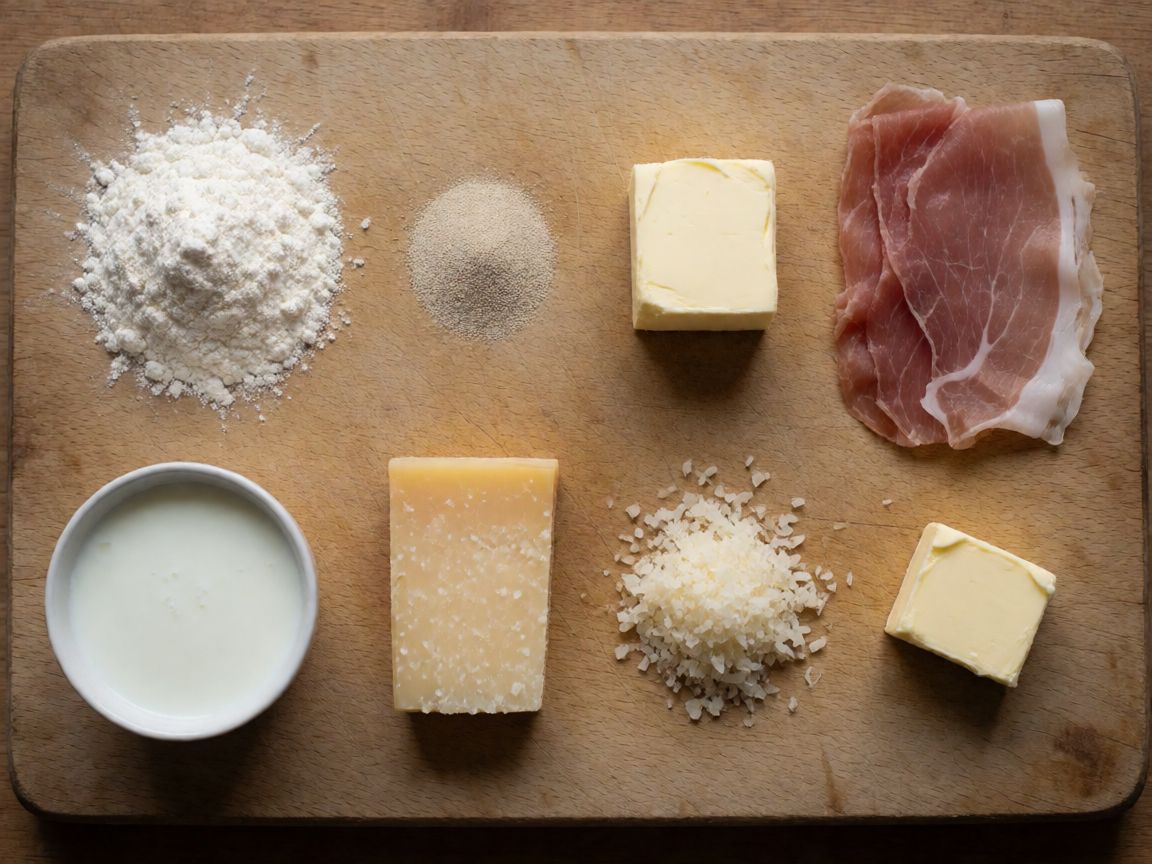
- 580 g Plain flour
- 380 ml Milk
- 20 g Yeast
- 10 g Salt
- 70 g Butter
- 200 g Prosciutto
- 80 g Parmesan
- Parmesan to taste
- Butter to taste





Steps
Dissolve the yeast in warm milk. Tip the flour into a bowl, gradually pour in the milk and start kneading the dough.
Add the salt, then gradually add the butter in small cubes until fully absorbed and the dough is soft.
Shape into a ball, place in a bowl, cover and leave to rise until doubled in size.
120 minTransfer the dough to a work surface. Roll it out with a rolling pin into a thin rectangle.
Spread the prosciutto over the whole surface of the dough, then scatter the Parmesan evenly on top.
Roll the dough up tightly from the long edge into a log. Shape it into a sausage and join the ends into a ring.
Place the bread on a parchment-lined baking tray, cover with cling film and leave to rise for a further 60 minutes.
60 minCut slashes into the surface with a sharp knife. Sprinkle them with a pinch of Parmesan and top each with a small piece of butter.
Bake at 190°C on the standard setting for about 30 minutes.
30 minRemove the bread and let it rest for 30 minutes before serving.
30 min
What was changed
The oven temperature is set to a single value of 190°C instead of the original range .
This is a stuffed bread ring — think of it as a savoury brioche wearing a crown. The dough is enriched, so it behaves more like a soft bun dough than a rustic loaf: milk and butter instead of water and olive oil, which is why it browns fast and stays tender rather than crusty. What decides whether it works isn't the rolling or the shaping — it's whether the dough actually doubled before you touched it, and whether it doubled again before it saw the oven.
The name points at Bologna — San Petronio is the city's patron saint, and this ring of bread studded with prosciutto and Parmesan is the kind of thing that turns up on a feast-day table, somewhere between bread and savoury pastry. It's built the way a lot of filled breads are built across Italy: not out of mystique, but out of economics. A ring of enriched dough stretches a modest amount of cured meat and cheese across a whole table — bread was always the cheap bulk, ham and cheese the expensive accent, and rolling the filling inside rather than piling it on top means every slice gets a bit of both.
Flour: 580 g of plain flour, not strong bread flour, and that's deliberate — this isn't meant to be chewy and open-holed like a baguette. Plain flour has less protein, so the crumb stays soft and close, closer to a dinner roll than a crusty cob. If all you've got is strong flour, it will still rise, but the result will be a touch tougher — cut it with a spoonful of extra milk if the dough feels tight.
Milk and yeast: 380 ml of milk, warm enough that it feels pleasantly warm on the inside of your wrist, not hot. Yeast dies above roughly 50°C, which is the real reason behind "warm, not hot" — not tradition, biology. Fresh yeast (20 g here) dissolves into milk more readily than it does into water because milk's proteins and sugars give it something to feed on early. If you only have dried yeast, use about a third the weight and let it sit in the milk a few minutes until it smells faintly of beer before mixing in the flour — that smell is your proof it's alive.
Butter, twice: 70 g worked into the dough for softness, and a small extra piece — "to taste" — dropped onto each slash before baking. The dough butter enriches the crumb; the topping butter does something else entirely — it melts into the cuts as they open in the oven, glazing the exposed surface so it browns rather than drying out and going pale. Any neutral fat with no flavour of its own won't do the same job here, because you want butter's flavour on the crust, not just its fat — so don't swap this one out for oil.
Salt: 10 g, added after the first mix, not before. Salt tightens gluten and slows yeast activity, so going in too early can fight the dough just as it's trying to come together. This is the same logic that sits behind the staggered butter — sequence matters more than people expect in an enriched dough.
Prosciutto and Parmesan: 200 g and 80 g, laid flat across the rolled-out rectangle before you coil it. Prosciutto brings salt and fat that render slightly in the oven's heat, basting the dough from inside as it bakes — which is also why you want it in thin, even slices, not thick-cut: thick slices leave pockets of unmelted fat and gaps in the spiral. If you've no prosciutto, any dry-cured ham with a similar fat-to-meat ratio — Serrano, a good cooked ham in a pinch — will behave the same way, though the flavour shifts. Parmesan brings savoury depth and, as it melts, a faint crust where it touches the dough's inner layers; a hard, aged grana-style cheese is what you need for that — a soft cheese would just turn to liquid and soak into the dough rather than holding its own layer.
On the oven: 190°C on your "standard setting" means fan-off, top-and-bottom conventional heat if your oven makes that distinction — worth checking, because a fan oven running at the same dial setting runs hotter in practice and can brown this before the inside sets. In a standard UK domestic oven without a stone or steam, don't expect a thin crackling crust like a bakery loaf gets from a blast of steam — your crust here will be softer and more biscuit-coloured, and that's fine, because this dough was never built to crackle. Judge it done not by the clock but by colour: the surface should go from pale and doughy to a deep gold, especially along those slashed cuts where the butter's pooled and started to catch.
Last point, and it's the one people skip because it feels like wasted time: the 30 minutes resting after baking isn't there to cool it down for you — it's there so the crumb, which is still setting internally even after the oven's off, finishes firming up around the layers of ham and cheese. Cut it straight from the oven and the inside will be gummy and the filling will slide rather than slice. Six people, a loaf shaped like a crown, cut in wedges — good with the tea you'll already have on, better than you'd expect alongside a Sunday roast as something to pick at before the main event.